Delivering Founder Happiness
TL;DR
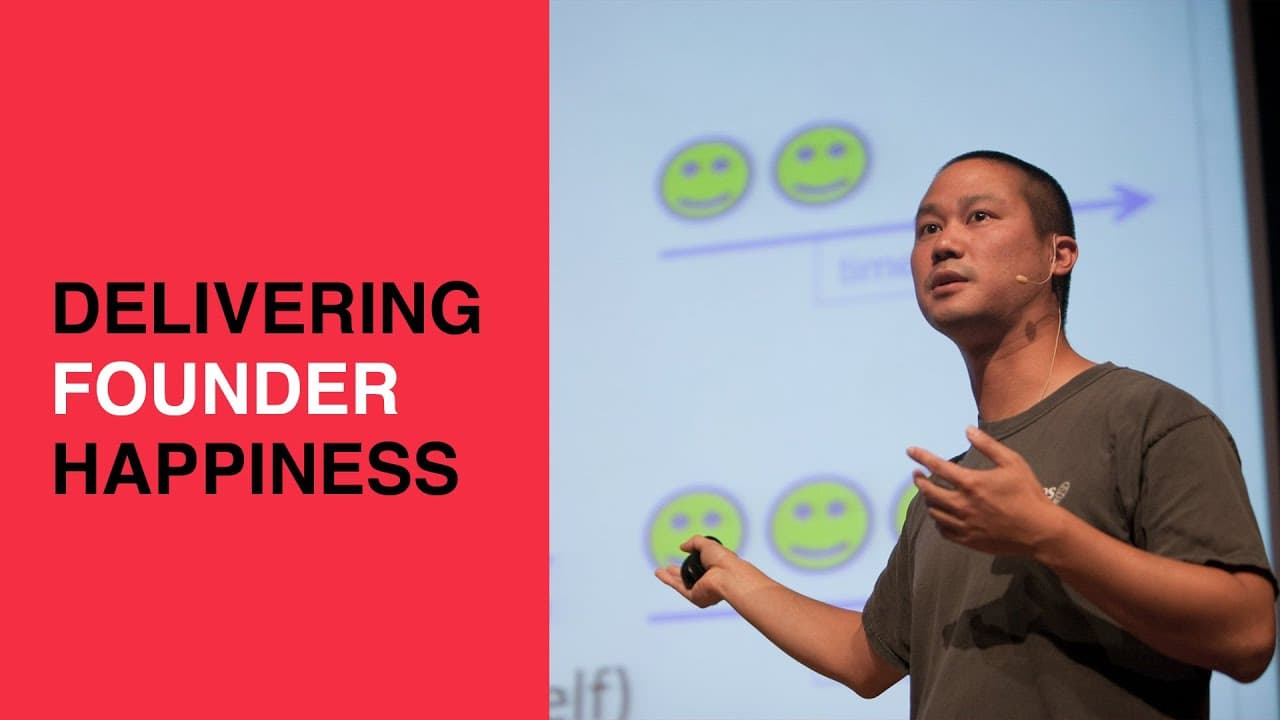
Happiness for founders rests on four facts: perceived control, perceived progress, connectedness, and meaning. Progress comes from delighting customers and building great products, while meaning comes from being part of something bigger than oneself. Build teams, networks, and a shared mission to sustain long term success.
Transcript
- Tony Hsieh, longtime CEO of Zappos died this past week, and it was a gut punch. I knew him from afar, but now I realize a lot of what I pursued in my life came from following his path. He grew up in the Bay area and so to did I. I'm eight years younger. As a college junior at Stanford, my roommate and I were friends with his brother. One Saturday... Read More
Key Insights
- Perceived control is the freedom to act without a boss, but it carries responsibility and risk.
- Progress comes from directly meeting customer needs and delivering a great product or service.
- Deep connectedness means building networks of people who can contribute when you have an idea.
- Meaning comes from being part of something bigger than yourself and a shared mission.
- The garage phase is romantic but fragile; later phases require new management and communication skills.
- Holacracy is an attempt to improve large team organization by reducing hierarchy.
- Successful founders balance control with accountability and rely on strong teams to scale.
- Delighting customers is the practical path to sustained progress and business growth.
- More videos from this channel:
- More from this channel: Garry Tan
Install to Summarize YouTube Videos and Get Transcripts
Explore YouTube Video Summarizer or Get YouTube Transcript Extractor
Questions & Answers
Q: What is the four part framework for founder happiness
The four parts are perceived control, perceived progress, connectedness, and meaning. Perceived control refers to the authority founders have over their work, though it comes with responsibility. Perceived progress is measured by how fast and how well products or services improve user experience. Connectedness means cultivating deep relationships inside and outside the company to support growth. Meaning is being part of something bigger than oneself and having a clear mission that guides effort.
Q: How does progress relate to customer focus
Progress is achieved by staying tightly connected to customers and their needs. A founder should focus on delivering value that delights customers because that direct feedback loop determines product success. This means iterating based on what customers show they want and ensuring the product or service continuously improves in ways that customers recognize and appreciate.
Q: Why is connectedness important in a startup
Connectedness creates a network of people who share knowledge, skills, and trust, which is essential for scaling. Highly integrated teams can feel like one brain, enabling rapid collaboration and problem solving. Building strong relationships early helps you assemble high performing teams and maintain momentum as the company grows.
Q: What role does meaning play in sustaining founders
Meaning is about being part of something bigger than yourself and pursuing a mission that justifies hard work. Founders who connect work to a larger purpose stay motivated through obstacles, attract like minded people, and can align decisions with long term goals rather than short term gains.
Q: How are garage phase and later phases different for founders
The garage phase focuses on close collaboration and rapid experimentation, with everyone knowing each other and working to build something from little more than an idea. Later phases require formal structures, leadership, and management practices to coordinate larger teams and complex operations while preserving core culture.
Q: What is holacracy and why was it mentioned
Holacracy is discussed as an approach to manage large teams without traditional hierarchy. It represents an attempt to improve organization by distributing authority and defining roles clearly. The idea is to sustain agility and clarity in decision making as the company scales beyond the founder’s direct reach.
Q: How does customer happiness relate to team happiness
Customer happiness and team happiness are interconnected. When teams are deeply connected and empowered to meet customer needs, they experience a sense of progress and meaning. Aligning internal culture with a customer centered mission helps keep teams motivated and the company competitive.
Q: What would Tony Hsieh say about being a founder
Tony Hsieh emphasized four elements of happiness for founders: control, progress, connectedness, and meaning. He suggested that true success comes from being part of something bigger than yourself and from leading teams that deliver lasting value to customers. His message encourages founders to pursue purposeful work with strong relationships and clear direction.
Summary
This video pays tribute to Tony Hsieh, the former CEO of Zappos, who recently passed away. The speaker reflects on his personal connection to Tony and how Tony's journey influenced his own path as an entrepreneur. The video explores one of Tony's favorite quotes which emphasizes four key elements of happiness: perceived control, perceived progress, connectedness, and meaning. The speaker then delves deeper into each of these elements and how they relate to being a founder, highlighting the importance of personal responsibility, customer satisfaction, building relationships, and having a strong sense of purpose.
Questions & Answers
Q: What are the four key elements of happiness according to Tony Hsieh?
According to Tony Hsieh, the four key elements of happiness are perceived control, perceived progress, connectedness (number and depth of relationships), and vision/meaning (being part of something bigger than oneself).
Q: How does being a founder provide a sense of control?
Being a founder grants a significant level of control as one is in charge of the company without a boss to answer to. However, this control is a double-edged sword, as it also means that the founder is solely responsible for the success or failure of the venture.
Q: What role does progress play in the life of a founder?
Progress is crucial for a founder as it stems from the delighting of customers and achieving milestones. Unlike being part of a larger organization, founders have the freedom to focus solely on progressing their own product or service without bureaucratic obstacles.
Q: Why is connectedness important for founders?
Connectedness, which refers to the number and depth of relationships, holds great significance for founders. In order to build a successful organization, founders must have a strong network of deep relationships that can support and contribute to the growth of their venture.
Q: How does Tony Hsieh propose catching lightning in a bottle?
Tony Hsieh suggests that catching lightning in a bottle, or finding that initial spark of success, involves becoming exceptionally good at a few key aspects of the business and forming a co-founding team of high-performing individuals who share the same vision.
Q: What challenges arise in the later phase of founding a company?
The later phase of founding a company can become increasingly challenging, particularly for relationships. As a company grows, founders must navigate the complexities of communication, management, and leadership, making the initial, heady "garage phase" appear more appealing in retrospect.
Q: How did Tony Hsieh try to tackle the challenges of managing large teams?
Tony Hsieh invested significant effort and risk into pioneering holacracy as a management approach, aiming to create a better way to organize large teams without relying on hierarchical structures. This was in service of his core mission of delivering happiness.
Q: Why is meaning important for founders?
Meaning, or having a sense of purpose and being part of something bigger, is essential for founders. It drives their dedication and motivates them to overcome challenges with unwavering determination. Founders must constantly question if their work aligns with their personal values and goals.
Q: How does Tony Hsieh encourage founders to go beyond financial success?
Tony Hsieh encourages founders to think beyond financial gain and power. He challenges them to build something that lasts beyond their individual involvement and surpasses the achievements of typical institutions. The aim is to leave a lasting legacy driven by a shared purpose and vision.
Q: What can aspiring founders learn from Tony Hsieh's journey?
Aspiring founders can learn from Tony Hsieh's journey by recognizing that they have what it takes to be a founder only when they take the first step and try. Tony's example can serve as a guide, providing inspiration and breadcrumbs for others to follow in the pursuit of their own entrepreneurial paths.
Takeaways
Tony Hsieh's four elements of happiness - perceived control, perceived progress, connectedness, and meaning - offer valuable insights for founders. Having control over their venture, striving for continuous progress and improvement, building deep relationships, and finding a meaningful mission are crucial components of a founder's journey. Tony Hsieh's legacy serves as a reminder that success goes beyond monetary gain and that the impact of one's work can transcend individual pursuits. Aspiring founders can draw inspiration from his path and strive to create something greater than themselves.
Summary & Key Takeaways
-
First, happiness hinges on control, progress, connectedness, and meaning, which together form a blueprint for founder well being. Second, progress requires deep customer focus and delivering value that people recognize and love. Third, connectedness means cultivating strong, high quality relationships to support a growing organization.
-
Fourth, meaning is found in a mission that is larger than any single founder, guiding decisions and sustaining effort. Fifth, the garage phase and the later scaling phase demand different skills, from founder intuition to formal leadership and organization design.
-
Sixth, Tony Hsieh and Zappos embody the idea that organizational culture and customer happiness are inseparable. Seventh, holacracy represents an attempt to reduce hierarchy in favor of clearer roles and more flexible teams. Eighth, remember that happiness is a practical outcome of aligning control, progress, connectedness, and meaning.
Read in Other Languages (beta)
Share This Summary 📚
Summarize YouTube Videos and Get Video Transcripts with 1-Click
Try YouTube Summary with ChatGPT & Claude or YouTube Transcript Generator
Explore More Summaries from Garry Tan 📚






Summarize YouTube Videos and Get Video Transcripts with 1-Click
Try YouTube Summary with ChatGPT & Claude or YouTube Transcript Generator