How to Pitch a Consumer Startup to Venture Capital
TL;DR
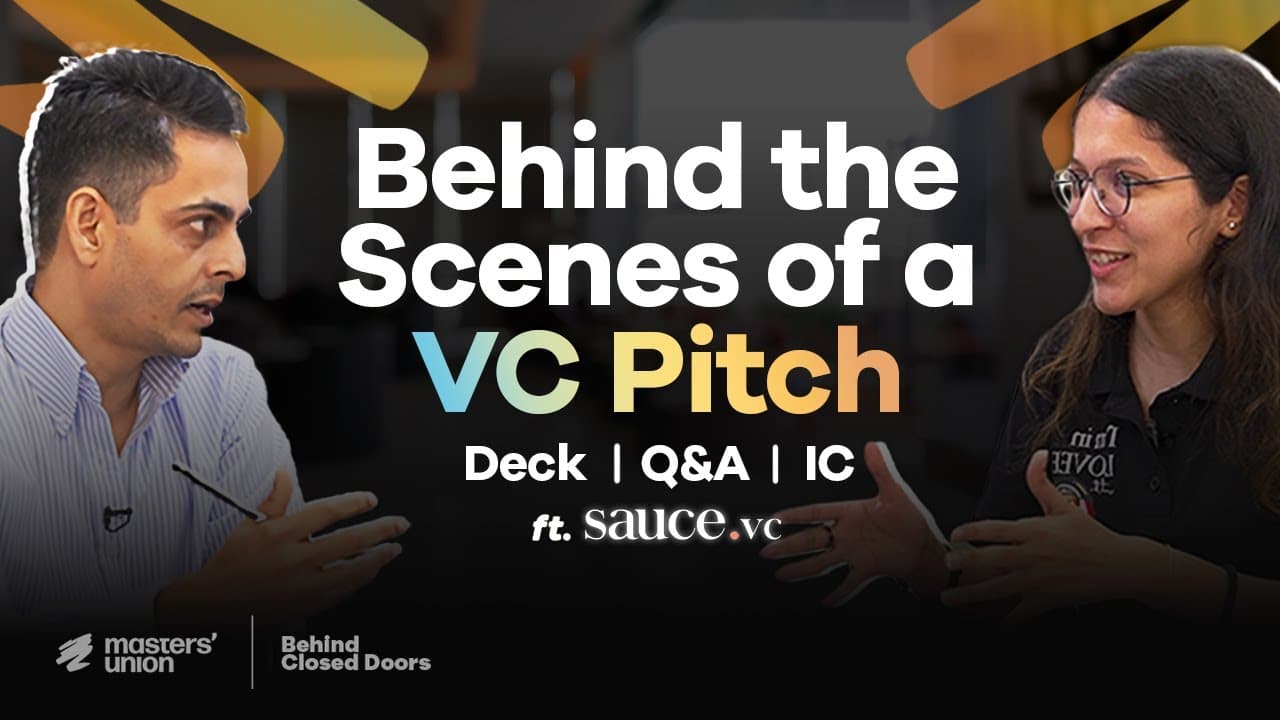
A strong VC pitch must define the target consumer, quantify the market, demonstrate product differentiation, and explain how the company can win. EatAtlas supports its case with international chip-and-dip flavors, early sales, customer trials, and a product-selection model, while Sauce.vc tests whether the founders understand their ingredients, product pipeline, customer demand, revenue sources, and growth plan.
Transcript
so presenting to you eat Atlas every flavor comes from a different country this is the team how do you guys know each other he was starting with me as Master's Union in the final term at Master's Union students actually get to pitch their startups that they've been building through the year to real VCS and get realtime feedback as well as funding t... Read More
Key Insights
- Sauce.vc is a super-early-stage venture capital fund focused on consumer brands. Its representatives say they look for the size of the market, the specific consumer cohort being targeted, the founders' understanding of that cohort, and a credible explanation of how the company will win.
- EatAtlas is positioned as an experiential snack brand offering flavors associated with different countries. The founders argue that international cuisine has become increasingly aspirational among younger Indian consumers, while packaged snacks still rely heavily on familiar potato bases, artificial seasonings, and conventional flavor choices.
- The initial EatAtlas portfolio consists of four cheese-based dips paired with thin lavash chips. The flavors are presented as ema datshi from Bhutan, gochujang from Korea, Alfredo from Italy, and doubanjiang from China, giving each product a distinct country-linked identity.
- EatAtlas selects potential flavors through a scoring model intended to reduce subjective decision-making. The founders assess candidates across 13 parameters, including virality, adaptability, feasibility, base, flavor profile, and texture, then use the resulting rankings to guide research, production, and test-batch decisions.
- The product differentiation rests on cheese-based dips and baked lavash chips. EatAtlas says India's dip category is largely mayonnaise-based, while its products remove mayonnaise-based emulsifiers and aim for lower calorie and sodium content, natural ingredients, and a thinner chip that emphasizes the dip's flavor.
- Early traction includes more than 10,000 people trying the product and over 4,000 units sold. The founders report approximately ₹9 lakh in revenue, approaching ₹10 lakh, during the initial selling period, although the investors establish that much of the revenue came from one corporate event order.
- The brand strategy emphasizes premium indulgence, portability, packaging, and globally inspired flavors. EatAtlas describes an on-the-go chip-and-dip SKU, dips for different customer personas, and larger celebration formats such as a Netflix-themed box and party pack for consumption at home.
- The growth plan targets a stated 100 mark within three years through online marketplaces, followed by quick-commerce channels and later international expansion. The pitch does not clarify what the 100 mark measures, making the ambition less useful than a precisely defined revenue, distribution, or sales target.
Install to Summarize YouTube Videos and Get Transcripts
Explore YouTube Video Summarizer or Get YouTube Transcript Extractor
Questions & Answers
Q: What do venture capital investors want in a startup pitch?
Sauce.vc says a startup pitch should identify the size of the market, specify the consumer group or cohort being pursued, and demonstrate a detailed understanding of that audience. Investors also want to know how the company plans to win the market. That explanation should connect the founders' relevant experience and expertise with the product, its differentiation, and the proposed route to growth.
Q: How did EatAtlas present its consumer problem to investors?
EatAtlas argued that choosing food for groups can become difficult because people want different cuisines, while younger consumers increasingly seek international flavors and experiences. The founders contrasted this demand with a packaged-snack market they described as repetitive, potato-heavy, artificially seasoned, and disappointing in portion presentation. Their proposed solution was a more experiential chip-and-dip format linked to flavors from different countries.
Q: What products and flavors did EatAtlas pitch?
EatAtlas presented thin lavash chips paired with four cheese-based dips. The stated flavors were ema datshi from Bhutan, gochujang from Korea, Alfredo from Italy, and doubanjiang from China. The founders said the lavash recipe was made thinner than typical market alternatives so the dip would remain the prominent flavor. They also discussed additional dips, sides, and possible pencil-shaped snacks in the pipeline.
Q: How does EatAtlas decide which new flavors to launch?
EatAtlas uses an Excel-based scoring model designed to reduce subjectivity when comparing possible flavors. The founders said candidates are evaluated across 13 parameters, with major considerations including virality, adaptability, and feasibility. Inputs also cover the product base, flavor profile, and texture. The resulting rankings guide decisions about whether a concept should proceed into research and development, production work, and test batches.
Q: How is EatAtlas different from competing snack products?
EatAtlas differentiates itself through globally inspired cheese-based dips, thin baked lavash chips, portable packaging, and a premium indulgent position. The founders said the Indian dip portfolio is mainly mayonnaise-based, while their dips eliminate mayonnaise-based emulsifiers and aim for lower calorie and sodium content. They also said the lavash contains no oil and is designed to let the dip provide the dominant flavor.
Q: What traction did EatAtlas report during its VC pitch?
The founders said more than 10,000 people had tried EatAtlas and that the company had sold over 4,000 units. They reported approximately ₹9 lakh in revenue, approaching ₹10 lakh, while using a draft version of the packaging. They also cited a ₹5 lakh check received without equity dilution, selection for product innovation at World Food India, incubation at NIFTEM, and increased website traffic after media coverage.
Q: Why did the investors question EatAtlas's revenue source?
The investors asked where the reported revenue came from and learned that much of it was connected to a corporate order for an event. The order involved a box containing dips and chips. This distinction matters within the pitch because a large event order differs from recurring purchases by individual consumers. The questioning therefore helped clarify what the early revenue actually represented without dismissing the sales achievement.
Q: What growth strategy did EatAtlas present to Sauce.vc?
EatAtlas said it wanted to reach a stated 100 mark within the next three years, although the pitch segment did not define that measure. The founders planned to pursue growth first through online marketplaces, then move into quick-commerce channels, and later expand globally. They also described a broader portfolio with an on-the-go chip-and-dip product, persona-oriented dips, and celebration packages for at-home occasions.
Summary & Key Takeaways
-
EatAtlas pitches an experiential snacking brand built around flavors associated with different countries. Its initial portfolio combines thin, baked lavash chips with four cheese-based dips inspired by Bhutan, Korea, Italy, and China. The company positions the products as premium, portable alternatives to familiar potato snacks and mayonnaise-based dips.
-
The founders say more than 10,000 people have tried EatAtlas, over 4,000 units have been sold, and revenue reached about ₹9 lakh, approaching ₹10 lakh. However, they acknowledge that much of this revenue came from a corporate event order, giving the investors an important reason to examine repeat consumer demand.
-
Sauce.vc evaluates the pitch by questioning product composition, differentiation, flavor selection, future products, sales timing, revenue sources, packaging, and the founding team. The fund says it wants founders to explain market size, identify a precise consumer cohort, demonstrate deep understanding of that group, and show how their experience, expertise, and product can win.
Read in Other Languages (beta)
Share This Summary 📚
Summarize YouTube Videos and Get Video Transcripts with 1-Click
Try YouTube Summary with ChatGPT & Claude or YouTube Transcript Generator
Explore More Summaries from Masters' Union 📚
Summarize YouTube Videos and Get Video Transcripts with 1-Click
Try YouTube Summary with ChatGPT & Claude or YouTube Transcript Generator