What Does Open Source AI Really Mean for Transparency?
TL;DR
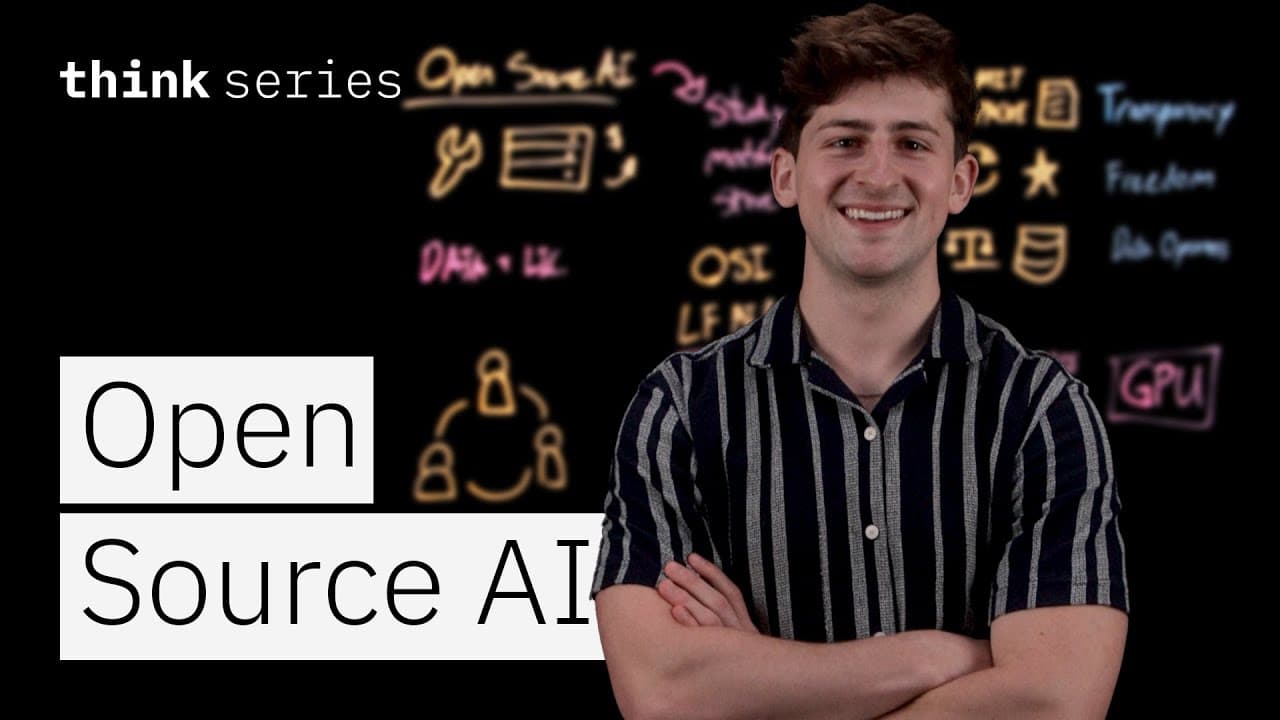
Open source AI centers on making source code, model architectures, parameters, and sometimes training data accessible under open licenses, enabling study, modification, and sharing. It emphasizes transparency, freedom to run and fine tune locally, and data openness to assess bias and fairness, while noting licensing and resource challenges.
Transcript
By now, you've probably seen or used some type of open source AI, and whether it's granite, llama, Mistral, whatever you might use, those are just a few examples of the most known public models, but there's over a million just on Hugging Face, which is a popular AI repository. And with these open models, we have the freedom to be able to take one a... Read More
Key Insights
- Open source AI is defined by accessible source code and open licenses that permit use, study, modification, and sharing.
- Transparency involves not only code but also methodologies and, when possible, training data details.
- Freedom means users can run, modify, and contribute back to models without restrictive barriers.
- Data openness requires comprehensive details about training data, scope, labeling methods, and processing techniques.
- Open source AI enables running models on local hardware to reduce costs and improve efficiency.
- Licensing and data disclosure issues complicate openness and may limit full transparency.
- Validation steps like Linux Foundation's Model Openness Framework and an AI bill of materials help ensure accuracy and fairness.
- Open source AI faces challenges such as large compute needs and varying degrees of openness across models.
Install to Summarize YouTube Videos and Get Transcripts
Explore YouTube Video Summarizer or Get YouTube Transcript Extractor
Questions & Answers
Q: What is open source AI and why does it matter for transparency?
Open source AI refers to models and components whose source code, architecture, parameters, and sometimes training data are accessible under open licenses, allowing anyone to study, modify, and share. This openness matters for transparency because it enables verification of how models work, what data shaped them, and how they can be improved or corrected. It promotes trust and collaboration across organizations.
Q: How does data openness affect open source AI, and what details are important?
Data openness means providing comprehensive information about the training data, including its scope, labeling methods, and processing techniques. This matters because it allows users to assess bias, fairness, and potential gaps in the data. Without these details, evaluating model reliability and ethical implications becomes difficult, hindering responsible deployment.
Q: What are the three key components of open source AI mentioned in the video?
The three key components are transparency, freedom, and data openness. Transparency ensures accessible code and methodology details. Freedom ensures users can use, study, modify, and share the system and its weights. Data openness ensures access to training data information to assess bias and fairness and enable responsible reuse.
Q: What challenges are associated with open source AI according to the transcript?
Challenges include defining what openness means for different models, licensing restrictions that limit full access to weights or code, lack of disclosed training data due to legal or ethical concerns, and the significant computing power and hardware access required to train large models. These barriers can slow collaboration and broader participation.
Q: Why is licensing a critical factor in open source AI discussions?
Licensing determines what users can legally do with a model, weights, or code. Some models provide only access to weights or API endpoints rather than full source code, limiting modifications and verification. Clear licenses help users understand permissions, restrictions, and the ability to contribute back to the project.
Q: What role do organizations like the Linux Foundation play in open source AI?
Organizations like the Linux Foundation provide frameworks and guidelines such as the Model Openness Framework to evaluate how open a model truly is. They help document best practices, promote transparency, and guide the creation of an AI bill of materials, aiding users in assessing accuracy, fairness, and compliance before deployment.
Q: How can open source AI benefit organizations across domains?
Open source AI enables teams to contribute to shared models, customize them for specific domain needs, and run them on their own hardware to reduce costs. This ecosystem fosters collaboration across regions and sectors, allowing nonprofits and for-profit entities to leverage powerful AI while maintaining control over deployment and privacy.
Q: What practical steps should developers take when evaluating an open source AI model?
Developers should check the openness level of the model, review licensing terms, seek available documentation on training data and methodologies, and verify the model weights and architecture. They should also consult frameworks like the Model Openness Framework and consider creating or referencing an AI bill of materials to assess accuracy and fairness before use.
Summary & Key Takeaways
-
Open source AI is defined by accessibility of source code, licenses, and sometimes training data, enabling verification and modification by users.
-
The three core components are transparency, freedom to use and modify, and data openness to assess training data and bias.
-
Challenges include varying openness levels, licensing constraints, and the heavy computing resources needed for training large models.
Read in Other Languages (beta)
Share This Summary 📚
Summarize YouTube Videos and Get Video Transcripts with 1-Click
Try YouTube Summary with ChatGPT & Claude or YouTube Transcript Generator
Explore More Summaries from IBM Technology 📚





Summarize YouTube Videos and Get Video Transcripts with 1-Click
Try YouTube Summary with ChatGPT & Claude or YouTube Transcript Generator