How to Disable a Tiger Tank with Wire
TL;DR
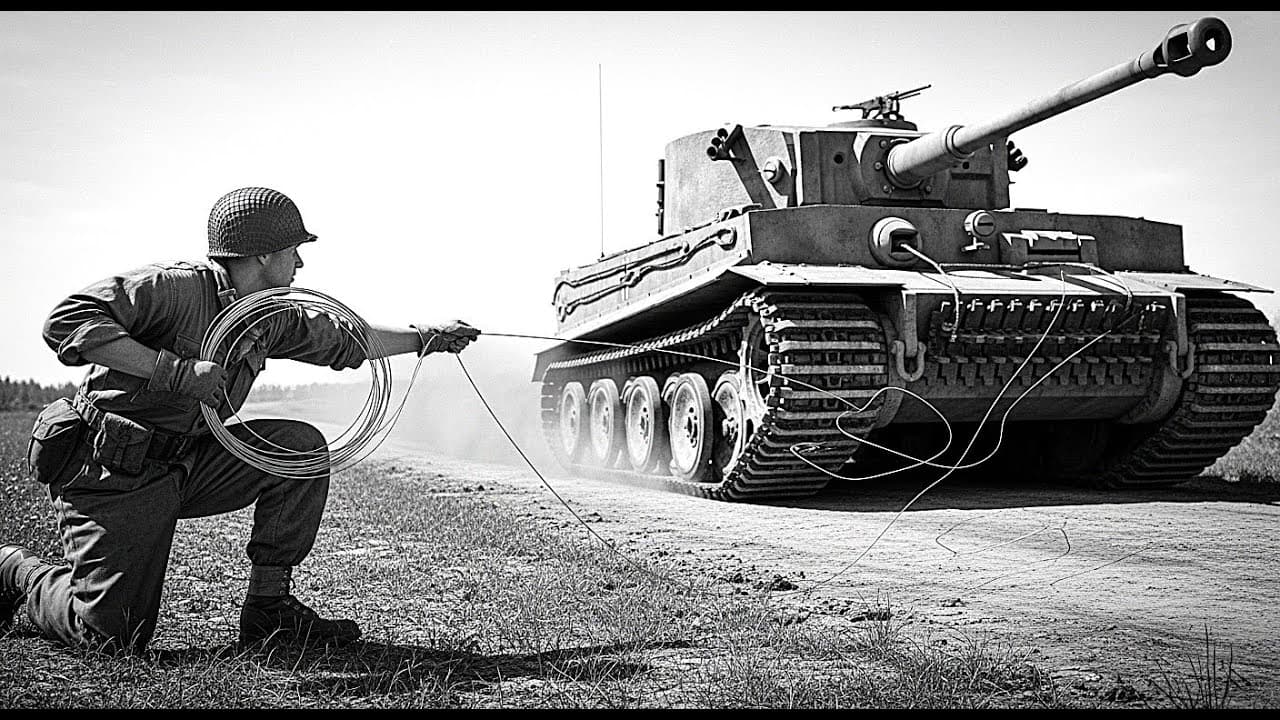
In June 1944, Corporal James Mallister used a simple telephone wire to immobilize a German Tiger tank in Normandy, France. By strategically placing the wire across a sunken road, he jammed the tank's complex wheel system, halting its advance and saving his platoon. This innovative tactic highlighted the vulnerabilities of over-engineered military machines.
Transcript
June 1944. The claustrophobic green hell of the Normandy bokeh. An 8 oz strand of simple telephone wire is about to paralyze 56 tons of German steel. This isn't fiction. This isn't a Hollywood script. This is the declassified almost unbelievable story of how one engineer's desperate absurd idea halted the most feared weapon of the Second World War ... Read More
Key Insights
- The Tiger tank was a formidable weapon, with thick armor and a powerful 88mm gun, making it nearly invulnerable to Allied tanks.
- The Tiger's overlapping wheel design, while effective for weight distribution, was prone to jamming with debris such as mud or wire.
- Corporal James Mallister utilized the Tiger's wheel vulnerability by setting a wire trap, immobilizing the tank in under three seconds.
- The wire trap worked by jamming the Tiger's running gear, causing a suspension failure and halting the tank's movement.
- Mallister's quick thinking and knowledge of mechanical systems saved his platoon from certain destruction by the advancing Tigers.
- The success of the wire trap was documented and shared among Allied forces, though its effectiveness was limited to specific conditions.
- The Tiger's complexity and maintenance demands contrasted with the simpler, more reliable designs of Allied tanks like the Sherman.
- The story of Mallister's wire trap underscores the importance of ingenuity and adaptability in overcoming seemingly insurmountable challenges.
Install to Summarize YouTube Videos and Get Transcripts
Explore YouTube Video Summarizer or Get YouTube Transcript Extractor
Questions & Answers
Q: How did a simple wire stop a Tiger tank?
A simple wire stopped a Tiger tank by exploiting the tank's complex wheel design. Corporal James Mallister placed a wire across a road, which got caught in the gaps between the Tiger's overlapping wheels. The wire jammed the running gear, causing the suspension to fail and the tank to become immobilized, effectively halting its advance.
Q: What was the vulnerability of the Tiger tank?
The vulnerability of the Tiger tank lay in its overlapping wheel design. While this design was intended to distribute weight and improve mobility, it also created narrow gaps that could easily trap debris. This flaw was exploited by Corporal James Mallister, who used a wire to jam the wheels, immobilizing the tank and rendering it ineffective in battle.
Q: Why was the Tiger tank considered nearly invincible?
The Tiger tank was considered nearly invincible due to its thick armor and powerful 88mm gun, which could penetrate Allied tanks at long ranges. Its design made it a formidable opponent on the battlefield, capable of withstanding direct hits and delivering devastating firepower. However, its complexity also introduced maintenance challenges and vulnerabilities.
Q: How did Mallister's wire trap impact the battle?
Mallister's wire trap had a significant impact on the battle by halting the advance of a Tiger tank column, saving his platoon from destruction. By immobilizing the lead tank, he created a bottleneck that prevented the other tanks from advancing. This allowed Allied forces to call in artillery and maneuver around the trapped tanks, turning the tide in their favor.
Q: What lessons were learned from the Tiger tank's design flaws?
The lessons learned from the Tiger tank's design flaws include the importance of simplicity and reliability in military equipment. The Tiger's complex wheel system, while effective under ideal conditions, proved vulnerable to jamming and difficult to maintain in the field. Modern tank designs prioritize maintainability and robustness over complex engineering to ensure operational effectiveness.
Q: How did the wire trap become part of military strategy?
The wire trap became part of military strategy as it was documented and shared among Allied forces, demonstrating a simple yet effective method to immobilize enemy tanks. Engineer units began carrying extra wire for similar traps, although its success depended on specific conditions. The tactic highlighted the value of ingenuity and adaptability in warfare.
Q: What was the role of ingenuity in Mallister's success?
Ingenuity played a crucial role in Mallister's success, as his quick thinking and understanding of mechanical systems allowed him to exploit the Tiger tank's vulnerabilities. Faced with overwhelming odds, he devised an unconventional solution using available resources, demonstrating how innovative thinking can overcome seemingly insurmountable challenges in combat situations.
Q: Why was the Tiger tank's complexity a liability?
The Tiger tank's complexity was a liability because it required extensive maintenance and was prone to mechanical failures in harsh conditions. Its intricate wheel system, while designed for optimal performance, was vulnerable to jamming by debris. This made the tank difficult to repair and less reliable in the field, contrasting with the simpler, more robust designs of Allied tanks.
Summary & Key Takeaways
-
In June 1944, Corporal James Mallister ingeniously stopped a German Tiger tank using a simple wire trap. The Tiger's complex wheel design was its Achilles' heel, and Mallister exploited this by setting a wire across a road, jamming the wheels and immobilizing the tank. This act of innovation saved his platoon and demonstrated the power of simple solutions against sophisticated machinery.
-
The Tiger tank, a fearsome weapon of World War II, was vulnerable to jamming due to its intricate wheel system. Mallister's improvised wire trap highlighted this weakness, providing a tactical advantage to Allied forces. His quick thinking and understanding of mechanical vulnerabilities turned the tide in a critical moment, showcasing the impact of individual actions in warfare.
-
Mallister's wire trap became a legend among combat engineers, illustrating the potential of unconventional tactics in warfare. Despite the Tiger's dominance on the battlefield, its design flaws were exposed by Mallister's simple yet effective solution. This story is a testament to the power of innovation and adaptability in overcoming formidable challenges.
Read in Other Languages (beta)
Share This Summary 📚
Summarize YouTube Videos and Get Video Transcripts with 1-Click
Try YouTube Summary with ChatGPT & Claude or YouTube Transcript Generator
Explore More Summaries from WW2 Missing Pages 📚

Summarize YouTube Videos and Get Video Transcripts with 1-Click
Try YouTube Summary with ChatGPT & Claude or YouTube Transcript Generator