How to Make Liquid Rockets Using Test Tubes
TL;DR
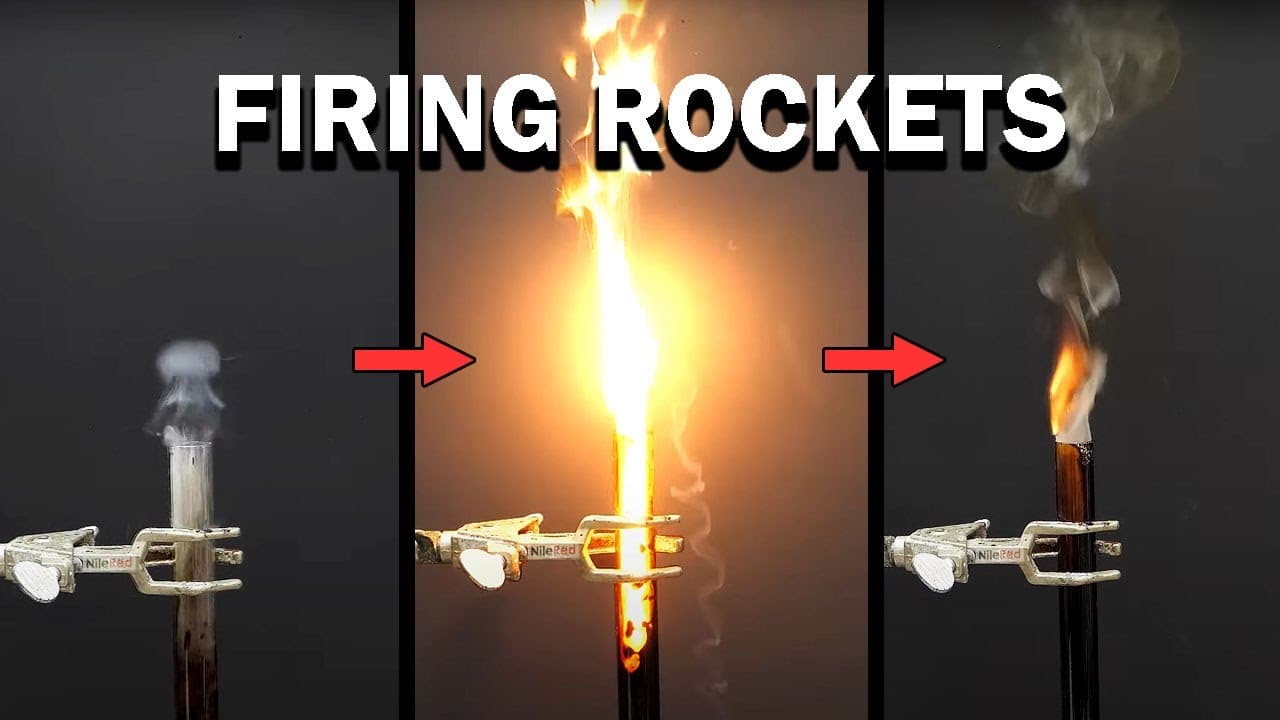
You can create liquid rockets using nitric acid and aniline as propellant. The key factors include tube length and the ratio of components, which affect ignition delay and reaction efficiency. Hypergolic mixtures like these ignite on contact, allowing for small-scale experiments without external ignition sources.
Transcript
this video has been sponsored by Nord VPN you can get 66% off your plan today by going to Nord VPN comm slash Nile red a few months ago I made some super concentrated nitric acid which was close to a hundred percent my main purpose with that video was to explore some of its different properties and of course to also show that it can light common la... Read More
Key Insights
- 🫗 Nitric acid and aniline can be used as fuel and oxidizer, respectively, for liquid propelled rockets.
- 🪡 Hypergolic propellant mixtures eliminate the need for an outside ignition source.
- 🫗 Tube length affects ignition delay and fuel and oxidizer mixing in liquid propelled rockets.
- 🥺 Shorter tubes can lead to faster ignition, but if too short, can cause ejection of the contents.
- 🚒 The convergent-divergent nozzle is an essential component of rocket engines, converting thermal energy into kinetic energy.
- ⛽ Obtaining hydrazine-based fuels for rocket experiments is challenging.
Install to Summarize YouTube Videos and Get Transcripts
Explore YouTube Video Summarizer or Get YouTube Transcript Extractor
Questions & Answers
Q: How are liquid propelled rockets different from other types of rockets?
Liquid propelled rockets use a fuel and an oxidizer that are reacted together to generate thrust, unlike solid fueled rockets that already have their propellant inside.
Q: What are hypergolic propellant mixtures?
Hypergolic propellant mixtures react so vigorously with each other that they self-ignite on contact, eliminating the need for an outside ignition source.
Q: Why is it difficult to mix fuel and oxidizer in non-hypergolic propellant mixtures?
Non-hypergolic propellant mixtures require a precise ratio of fuel and oxidizer, which can be challenging to achieve, and they also need an outside ignition source to start the reaction.
Q: Why is tube length important in liquid propelled rockets?
Tube length affects the ignition delay and splashing of the fuel and oxidizer. Shorter tubes tend to have a faster ignition and more violent mixing, but if too short, they can eject the contents before reaching the ignition point.
Q: What is the purpose of a convergent-divergent nozzle in a rocket engine?
A convergent-divergent nozzle converts the thermal energy of expanding gases into kinetic energy, increasing their velocity. This helps propel the rocket forward.
Summary & Key Takeaways
-
The video begins by discussing the creation of concentrated nitric acid and its properties, including its ability to ignite lab gloves.
-
The content then explores the concept of liquid propelled rockets, explaining the difference between hypergolic and non-hypergolic propellant mixtures.
-
The video demonstrates various experiments using nitric acid and aniline, discussing tube length, ignition delays, and attempts at mimicking a convergent-divergent nozzle.
Read in Other Languages (beta)
Share This Summary 📚
Summarize YouTube Videos and Get Video Transcripts with 1-Click
Try YouTube Summary with ChatGPT & Claude or YouTube Transcript Generator
Explore More Summaries from NileRed 📚

Summarize YouTube Videos and Get Video Transcripts with 1-Click
Try YouTube Summary with ChatGPT & Claude or YouTube Transcript Generator