How to Set Up Logging in Kubernetes with Grafana and Loki?
TL;DR
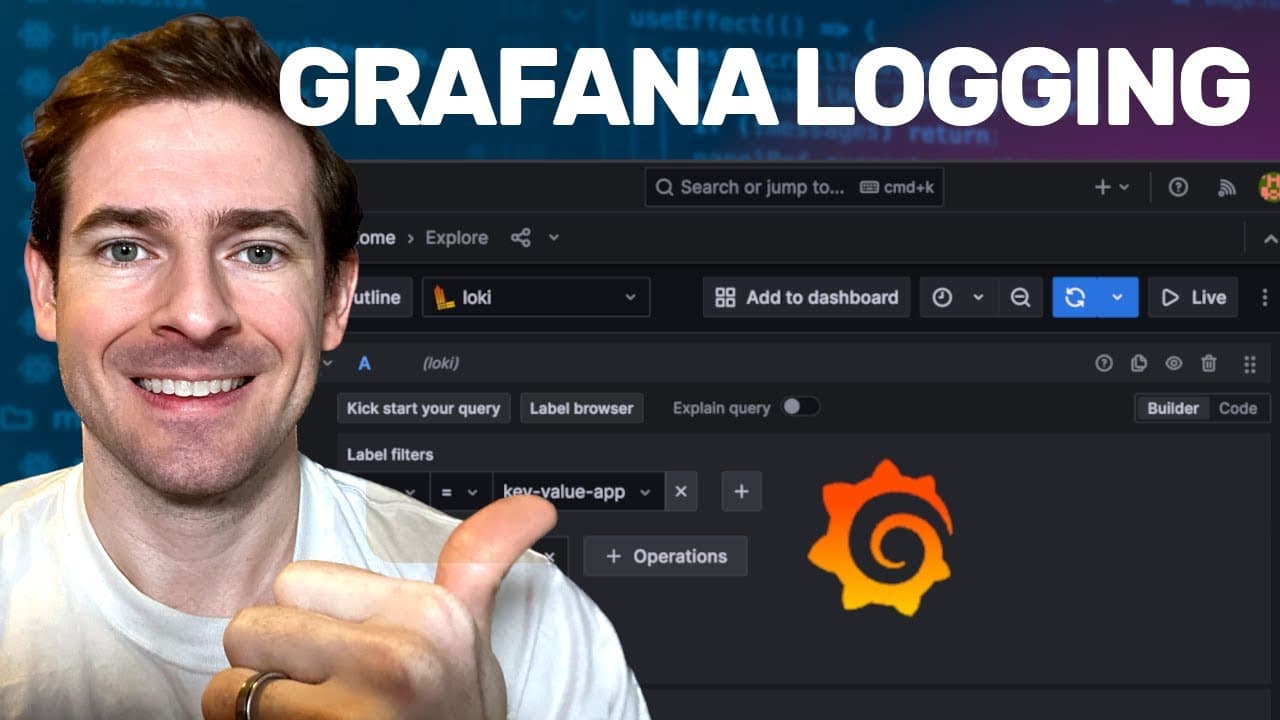
To set up logging in Kubernetes, install Grafana, Loki, and Promtail. Grafana acts as the dashboard, while Loki aggregates logs from all pods. After configuration, you can query logs for real-time monitoring and troubleshooting, creating a robust logging environment within your Kubernetes cluster.
Transcript
so over these past couple of nights I've been just diving more into learning about kubernetes and one of the things that I looked into was learning how to do logging right so when you have a bunch of different pods running in your cluster it's kind of a pain to have to go in every single pod and like look at the logs so right now I'm using the uh k... Read More
Key Insights
- 🧑💻 Efficient log management in Kubernetes clusters is crucial for real-time troubleshooting and maintenance of applications, necessitating robust tools like Grafana and Loki.
- ❓ Utilizing namespaces in Kubernetes streamlines resource organization, simplifying management and cleanup processes for complex deployments.
- 😫 Stateful sets allow Kubernetes applications to maintain persistent storage, improving reliability and scalability compared to ephemeral solutions.
- 😋 Employing hash ring strategies can enhance data distribution in distributed systems, approximating efficient load balancing across nodes.
- 🪡 Integration challenges between multiple logging and monitoring tools highlight the need for comprehensive documentation and configuration awareness.
- 👤 Load testing is essential in evaluating application performance, helping developers identify bottlenecks and optimize for better user experience.
- ✳️ Transitioning to a decentralized storage architecture can mitigate risks associated with shared resources and enhance data resilience in distributed applications.
Install to Summarize YouTube Videos and Get Transcripts
Explore YouTube Video Summarizer or Get YouTube Transcript Extractor
Questions & Answers
Q: What is the challenge the author faced regarding logging in Kubernetes?
The author experienced difficulties with logging as monitoring logs from each individual pod was cumbersome. They sought a consolidated solution and decided to set up Grafana with Loki, which proved to be a complex task filled with various technical hurdles, requiring extensive reading and experimentation with documentation and blog posts.
Q: How does Grafana integrate with Loki in the author's setup?
Grafana serves as the visualization tool that hooks into Loki, which is configured as a log aggregation service within the Kubernetes cluster. The author had to set up a data source in Grafana pointing to the Loki endpoint. This connection allows the author to visualize logs from all pods in one interface, simplifying log analysis and monitoring.
Q: What modifications did the author implement in their application architecture?
The author aims to improve their key-value store application by transitioning from a shared storage approach to a stateful set architecture, where each pod gets its own storage. This adjustment helps to avoid the limitations of single-point-of-failure risks associated with shared storage and message brokers, facilitating better scalability and data management.
Q: What insights did the author gain about namespaces in Kubernetes?
The author learned the importance of namespaces in Kubernetes as a way to group resources logically. By organizing resources into namespaces, they can easily manage and maintain resources, and quickly delete all associated resources in a namespace when needed. This structure improves the organization of deployments in complex applications.
Q: What tools did the author use for load testing their application?
To conduct load testing, the author employed k6, a JavaScript-based load testing tool provided by Grafana. This tool enables the simulation of multiple virtual users making requests to the application, allowing the author to analyze performance metrics, such as response times and throughput, assisting in identifying potential bottlenecks.
Q: How did the author address the limitations of their initial key-value store design?
The author recognized that their initial design—where multiple pods shared a single block storage device—was not scalable and posed risks of single points of failure. To solve this, they developed a new architecture using a stateful set configuration, assigning separate storage for each pod, thereby enhancing the reliability and distribution of data.
Q: Can you explain the concept of a hash ring as described by the author?
A hash ring is a method used for distributing keys across multiple nodes in a distributed system. When a key is received, it is hashed to determine its position on the ring. The system then identifies which node corresponds to that position, ensuring a balanced distribution of data while enabling efficient retrieval and storage of key-value pairs.
Q: What were some of the difficulties the author encountered during the installation process?
The installation of Grafana, Loki, and Promtail was fraught with challenges. The author faced roadblocks related to configuration options, particularly a security option in Loki that needed to be disabled for successful integration. Additionally, navigating through various resources and blog posts created confusion and prolonged the setup time.
Summary & Key Takeaways
-
The author shares their experience learning Kubernetes, focusing on setting up effective logging using Grafana, Loki, and Promtail. The complexity of installation and configuration is highlighted, alongside various challenges faced during the setup process.
-
Grafana serves as the dashboard that connects to Loki, which aggregates logs from multiple pods. The author demonstrates the process of querying logs, showcasing how logs can be filtered and accessed for troubleshooting and monitoring.
-
An evolving application, a key-value store akin to Redis, is being developed with lessons learned from setting up a stateful environment. The author discusses transitioning to a more distributed architecture, utilizing unique storage solutions for each pod to improve data scalability.
Read in Other Languages (beta)
Share This Summary 📚
Summarize YouTube Videos and Get Video Transcripts with 1-Click
Try YouTube Summary with ChatGPT & Claude or YouTube Transcript Generator
Explore More Summaries from Web Dev Cody 📚
Summarize YouTube Videos and Get Video Transcripts with 1-Click
Try YouTube Summary with ChatGPT & Claude or YouTube Transcript Generator