How Does Your Ego Impact Your Relationship?
TL;DR
Your ego can significantly deteriorate your relationship by fueling conflicts instead of connection. Embracing accountability and curiosity about yourself and your partner can pave the way for deeper understanding and healing. Explore how to navigate these dynamics and transform challenges into opportunities for growth.
Transcript
we are often drawn to a person who brings characteristics that we are trying to get away from are you looking for chemistry for a love story or are you looking for chemistry for a life story he's a psychotherapist author and host a round of applause for welcome perel how do you turn conflict into connection it's not what you fight a... Read More
Key Insights
- Relationships often involve partners bringing traits we're trying to avoid, highlighting the need for self-awareness and growth.
- Decision-making in relationships involves accepting inherent contradictions rather than seeking binary answers.
- Grief in relationships arises from the loss of potential futures, and every choice involves some form of loss.
- Accountability is crucial in relationships; changing oneself can lead to changes in the partner and relationship dynamics.
- Conflict often stems from unmet needs for recognition, power, and trust rather than the surface issues being argued about.
- Curiosity about oneself and one's partner can transform conflicts and deepen understanding in relationships.
- The modern dating landscape, influenced by technology, often lacks genuine human connection and fosters uncertainty.
- Long-term relationships require adaptability and the creation of new shared values and experiences to thrive.
Install to Summarize YouTube Videos and Get Transcripts
Explore YouTube Video Summarizer or Get YouTube Transcript Extractor
Questions & Answers
Q: What role does ego play in relationships?
Ego can negatively impact relationships by fostering a need for control and power struggles. It often leads to partners projecting their values onto each other, rather than co-creating a shared set of beliefs. Recognizing and managing ego can help transform conflicts into opportunities for connection and growth.
Q: How can accountability improve relationships?
Accountability involves taking responsibility for one's actions and being open to self-change. By focusing on what one can do to improve the relationship, rather than expecting the partner to change, individuals can create a positive ripple effect. This approach fosters interdependence and can lead to significant improvements in relationship dynamics.
Q: Why do we grieve after a breakup?
Grief after a breakup stems from the loss of potential futures and the inherent contradictions in decision-making. Every choice involves some form of loss, whether it's the dream of what could have been or the reality of what was. Accepting these contradictions and the associated grief is part of the healing process.
Q: What is the significance of curiosity in relationships?
Curiosity is crucial for transforming conflicts into meaningful dialogue. It involves being open to understanding oneself and one's partner on a deeper level, beyond surface-level disagreements. Curiosity helps shift from reactivity to reflection, fostering a more empathetic and understanding relationship dynamic.
Q: How does modern dating affect relationships?
Modern dating, influenced by technology, often emphasizes consumerism and a checklist mentality. This can lead to a focus on finding the 'perfect' partner rather than appreciating the 'good.' The commodification of relationships can result in uncertainty and self-doubt, making it challenging to form genuine connections.
Q: What are the phases of rebuilding trust after betrayal?
Rebuilding trust involves several phases: expressing guilt and remorse for the hurt caused, becoming a 'Vigilante' of the relationship by actively protecting and valuing it, and exploring the meaning of the betrayal for both partners. These stages help couples understand the underlying issues and work towards a renewed bond.
Q: What is the difference between a love story and a life story in relationships?
A love story focuses on chemistry and passion, often characterized by short-term attraction and excitement. A life story, however, involves compatibility, shared values, and the ability to build a life together. It requires adaptability, mutual respect, and the creation of new shared experiences to sustain a long-term relationship.
Q: How can one balance self-identity and influence in a relationship?
Balancing self-identity and influence involves being open to letting a partner have an impact without feeling threatened. It's about co-creating a new set of shared values and experiences, rather than rigidly adhering to one's pre-existing beliefs. This approach fosters mutual growth and a deeper connection in the relationship.
Summary & Key Takeaways
-
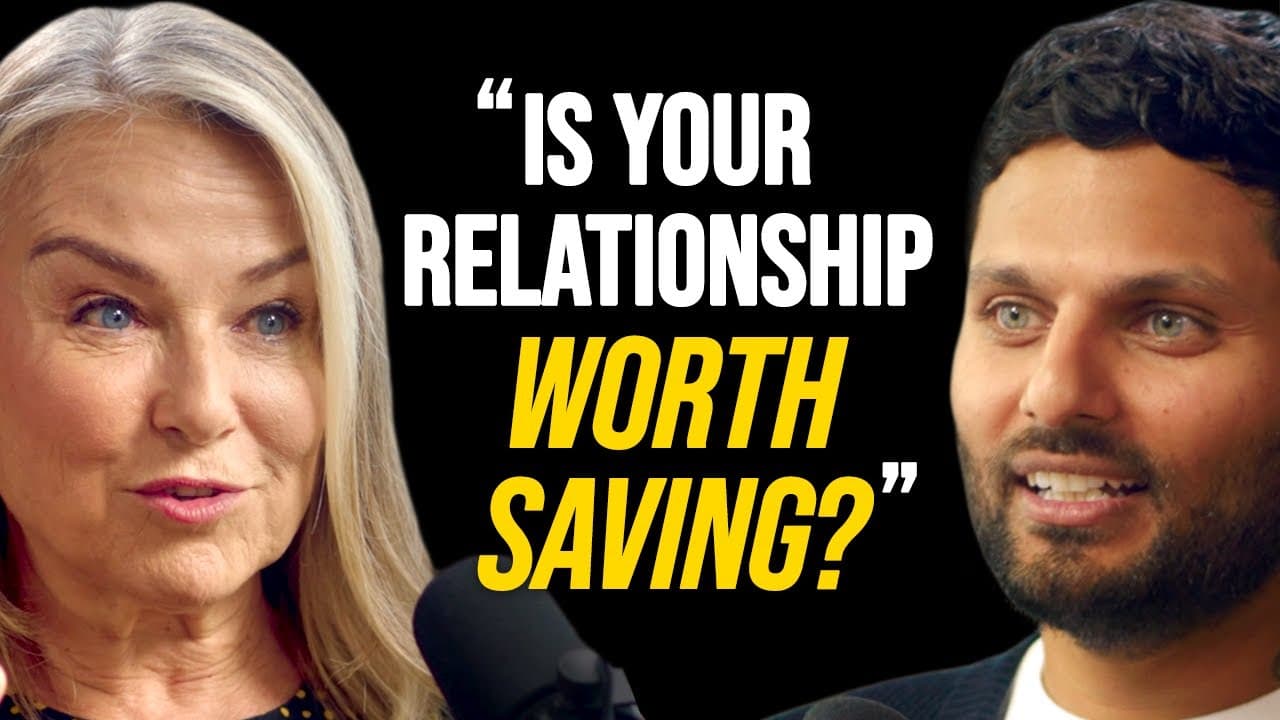
Esther Perel explores the complexities of relationship dynamics, emphasizing the role of ego and accountability in fostering deeper connections. She highlights the importance of self-awareness and curiosity in transforming conflict into meaningful dialogue.
-
The conversation delves into the grieving process in relationships, explaining that every choice involves loss and the need to accept inherent contradictions. Perel also discusses how accountability and self-change can influence relationship dynamics.
-
Perel addresses the challenges of modern dating, shaped by technology and consumerism, and offers insights into maintaining curiosity and openness in relationships. She advocates for creating new shared values and experiences to sustain long-term relationships.
Read in Other Languages (beta)
Share This Summary 📚
Summarize YouTube Videos and Get Video Transcripts with 1-Click
Try YouTube Summary with ChatGPT & Claude or YouTube Transcript Generator
Explore More Summaries from Jay Shetty Podcast 📚



Summarize YouTube Videos and Get Video Transcripts with 1-Click
Try YouTube Summary with ChatGPT & Claude or YouTube Transcript Generator