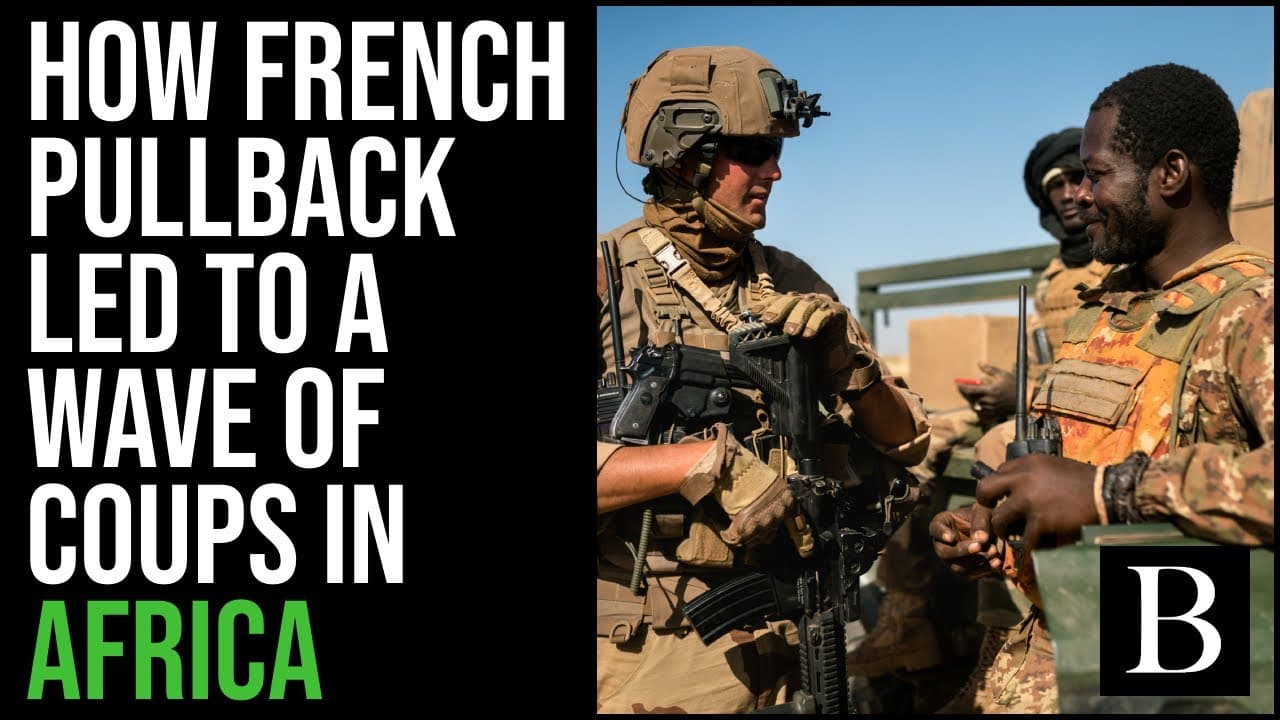
How French Pullback Led to a Wave of Coups in Africa - Bismarck Brief
TL;DR
France’s reduced military commitment weakened its support for allied governments in West Africa, creating a power vacuum that local military leaders, the Vagner Group, and the United States moved to fill. Emmanuel Macron’s effort to reset France’s relationship with Africa left weak states struggling with insurgencies and economic privation while French prestige declined. Read on to understand how Operation Baran’s retreat reshaped regional power.
Transcript
how French pullback led to a wave of coups in Africa Bismark brief the 8th of February 2023 France has reduced its military commitments to Africa the resulting power vacuum is being filled by local military kunas Russian mercenaries and the US government Africa is the only continent where every country has a total fertility rate above replacement l... Read More
Key Insights
- ✋ Africa's high population growth offers economic opportunities, but stability is crucial for growth.
- ✊ French pullback has created a power vacuum that has been filled by local military coups, Russian mercenaries, and increased US involvement.
- 🍟 French influence in Africa has declined, while Russia and the US have taken advantage of the situation.
- 🌍 US involvement in Africa is driven by personal empire-building within the US government rather than a grand strategic vision.
- 🌸 France's attempt to reset relations with Africa has resulted in the loss of economic, social, and military ties to the continent.
- ✊ Weak states in Africa are likely to depend on foreign powers for support, with the US being the most probable replacement for France.
- 🇨🇫 The Vagner Group, a private military company, is expanding its presence in Africa, particularly in Mali, Burkina Faso, and the Central African Republic.
Install to Summarize YouTube Videos and Get Transcripts
Explore YouTube Video Summarizer or Get YouTube Transcript Extractor
Questions & Answers
Q: How did the French pullback lead to a wave of coups in Africa?
France made clear that its military support would not increase, while local governments and militaries failed to suppress insurgencies or carry out major political reforms. The Malian military then overthrew its civilian government, and other coup attempts followed as regional commanders exploited the resulting power vacuum.
Q: Why did Emmanuel Macron reduce France’s military involvement in Africa?
Macron believed France’s relationship with Africa needed a reset from its colonial past and that African countries should solve more of their own problems. His strategy reduced France’s geographical military focus, sought more help from European allies and the United Nations, and pressed local governments to take greater initiative.
Q: What was Operation Baran?
Operation Baran formalized and expanded the French deployment that began with an offensive against armed separatists in northern Mali. It extended into neighboring countries, including Niger, Burkina Faso, and Chad, before being formally terminated.
Q: How did France’s withdrawal affect Mali and Burkina Faso?
France completely exited Mali and began leaving Burkina Faso, reducing the external military support available to their governments. Coup leaders in both countries subsequently invited the Vagner Group to assist them.
Q: How has the pullback affected French influence in Africa?
French prestige and influence dropped alongside the power of French-backed local elites. The retreat weakened an informal sphere of influence that France had maintained through military involvement and elite social and business ties.
Q: Why is the Vagner Group involved in Africa?
The transcript describes the Vagner Group’s involvement as primarily a business decision. It can receive payment through leases on lucrative gold mines or other natural resources, giving the private military company a strong interest in the region.
Q: What role is the United States playing after the French pullback?
The United States is one of the outside players entering the space left by France. It developed a renewed interest in Africa, committed substantial aid, and already had troops deployed there partly to assist France’s operation.
Q: Why do weak African states continue to depend on foreign powers?
The affected states cannot suppress insurgencies or alleviate economic privation on their own. According to the transcript, that weakness pushes them to rely on stronger states and potentially become clients of France, the United States, or Russia.
Summary & Key Takeaways
-
France reduced its military involvement in Africa, creating a void that has been filled by local military coups, Russian mercenaries, and increased US presence.
-
Africa's high population growth offers economic opportunities, but stability is crucial, which has been disrupted by the wave of coups in several countries.
-
French president Emmanuel Macron's strategy to reset relations with Africa and encourage local African governments has backfired, leading to a decline in French influence.
Read in Other Languages (beta)
Share This Summary 📚
Summarize YouTube Videos and Get Video Transcripts with 1-Click
Try YouTube Summary with ChatGPT & Claude or YouTube Transcript Generator
Explore More Summaries from Samo Burja 📚





Summarize YouTube Videos and Get Video Transcripts with 1-Click
Try YouTube Summary with ChatGPT & Claude or YouTube Transcript Generator