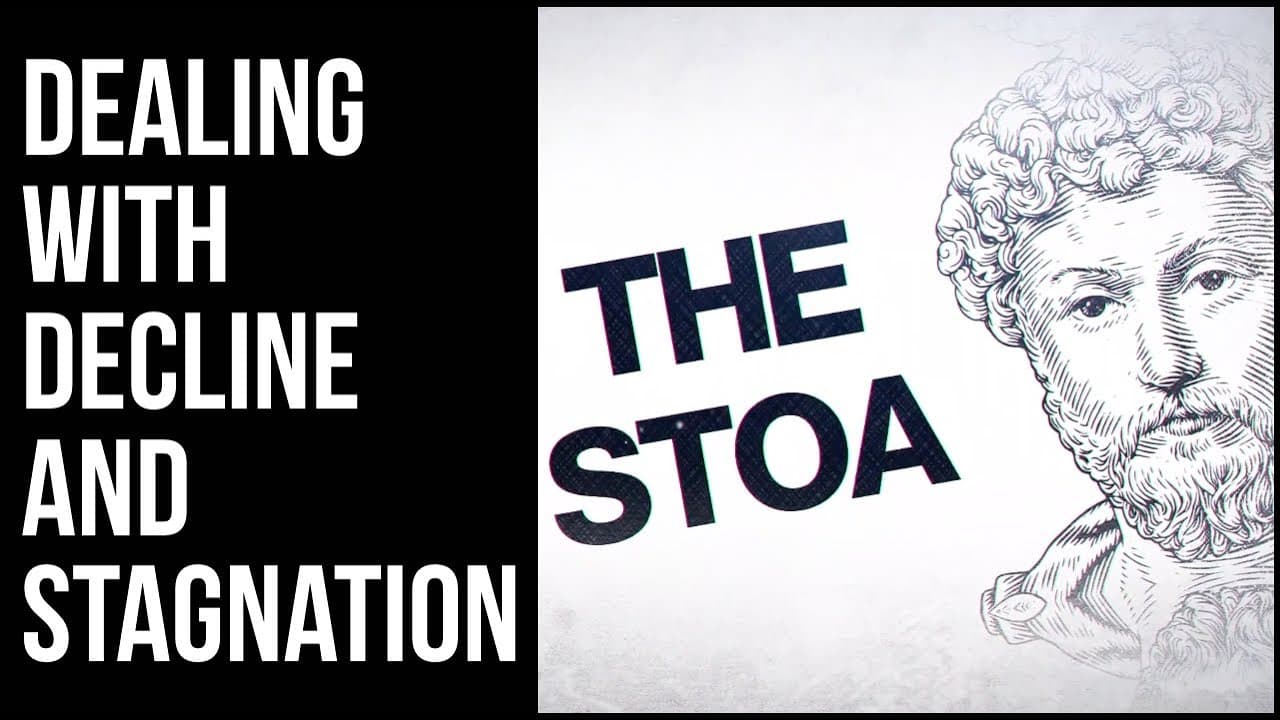
The Stoa: Dealing with Decline and Stagnation
TL;DR
Societies should deal with possible decline by distinguishing genuine material deterioration from cultural change that merely displaces older social structures. Samo Burja favors indicators such as stagnant or falling urban populations, economic underperformance, technological capability, and material production, while warning that even violence can accompany expansion rather than collapse. The Garamantian civilization’s loss of fossil water illustrates how resource exhaustion can drive decline; read on for the full framework.
Transcript
welcome to the stola the stoah is a digital campfire where equal hear and dialogue about what matters most at the night's edge what's happening now hello everybody and welcome to the stoah stoah is a digital campfire where we gathered to go here in dialogue at the knife's edge of what matters most my name is Raven and I will be your host for the ev... Read More
Key Insights
- 🧑🏭 The concept of decline in society is complex and multifaceted, with various factors contributing to its manifestation.
- 🥶 Social technologies can accelerate societal change and potentially lead to the obsolescence of older systems and structures.
- #️⃣ Objective indicators such as population numbers and economic underperformance can provide insights into societal decline.
- ❓ Resource depletion, whether tangible or abstract, can have significant implications for societal well-being.
Install to Summarize YouTube Videos and Get Transcripts
Explore YouTube Video Summarizer or Get YouTube Transcript Extractor
Questions & Answers
Q: How can societies deal with decline and stagnation?
They can begin by separating measurable deterioration from cultural changes that only make society look unfamiliar. Samo Burja recommends examining population trends, economic performance, technological capability, material production, and the resources a society may be exhausting.
Q: What does societal decline mean?
The discussion presents decline as more than complaints about changing norms or institutions. It is better identified through persistent material constraints and outcomes such as stagnant or falling urban populations, economic underperformance, and reduced production.
Q: Why are cultural observations unreliable indicators of decline?
Cultural transformation can reflect one social technology replacing another rather than an actual collapse. For example, urbanization and national consciousness may displace strong kin-based structures while also supporting larger economies and stronger armies.
Q: What objective indicators can reveal societal decline?
The suggested proxies include urban population numbers, economic performance, advanced technologies, and the presence or absence of material production. Unrest and violence are more concrete than cultural judgments, but they can still be misleading.
Q: Does violence necessarily mean a society is declining?
No, because violent and disorderly societies can also be expansionary and productive. The Wild West is offered as an example of a violent frontier culture that generated massive growth rather than simply reflecting collapsing social ties.
Q: How do social technologies affect perceptions of societal decline?
New social technologies can make older structures obsolete, creating the appearance of decay. The shift from kin-centered organization toward urban society and national consciousness may bring losses, but it can also produce strengths such as larger economies.
Q: How can resource exhaustion cause societal decline?
Societies may reduce consumption because they are economizing around a limit rather than choosing to consume less. The exhausted resource may be concrete, such as water, or more abstract, making the underlying constraint difficult to recognize.
Q: What happened when the Garamantian civilization ran out of fossil water?
The civilization in modern-day Libya depended on fossil water accessed through wells, but that water was not renewed by the water cycle. When it ran out, irrigation failed, the population dropped, Roman punitive expeditions could no longer be repulsed, and the civilization vanished as members migrated or perished.
Summary & Key Takeaways
-
The question of decline in society and the consequences of declining institutional opportunities and social technologies.
-
The difficulty of measuring decline and the importance of looking at objective indicators such as population numbers and economic underperformance.
-
The concept of the decline of social trust and its effects on economic growth and social well-being.
Read in Other Languages (beta)
Share This Summary 📚
Summarize YouTube Videos and Get Video Transcripts with 1-Click
Try YouTube Summary with ChatGPT & Claude or YouTube Transcript Generator
Explore More Summaries from Samo Burja 📚





Summarize YouTube Videos and Get Video Transcripts with 1-Click
Try YouTube Summary with ChatGPT & Claude or YouTube Transcript Generator