Contract Law 50 III Watts v Watts
TL;DR
The Wisconsin Supreme Court held in Watt v. Watt that a contract between unmarried cohabitants to equally share property accumulated during their relationship is not unenforceable as against public policy.
Transcript
today we continue our discussion of when contracts are unenforceable because they violate public policy we will look at a 1987 Wisconsin case called watt vs. watt where the court considered whether and unmarried couples cohabitation agreement is enforceable in watt V watt the plaintiff suanne lived for 12 years with defendant James the couple held ... Read More
Key Insights
- 🚱 Non-marital cohabitation does not render every agreement between cohabitants illegal.
- 🇨🇫 Enforcing a contract between unmarried cohabitants is not against public policy unless it solely considers sexual relations.
- 🗯️ The court criticized the Illinois Supreme Court's opinion in Hewitt v. Hewitt, highlighting the need for legislative involvement in determining the rights of cohabiting couples.
- 😀 The legal system faces the challenge of deciding whether cohabitation agreements and other rights should be enforced and which branch of government should make such decisions.
- 💱 Social attitudes towards marriage and cohabitation agreements have changed, but the court believes legislators are better equipped to address these changes.
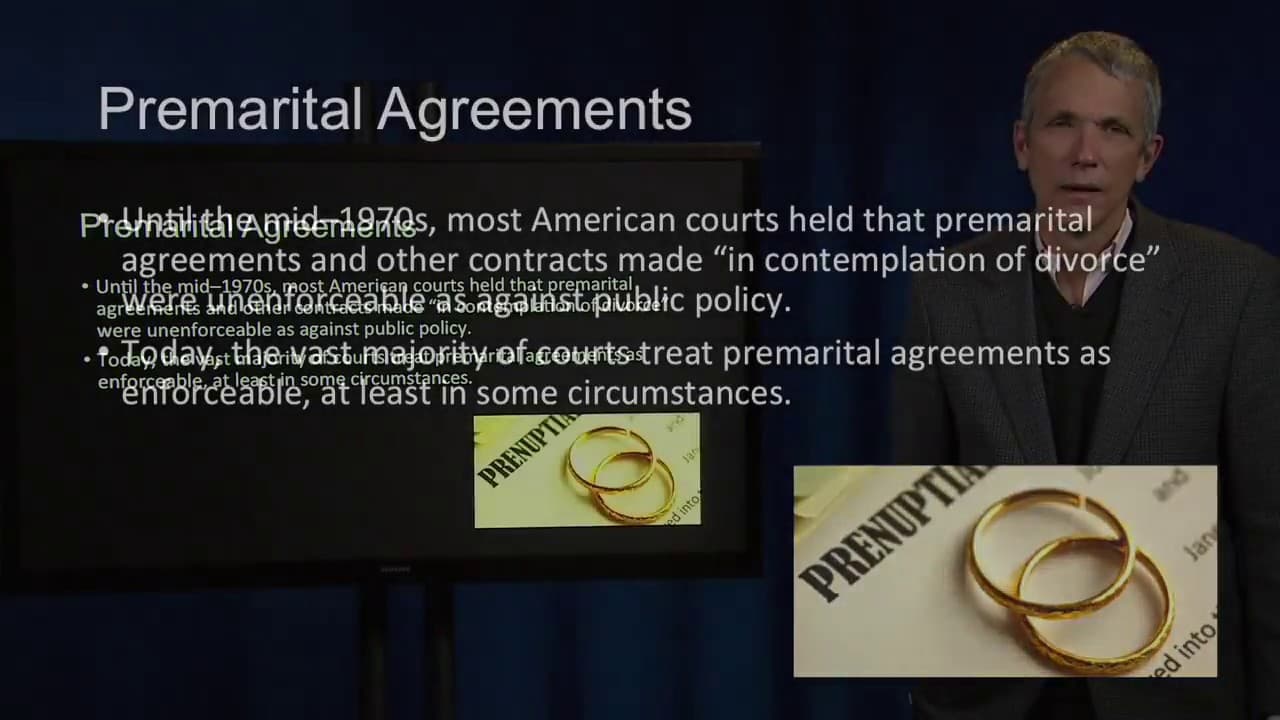
- 🫵 Premarital agreements have become increasingly enforceable, despite earlier views that such agreements encouraged divorce.
Install to Summarize YouTube Videos and Get Transcripts
Explore YouTube Video Summarizer or Get YouTube Transcript Extractor
Questions & Answers
Q: Was the cohabitation agreement between the plaintiff and defendant considered enforceable in Watt v. Watt?
Yes, the Wisconsin Supreme Court held that the cohabitation agreement to share property accumulated during their relationship was not unenforceable as against public policy.
Q: Did the court consider the immorality or illegality of the relationship in determining the enforceability of the contract?
The court stated that as long as the agreement between the parties was independent of the illicit relationship, a contract would not be deemed unenforceable based on the immorality or illegality of the relationship.
Q: What was the plaintiff's alternative claim in Watt v. Watt?
The plaintiff also asserted an unjust enrichment claim, arguing that it would be inequitable for the defendant to retain the benefit of the property without making a payment to the plaintiff.
Q: How did the court balance the interest in enforcing the contract against the policy against enforcement in Watt v. Watt?
The court applied a balancing standard, stating that the declaration of a contract being against public policy should only be made after careful consideration of all the circumstances.
Summary & Key Takeaways
-
In the case of Watt v. Watt, the plaintiff sued the defendant for a share of their property after their 12-year cohabitation ended, arguing that they had a contract to equally share their accumulated assets.
-
The trial court dismissed the complaint, but the Wisconsin Supreme Court reversed and remanded the case, stating that cohabitation does not render every agreement illegal.
-
The court held that enforcing such a contract would not violate public policy as long as the agreement was independent of the illicit relationship between the parties.
Read in Other Languages (beta)
Share This Summary 📚
Summarize YouTube Videos and Get Video Transcripts with 1-Click
Try YouTube Summary with ChatGPT & Claude or YouTube Transcript Generator
Explore More Summaries from YaleCourses 📚





Summarize YouTube Videos and Get Video Transcripts with 1-Click
Try YouTube Summary with ChatGPT & Claude or YouTube Transcript Generator