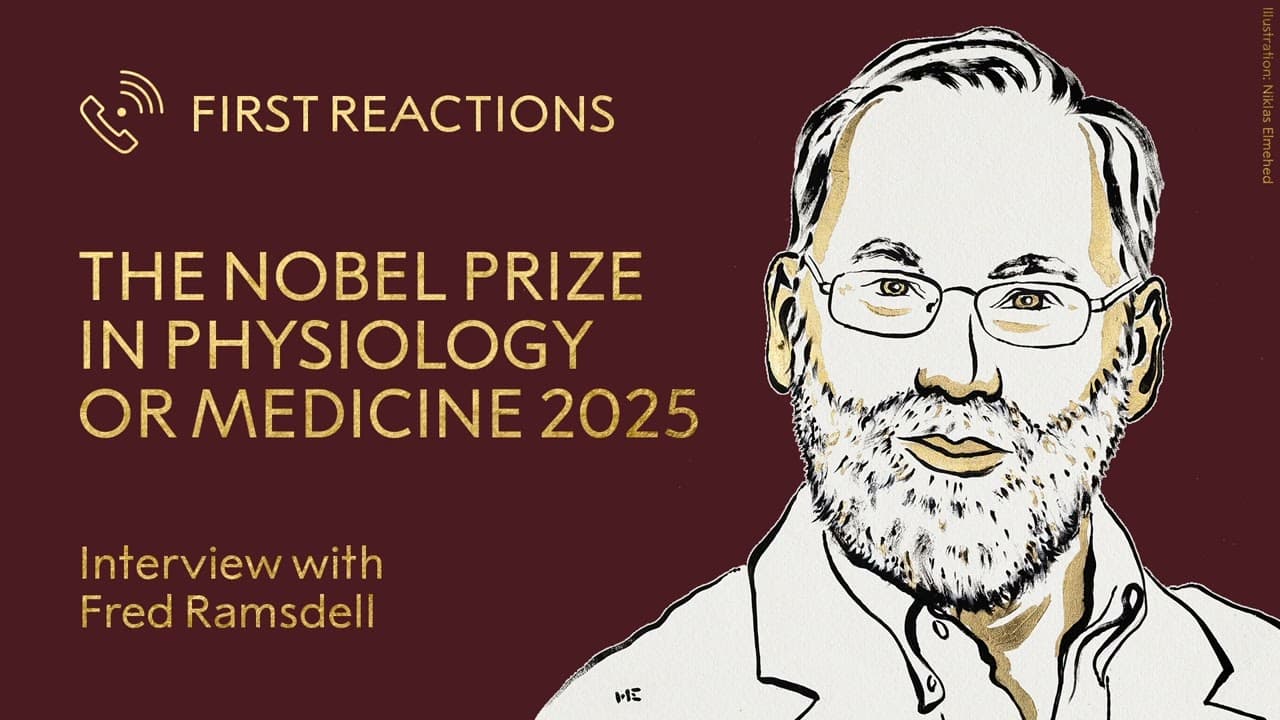
First Reactions: How Did Fred Ramsdell Learn He Won the Nobel Prize in Physiology or Medicine? | Telephone Interview
TL;DR
Fred Ramsdell learned he had won the Nobel Prize after his wife received 200 text messages as they returned from camping near Yellowstone National Park. In this telephone interview, he also explains why small biotechnology teams appealed to him, how regulatory T cells suggested a path toward treating autoimmune disease, and why academic collaboration and the preserved scurfy mouse line were essential. Read on for the story behind the discovery and its path toward clinical testing.
Transcript
Hi, this is Hi, this is Adam Smith calling from Nobelprize.org, the website for the Nobel Prize. Yes. Hi, Adam. Nice to talk to you. Sorry I missed your earlier call. Not at all. It's lovely to talk to you. Delighted to to find you. Um gosh, yes. You had a pretty unusual way of discovering the news. How did it actually happen? I did. Um it's funny.... Read More
Key Insights
- Ramsdell discovered his Nobel Prize win after leaving a remote mountain camping area where his phone had remained in airplane mode. His wife received the messages first, and he initially refused to believe her announcement.
- Small biotechnology companies are stimulating environments because they bring together highly skilled people with different specialties. Ramsdell values their team orientation and their common focus on creating treatments that may eventually reach patients in clinical settings.
- Regulatory T cell research suggested that harnessing these cells could treat autoimmune disease. The scientific path was visible when the discovery was made, but the required gene therapy and cell therapy approaches were then considered too difficult and expensive.
- Academic and biotechnology research are complementary because each environment supports work the other may not pursue. Ramsdell describes long-term academic collaborators as essential to connecting fundamental discoveries with the later creation of therapies and clinical trials.
- Effective collaboration depends on asking what each participant can contribute to the shared problem. Ramsdell favors exchanging knowledge and dividing credit when cooperation creates progress that no participant could achieve independently.
- Clinical translation became possible after technical capabilities caught up with the original biological insight. Ramsdell and his collaborators formed Sonoma Biotherapeutics when they could finally envision turning their earlier discovery into a drug for testing in patients.
- The scurfy mouse line was crucial to the discovery of the FOXP3 gene. Its value depended on caretakers who preserved the line across generations despite the expense and uncertainty surrounding its eventual scientific importance.
- Long-term support for basic research preserves opportunities whose significance may remain unknown for many years. Ramsdell views the maintenance of the scurfy mouse line as evidence that sustained scientific stewardship can enable discoveries far beyond the original project.
Install to Summarize YouTube Videos and Get Transcripts
Explore YouTube Video Summarizer or Get YouTube Transcript Extractor
Questions & Answers
Q: How did Fred Ramsdell learn he had won the Nobel Prize?
Ramsdell was returning from a camping trip in the Wyoming mountains near Yellowstone National Park, where his phone had remained in airplane mode. His wife’s phone began receiving messages in a small town, and she told him that 200 texts said he had won. He initially thought she was shouting about a grizzly bear and did not believe the news.
Q: Why was Fred Ramsdell surprised to receive the Nobel Prize?
Ramsdell said the Nobel Prize was completely off his radar. He, Mary Brunkow, Shimon Sakaguchi, and Sasha Rudensky had received the Crafoord Prize six or eight years earlier, and those involved assumed that would be the recognition for the discovery.
Q: Why did Fred Ramsdell choose to work in biotechnology?
Ramsdell found small biotechnology companies stimulating because they brought together highly capable people with different specialized skills. The teams shared a practical focus on creating something that could eventually enter the clinic and treat patients.
Q: What did regulatory T cell research suggest about autoimmune disease?
The research indicated that harnessing regulatory T cells could provide a way to treat autoimmune disease. Ramsdell said this possibility was already clear around 2000 and was described in patents, even though researchers could not yet follow the therapeutic path.
Q: Why was the regulatory T cell discovery not immediately turned into a treatment?
Around 2000, in vivo gene therapy was not considered practical, and cell therapy for autoimmune disease was viewed as too expensive and difficult. Ramsdell explained that researchers could see the path to a treatment, but the necessary technical capabilities were not yet available.
Q: How did academic and biotechnology researchers support one another?
Academic collaborators could pursue work that Ramsdell’s biotechnology teams were unable or unwilling to undertake in their operating environment. In turn, industry teams could concentrate on translating discoveries toward therapies, linking fundamental research with company formation, clinical trials, and potential patient treatment.
Q: What is Fred Ramsdell’s approach to scientific collaboration?
Ramsdell asks what each participant can contribute to solving a shared problem. He favors exchanging knowledge, combining complementary expertise, and dividing credit when cooperation can produce progress that no participant could achieve alone.
Q: Why was the scurfy mouse line important to the discovery of FOXP3?
The preserved scurfy mouse line enabled Ramsdell and Mary Brunkow to discover the FOXP3 gene. Ramsdell credited the people who maintained the line across generations despite its cost and uncertain future value, showing why sustained support for basic research can matter many years later.
Summary & Key Takeaways
-
Fred Ramsdell learned about his Nobel Prize while returning from a remote camping trip near Yellowstone National Park. His wife received a flood of messages while he was walking their dogs, and her shouting initially made him suspect a nearby grizzly bear. The unexpected news left both of them amazed.
-
Ramsdell chose small biotechnology companies because they assemble people with different specialized abilities around a shared goal: producing something that can reach clinics and treat patients. He also values academic partnerships because researchers in universities can pursue work that biotechnology teams may be unable or unwilling to undertake within their operating environment.
-
Research on regulatory T cells revealed a possible route to treating autoimmune disease, but the necessary gene and cell therapy capabilities were not initially practical. Continued collaboration eventually helped translate the fundamental discovery into experimental treatments. Ramsdell credits the preserved scurfy mouse line and its long-term caretakers as essential contributors to that progress.
Read in Other Languages (beta)
Share This Summary 📚
Summarize YouTube Videos and Get Video Transcripts with 1-Click
Try YouTube Summary with ChatGPT & Claude or YouTube Transcript Generator
Explore More Summaries from Nobel Prize 📚
Summarize YouTube Videos and Get Video Transcripts with 1-Click
Try YouTube Summary with ChatGPT & Claude or YouTube Transcript Generator