What does democracy actually mean in practice?
TL;DR
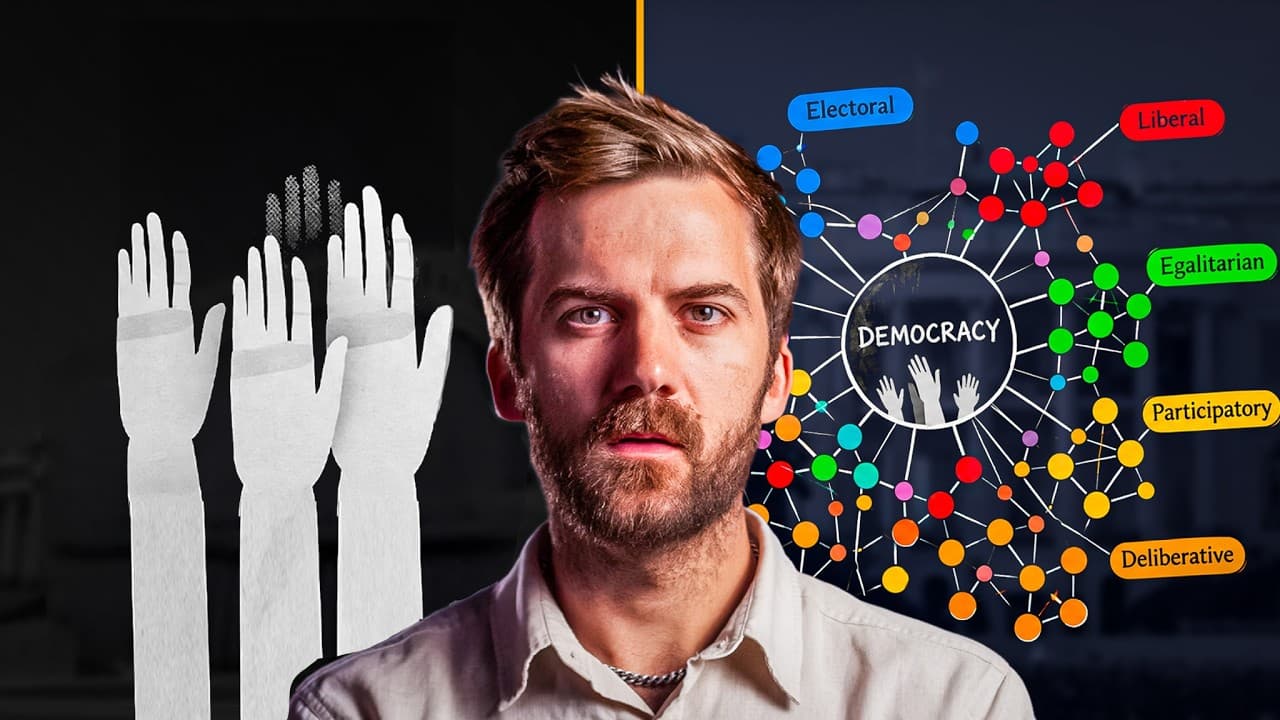
Democracy is not a single fixed idea but a set of five overlapping meanings that people use to judge governance. The video shows that elections matter but are not enough unless voting is broad and free, rights are protected, and people have real choices. It argues that democracy is diverse in practice and can be misunderstood when people equate it with only one feature.
Transcript
- [Commentator] We're in a situation that we in America never thought we would find ourselves in, that is, democratic backsliding. - [Commentator] ... for the people it robs and rules. America was founded as a constitutional republic, not a democracy. - [Commentator] ...but this would certainly be one of them. I think democracy is in trouble. - The... Read More
Key Insights
- Democracy has five distinct interpretations, not one universal meaning, which explains why people talk past each other when using the term. The core idea begins with the basic notion of people ruling through some form of governance, but the meaning expands from there. The most referenced interpretation is electoral democracy, where free, real, and broad elections are essential in a representative system. A free press and broad voting rights are seen as critical components that ensure elections translate into genuine choice. Direct democracy, while historically prominent, is presented as impractical at scale for modern states, making representative systems more typical today. The video emphasizes that elections alone do not guarantee democracy if the competition is not honest or if information is controlled. The concept of a “thin” democracy captures the idea that elections are the minimal requirement, while other rights and freedoms enrich and sustain democratic governance. The study cited in the video reveals that people rate a variety of democratic elements as important, from free elections to gender equality and civil rights, indicating diverse public expectations for democracy. Finally, the dialogue illustrates how the word democracy can be used to justify a range of policies, underscoring the need for clear definitions when discussing democratic legitimacy.
Install to Summarize YouTube Videos and Get Transcripts
Explore YouTube Video Summarizer or Get YouTube Transcript Extractor
Questions & Answers
Q: What is the basic idea of democracy as described in the video?
Democracy begins with the basic idea that the people rule, or have power, but translating that into governance raises questions about who the people are, how they govern, and how their governance is validated. The discussion distinguishes between direct democracy and the modern republican form, where representatives rule on behalf of the people. This sets up the framework for five interpretations that explain how democracy can be understood in practice.
Q: What does electoral democracy mean in the video?
Electoral democracy is defined as the foundation of democracy that relies on elections, but it requires real competition, broad and equal voting rights, and a free press to ensure voters can make informed choices. The video emphasizes that merely having elections does not guarantee democracy if the electoral environment is manipulated or if information is not accessible to all voters.
Q: Why does the video argue that direct democracy is impractical today?
The video notes that direct democracy, where people vote on matters in person, was common in ancient times but is impractical at scale for large modern states. It explains that most contemporary democracies use representative structures where citizens elect officials to govern on their behalf, which is more feasible than direct, continuous decision making by all citizens.
Q: What role do rights play in the five definitions of democracy presented?
Rights are central to several interpretations of democracy beyond elections. They include civil rights, protection from censorship, and personal data privacy. The video argues that without robust rights, the ability to participate in democracy is undermined, as citizens cannot freely express opinions, access information, or safeguard personal autonomy.
Q: How does the video describe the relationship between democracy and equality?
The video suggests democracy encompasses more than elections and formal procedures; it includes elements like gender equality and economic fairness. These aspects are viewed as essential to ensuring that political power is exercised fairly and that all citizens have meaningful opportunities to participate and influence governance.
Q: What does the study cited in the video illustrate about public understanding of democracy?
The study shows that ordinary people attribute many different elements to democracy, from free elections to civil rights and economic policies. This demonstrates that democracy is interpreted in diverse ways by the public, reinforcing the idea that there is no single consensus on what constitutes a democratic system.
Q: What are the five interpretations of democracy mentioned?
The video outlines five interpretations starting with elections as the core, followed by the presence of real competition and broad voting rights, a free press, and equal access to influence. It also discusses the broader meanings people assign to democracy, including rights protection, social equality, and the rule of law as integral parts of a functioning democratic system.
Q: How does the video address the common claim that democracy is in trouble?
The video explains that concerns about democracy often arise from differing definitions and expectations. By outlining five interpretations, it shows that the term is applied to a wide range of political practices and reforms. This helps contextualize worries about democratic backsliding and highlights the need for clarity in what is being evaluated.
Summary & Key Takeaways
-
Democracy is presented as a multi facet concept with five core interpretations, not a single fixed definition, illustrating how people mean different things when they discuss democratic systems. The video emphasizes that elections are necessary but insufficient without broad participation and protections for rights. It highlights the importance of transparency, rights, and accountable representation in defining democratic governance.
-
The discussion traces the evolution from direct democracy to representative, outlining how political scientists view elections as the thin baseline of democracy while noting additional elements like civil rights, gender equality, and economic fairness. It also uses examples to show how real world elections can fail to be democratic if access, competition, or information are compromised.
-
The speaker proposes a practical framework for understanding democracy by identifying five interpretations, starting with elections and expanding to rights, equality, and meaningful political participation. The analysis helps clarify common confusions and encourages a more nuanced view of how democratic systems function in complex societies.
Read in Other Languages (beta)
Share This Summary 📚
Summarize YouTube Videos and Get Video Transcripts with 1-Click
Try YouTube Summary with ChatGPT & Claude or YouTube Transcript Generator
Explore More Summaries from Johnny Harris 📚




Summarize YouTube Videos and Get Video Transcripts with 1-Click
Try YouTube Summary with ChatGPT & Claude or YouTube Transcript Generator