Can Intrinsic Curiosity Drive RL Learning Without Rewards?
TL;DR
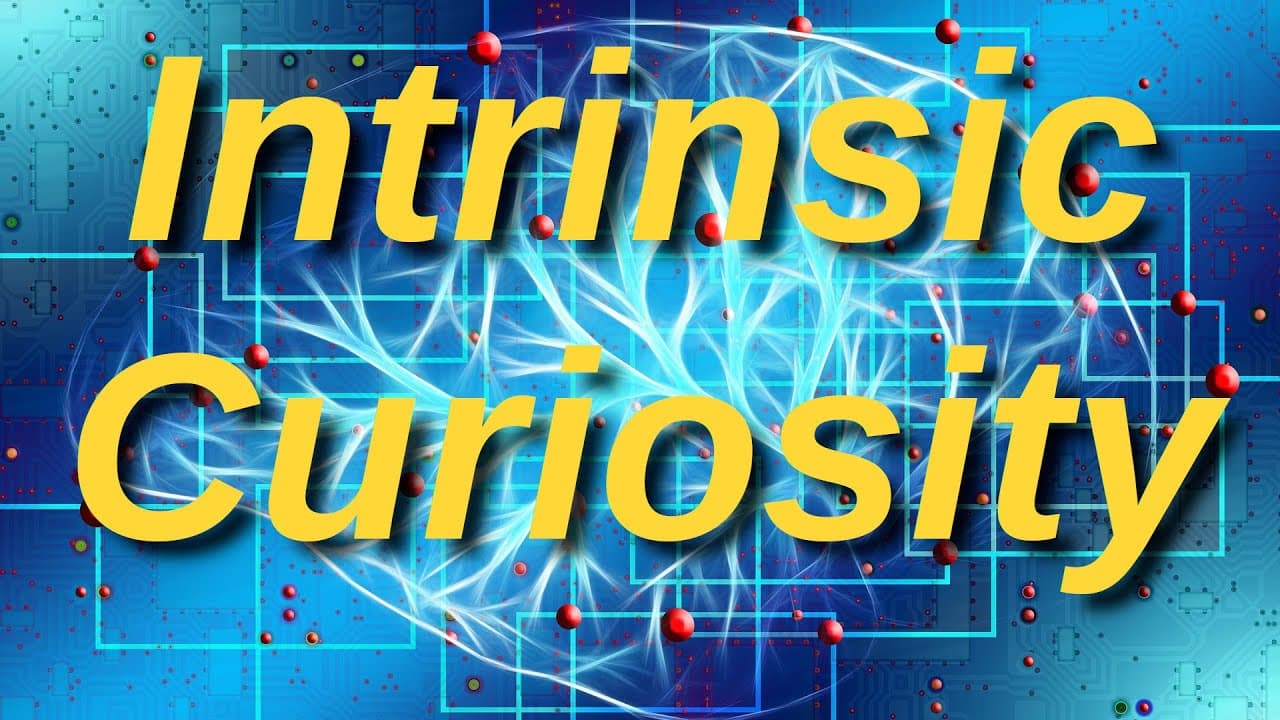
Yes, reinforcement learning agents can learn without external rewards through intrinsic curiosity. The ICN algorithm enables agents to explore and learn the environment by providing intrinsic rewards based on their uncertainty in predicting state transitions, demonstrating effective learning even in sparse reward scenarios.
Transcript
turn in the total absence of rewards from the environment it turns out it's not as crazy as it sounds and that's precisely what they demonstrate in this paper curiosity driven exploration by self-supervised prediction now before we go any further i have to give a shameless plug this is the central paper of my new course curiosity driven deep reinfo... Read More
Key Insights
- 🤳 The ICN algorithm combines self-supervised prediction and curiosity-driven exploration to learn the dynamics of the environment.
- 😒 It is well-suited for environments with very sparse rewards, as it uses intrinsic curiosity rewards.
- 👾 The algorithm can handle pixel-based environments by using a feature extractor to convert pixel representations into a more meaningful feature space.
- 🛀 The ICN algorithm has shown superior performance compared to traditional reinforcement learning algorithms in environments with very sparse rewards.
- ♻️ The implementation of the ICN algorithm in the Cartpole environment demonstrates that learning can occur without rewards.
- ♻️ The ICN algorithm can be extended and modified for different environments and applications.
- 😒 The use of curiosity-driven exploration can enhance the learning capabilities of reinforcement learning agents.
Install to Summarize YouTube Videos and Get Transcripts
Explore YouTube Video Summarizer or Get YouTube Transcript Extractor
Questions & Answers
Q: What is the ICN algorithm and how does it work?
The ICN algorithm involves self-supervised prediction and curiosity-driven exploration. It uses a feature extractor to convert pixel representations into a more meaningful feature space. The model consists of forward and inverse models that learn the dynamics of the environment.
Q: How does the ICN algorithm handle reward sparsity?
The ICN algorithm is well-suited for environments with very sparse rewards. It uses intrinsic curiosity rewards, which are directly proportional to the agent's inability to predict the resulting state. As the agent learns more about the environment, the curiosity reward diminishes.
Q: How does the ICN algorithm perform in different environments?
The ICN algorithm has been tested in various environments, such as Super Mario Bros and Viz Doom. In these environments, it has shown superior performance compared to traditional reinforcement learning algorithms, especially in environments with very sparse rewards.
Q: How does the ICN algorithm handle pixel-based environments?
In pixel-based environments, a convolutional neural network is used as a feature extractor to convert the pixel representations into a more meaningful feature space. This helps to reduce the impact of random changes in the environment that may affect the agent's ability to predict the resulting state.
Summary & Key Takeaways
-
The content explains the ICN algorithm, which involves self-supervised prediction and curiosity-driven exploration.
-
The algorithm uses a feature extractor to convert pixel representations of the environment into a more meaningful feature space.
-
The content demonstrates the implementation of the ICN algorithm in the Cartpole environment and shows that learning can occur without rewards.
Read in Other Languages (beta)
Share This Summary 📚
Summarize YouTube Videos and Get Video Transcripts with 1-Click
Try YouTube Summary with ChatGPT & Claude or YouTube Transcript Generator
Explore More Summaries from Machine Learning with Phil 📚



Summarize YouTube Videos and Get Video Transcripts with 1-Click
Try YouTube Summary with ChatGPT & Claude or YouTube Transcript Generator