Compound generator | Characteristics | DC machines | Lec-49
TL;DR
This session covers the characteristics and applications of compound generators, including types and classifications.
Transcript
hello everyone in this session we will discuss about the characteristics of compound generator up to now we discussed about the different different types of generators that is series generator and shunt generator like that now we will be entering into the compound generator so no mix name itself compound means it is a combination of series as well ... Read More
Key Insights
- ⚡ Compound generators combine series and shunt windings to optimize voltage output and load handling capabilities.
- 🅰️ The classification of compound generators assists in understanding their operational differences, notably between cumulative and differential types.
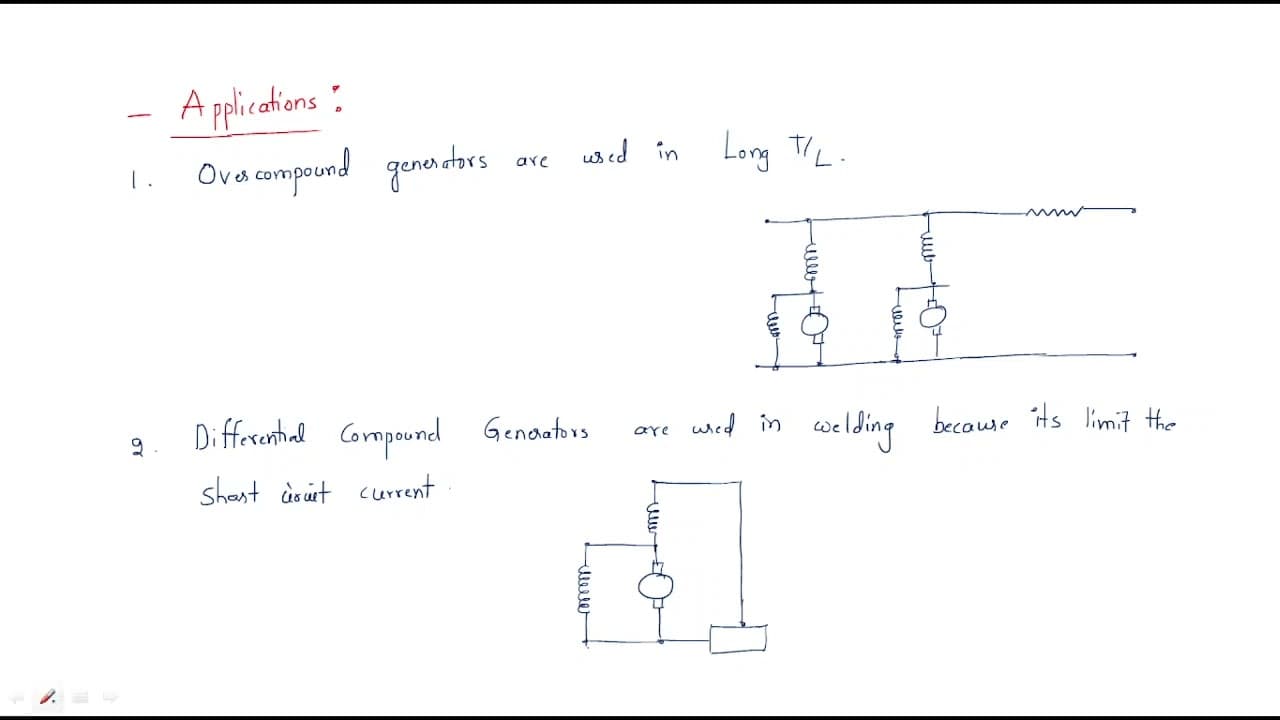
- ✊ Applications of compound generators include improved voltage management in welding operations and long-distance power transmission.
- 🫓 The under compound and flat compound generators serve specific needs in applications requiring regulated voltage outputs.
- ⚡ Understanding load voltage behavior in relation to induced emf is critical for effectively employing compound generators.
- 🫥 Voltage compensation provided by over compound generators is crucial for maintaining performance over long transmission lines.
- ✋ Control of short circuit current through differential compound generators enhances safety during high current applications, such as welding.
Install to Summarize YouTube Videos and Get Transcripts
Explore YouTube Video Summarizer or Get YouTube Transcript Extractor
Questions & Answers
Q: What are the two types of compound generators mentioned in the session?
The two types discussed are cumulative compound generators and differential compound generators. Cumulative compound generators combine the series and shunt flux, resulting in increased total flux. In contrast, differential compound generators work by subtracting the series flux from the shunt flux, leading to reduced total flux, which can result in lower voltage outputs.
Q: How do cumulative and differential compound generators affect load voltage?
In cumulative compound generators, the load voltage increases as both shunt and series flux contribute positively to the total flux, ensuring that the load voltage is greater than the induced emf. Conversely, in differential compound generators, the load voltage is less than the induced emf due to the opposing effects of the shunt and series winding, leading to potential scenarios of voltage drop under certain conditions.
Q: What is an over compound generator, and where is it used?
An over compound generator is characterized by its ability to produce a load voltage that exceeds the induced emf. This feature makes it suitable for long transmission lines, as it compensates for potential voltage drops over distances, ensuring a consistent voltage supply is maintained throughout the line.
Q: Why are differential compound generators important in welding applications?
Differential compound generators are particularly useful in welding because they can limit the short circuit current. During welding activities, high currents are required; however, the configuration of these generators helps maintain control over the short circuit conditions, ensuring that the generated voltage increases while keeping the current manageable.
Q: How do flat compound generators differ from under compound generators?
Flat compound generators maintain approximately equal load voltage and induced emf, meaning the voltage output aligns closely with the generator's inherent capabilities. In contrast, under compound generators produce a load voltage that is less than the induced emf, which can be crucial for maintaining lower output levels in specific applications where less power is necessary.
Q: What role do compound generators play in battery charging and auxiliary power supplies?
Flat and under compound generators are effectively utilized as voltage sources for auxiliary power supplies and battery charging. Their ability to stabilize the voltage under varying loads makes them ideal for providing consistent power needed for these applications, contributing to efficient energy management.
Q: What can be inferred about the importance of the rated armature current in compound generators?
The rated armature current is pivotal in defining generator performance, as it determines the maximum current that can flow through the armature without causing damage. Understanding this parameter is essential for predicting the behavior of the generator under different load conditions and ensuring it operates within safe limits.
Summary & Key Takeaways
-
The session explains the concept of compound generators, combining series and shunt windings to enhance performance, mainly in terms of voltage output.
-
Two types of compound generators are discussed: cumulative, which adds series and shunt flux for increased output, and differential, which subtracts for reduced flux.
-
The application of compound generators in welding and long transmission lines is highlighted, emphasizing how different types can optimize performance based on voltage and load requirements.
Read in Other Languages (beta)
Share This Summary 📚
Summarize YouTube Videos and Get Video Transcripts with 1-Click
Try YouTube Summary with ChatGPT & Claude or YouTube Transcript Generator
Explore More Summaries from Education 4u 📚

Summarize YouTube Videos and Get Video Transcripts with 1-Click
Try YouTube Summary with ChatGPT & Claude or YouTube Transcript Generator