Pie chart | Students in Departments | Data Interpretation | Reasoning | Part - 25 | Bharath Kumar
TL;DR
This session covers data interpretation of pie charts comparing student demographics in 2001 and 2002.
Transcript
hi everyone welcome to the session in this session I am continuing python data and repetition first of all we need to read the information carefully based on that we need to solve the questions uh according to the given information here two pie charts are given look at the information number of students studying in different faculties in the Years ... Read More
Key Insights
- 🧑🎓 The total student population in the educational sector increased from 35,000 to 40,000 between 2001 and 2002, reflecting overall growth.
- 🧑🎓 Faculty-wise breakdown shows specificity in enrollment dynamics, with students distributed across seven distinct faculties.
- 🧑⚕️ The Pharmacy faculty experienced the largest percentage increase, highlighting shifting student preferences towards health-related fields in the analyzed period.
- ❓ The Agriculture faculty had a notable decline, indicating potential areas for curriculum enhancements or recruitment efforts to regain interest.
- 🤩 Key formulas for percentage increment calculations involve comparing differences effectively while maintaining clarity in numerator and denominator selections.
- 🧑🎓 Understanding trends through the analysis of data can guide future academic program planning and development strategies to align with student interests.
- 🐎 Speed in calculations and approximations can significantly enhance performance in time-sensitive examinations, such as competitive tests relying on data interpretation.
Install to Summarize YouTube Videos and Get Transcripts
Explore YouTube Video Summarizer or Get YouTube Transcript Extractor
Questions & Answers
Q: How do the total student numbers in 2001 and 2002 compare?
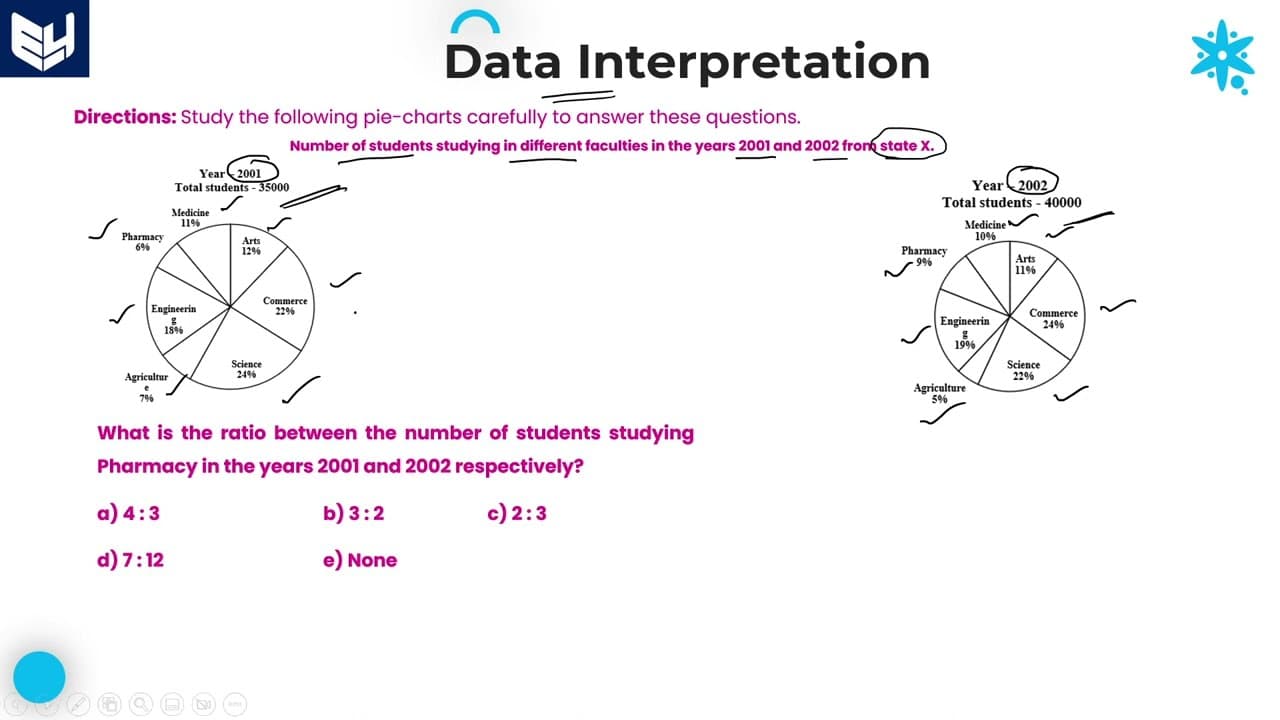
In 2001, a total of 35,000 students were enrolled across various faculties, while by 2002, this number had risen to 40,000. This increase signifies a growth in student enrollment in various fields over the year.
Q: What percentage of students were in the Pharmacy faculty in 2001 and 2002?
In 2001, 6% of students were enrolled in Pharmacy, equating to 2,100 students. In contrast, 9% of students, or 3,600, were studying Pharmacy in 2002, indicating a notable increase in enrollment in this faculty.
Q: What was the percentage increase in engineering students from 2001 to 2002?
Engineering students increased from 6,300 students in 2001 (18% of total) to 7,600 in 2002 (19% of total). The approximate percentage increase calculated is around 20%, representing significant growth in this faculty.
Q: Which faculty showed a decrease in student numbers from 2001 to 2002?
The Agriculture faculty experienced a decrease in student numbers from 2,450 in 2001 (7% of total) to 2,000 in 2002 (5% of total). This decline highlights shifts in student interests or available programs between the two years.
Q: What is the significance of calculating approximate percentages in data interpretation?
Calculating approximate percentages allows for quicker assessments and decision-making without getting bogged down in exact figures, especially useful in competitive exams where time is limited.
Q: How do the percentage increments in Arts and Medicine compare from 2001 to 2002?
The Arts faculty saw a slight decrease from 12% in 2001 to 11% in 2002, while Medicine decreased from 11% in 2001 to 10% in 2002. This trend indicates diminishing interest or availability in these faculties.
Q: How is the calculation of ratios important in pie chart analysis?
Ratios help to quickly understand the relative sizes of different categories within the total, providing immediate insights into trends or shifts in demographics from one time period to another.
Q: What learning strategies were emphasized for analyzing pie charts in competitive exams?
Quick calculations, approximate percentages, and understanding trends through ratios were emphasized as vital strategies to handle pie chart data interpretation efficiently and effectively during exams.
Summary & Key Takeaways
-
The session explains pie chart data representation showing the number of students across various faculties in State X for 2001 and 2002, with total student counts of 35,000 and 40,000 respectively.
-
Students are categorized into faculties such as Medicine, Arts, Commerce, Science, Agriculture, Engineering, and Pharmacy, with respective percentage increases and decreases analyzed between the two years.
-
Calculating ratios, percentage increases, and comparisons among faculties to determine trends and insights is essential for competitive examinations and quick problem-solving.
Read in Other Languages (beta)
Share This Summary 📚
Summarize YouTube Videos and Get Video Transcripts with 1-Click
Try YouTube Summary with ChatGPT & Claude or YouTube Transcript Generator