How to Convert 4-Bit Gray Code to Binary Code
TL;DR
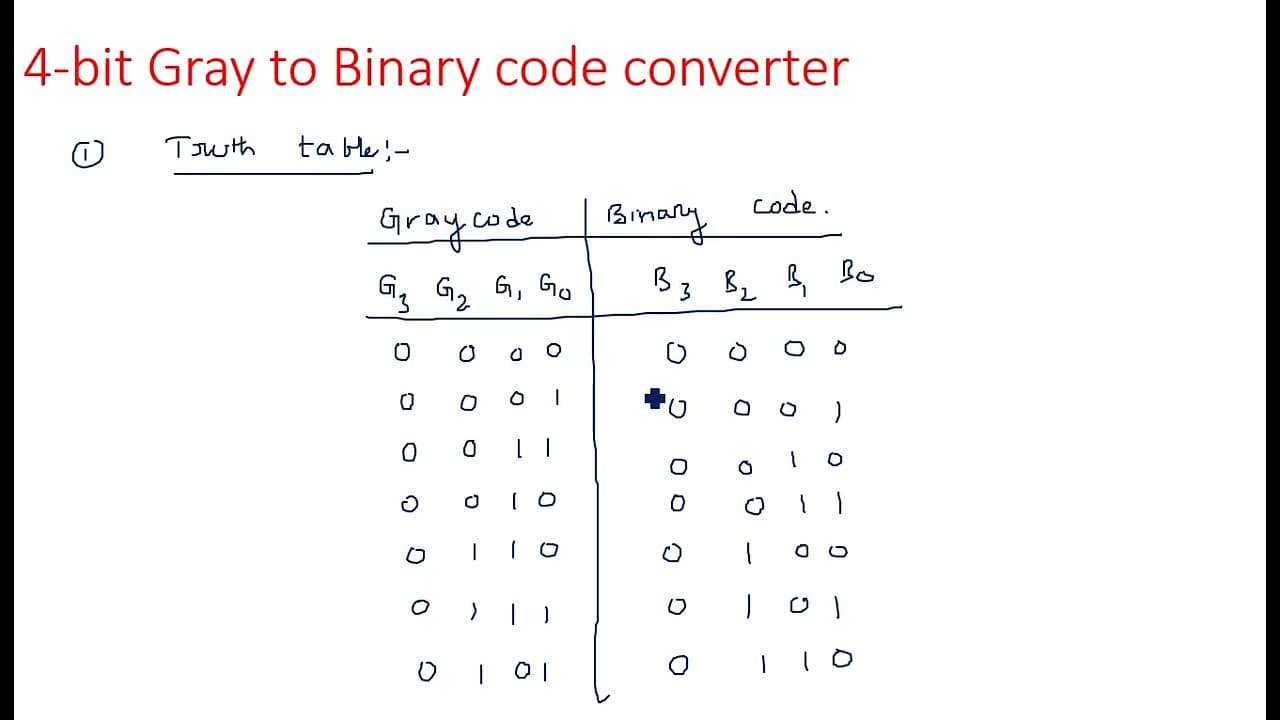
To convert 4-bit Gray code to binary code, first create a truth table illustrating the relationship between Gray and binary codes. Then, use K-map simplifications to derive the output expressions, ensuring the Gray code order is accurately represented. Finally, implement the conversion logic with XOR operations in a digital circuit diagram.
Transcript
hi everyone in this video I'm going to explain about 4bit gray code to binary code conversion in the previous video I gave you the explanation of reverse of this one binary code to gray code converter so for any conversion or any logic circuit design our first step is to draw the truth table so here also in order to convert uh gray code to binary c... Read More
Key Insights
- 🫦 Gray code reduces the risk of errors in digital communication systems by changing only one bit at a time during transitions.
- 👨💻 Constructing a truth table is fundamental for visualizing the relationships between Gray code inputs and binary code outputs.
- 😉 K-maps provide a systematic approach to minimizing complex boolean expressions derived from the truth table.
- 😉 The conversion process follows a clear order: truth table first, K-map simplification next, and finally the logic circuit design.
- 👨💻 XOR gates are essential in the logic circuit, corresponding to the unique properties of Gray code when deriving binary values.
- 😉 Maintaining the correct order when mapping input values into K-maps is crucial for accurate binary output determination.
- 🎨 The conversion steps reinforce the importance of accuracy in digital circuit design for reliable outputs.
Install to Summarize YouTube Videos and Get Transcripts
Explore YouTube Video Summarizer or Get YouTube Transcript Extractor
Questions & Answers
Q: What is Gray code, and why is it used in coding systems?
Gray code is a binary numeral system where two successive values differ in only one bit. It is primarily used in error correction applications and digital systems because it reduces the possibility of errors during transitions, ensuring that only one bit changes at a time, thus simplifying the detection of potential errors.
Q: How do you construct a truth table for Gray code to binary conversion?
To create a truth table for Gray code to binary conversion, first list all possible 4-bit Gray code values. Then, determine their corresponding binary values by using the rules of Gray code conversion, where the first binary bit is the same as the Gray bit, and subsequent binary bits are computed by XORing the previous binary bit with the current Gray bit.
Q: What is the K-map, and how is it used in this conversion?
The K-map (Karnaugh map) is a tool used to simplify boolean algebra expressions. In the context of Gray code to binary conversion, it organizes the truth table values visually, allowing for easier identification of patterns and simplification of boolean expressions, ultimately leading to the output equations for each binary bit.
Q: Can you explain the role of XOR operations in the conversion process?
XOR operations play a crucial role in Gray code to binary conversion as they are used to derive binary outputs based on the corresponding Gray code inputs. Each binary bit can be calculated using XOR between specific Gray bits, allowing for a smooth transformation based on the unique properties of Gray code.
Summary & Key Takeaways
-
The video outlines the method for converting 4-bit Gray code to binary code, beginning with the construction of a truth table detailing the relationship between Gray and binary codes.
-
Next, it describes how to use K-map simplifications to derive output expressions for the binary code based on the Gray code inputs, emphasizing the importance of accurately reflecting the Gray code order.
-
Finally, the video presents the logic circuit diagram for the conversion process, showcasing the XOR operations necessary to achieve the output binary code from the provided Gray code.
Read in Other Languages (beta)
Share This Summary 📚
Summarize YouTube Videos and Get Video Transcripts with 1-Click
Try YouTube Summary with ChatGPT & Claude or YouTube Transcript Generator