How to Calculate Power Flow in Synchronous Machines
TL;DR
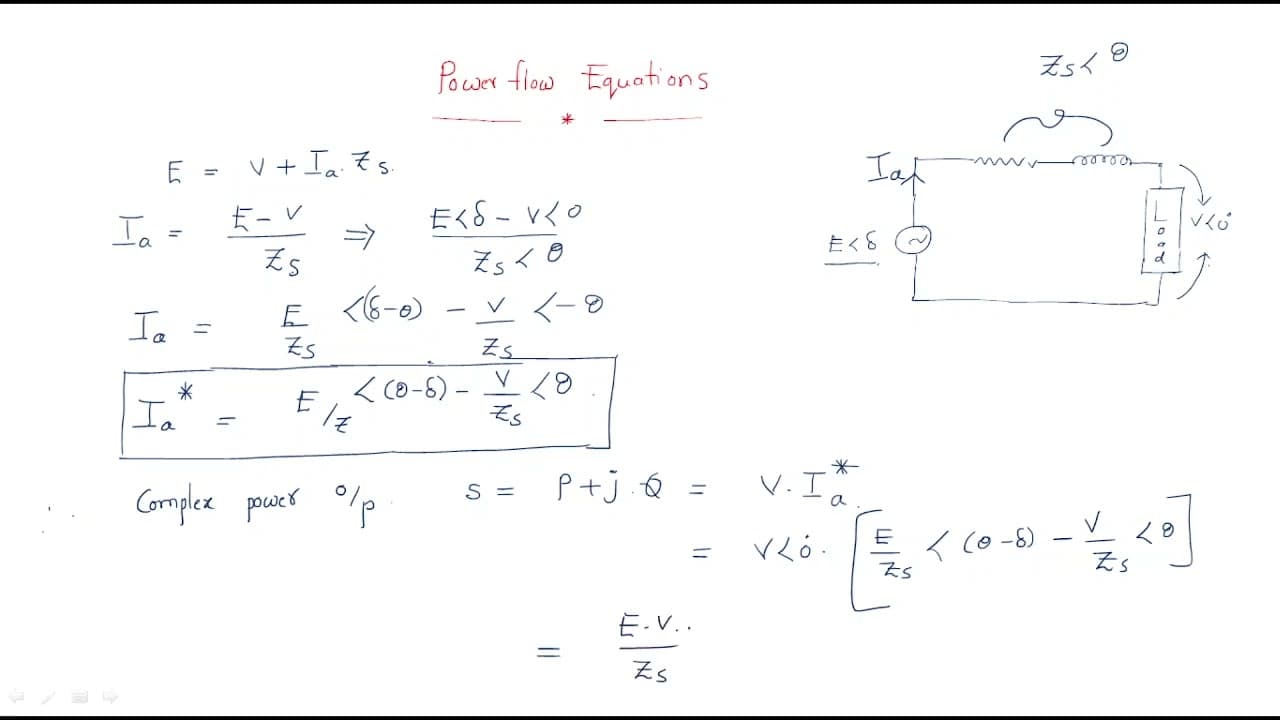
Calculate power flow in synchronous machines using derived equations that relate active and reactive power to key electrical parameters. The discussion covers slip tests, EMF induction, and the impact of rotor speed on performance, highlighting essential calculations for optimal motor operation.
Transcript
hello everyone in the last session we discussed about the slip test in that sleep test we are finding the direct axis direct axis reactance XD that is VA Max by IAM minimum and quadrature axis reactance X Cube that equaled VA minimum by IMAX VA minimum by IMX so the continuation part of the here we have two statements that is the relative velocity ... Read More
Key Insights
- 🐎 Synchronous motors operate below synchronous speed, impacting their slip speed and performance.
- 💋 The slip test is a fundamental procedure for evaluating motor parameters like reactance and EMF.
- 💋 Induced EMF during the slip test is sinusoidal and significantly influenced by slip frequency.
- ⏳ Power flow equations derive relationships between voltage, current, and impedance, essential for real-time motor performance analysis.
- ✊ Both active and reactive power equations can be modified for cylindrical machines to simplify calculations.
- 💦 The equations derived provide insights into how voltage drops and armature resistance affect motor efficiency and output power.
- 💦 Understanding these concepts is critical for engineers working in electrical machine design and testing.
Install to Summarize YouTube Videos and Get Transcripts
Explore YouTube Video Summarizer or Get YouTube Transcript Extractor
Questions & Answers
Q: What is the significance of slip speed in synchronous motors?
Slip speed is crucial for understanding the operational difference between synchronous speed and rotor speed. It directly affects the induced EMF in the motor, influencing overall performance, efficiency, and torque generation. This understanding helps in designing better motor control systems and improving responsiveness in various applications.
Q: How is the induced EMF related to the slip frequency during the slip test?
During the slip test, the induced EMF is generated because of the differential velocity between the field poles and the rotating armature. This EMF manifests as an AC sinusoidal waveform at the slip frequency, determining how the motor interacts with its load and adjusting its magnetic field accordingly.
Q: Can you explain the derivation of active power in synchronous motors?
Active power in synchronous motors is derived from the equations involving voltage (V), induced EMF (E), and synchronous impedance (Zs). By manipulating these variables and considering phase differences, we establish that active power is given by P = e v / Zs * sin(Delta), showcasing how operational characteristics of the motor influence power delivery.
Q: What role does the quadrature axis play in the equations discussed?
The quadrature axis is essential for understanding the dynamic behavior of the motor, especially in relation to EMF and current. In the discussed equations, we see how maximum and minimum values of quadrature axis EMF affect the overall performance and the reactive power delivered or absorbed by the motor during operation.
Summary & Key Takeaways
-
The discussion focuses on the slip test in synchronous motors, emphasizing the relationship between synchronous speed and rotor speed, known as slip speed, which impacts EMF induction.
-
A detailed explanation of how electrical parameters such as armature current and EMF relate to each other through power flow equations, revealing how active and reactive power are derived.
-
The content highlights the derivation of key power equations for synchronous motors, providing insights into active power and reactive power calculations based on the machine parameters and operating conditions.
Read in Other Languages (beta)
Share This Summary 📚
Summarize YouTube Videos and Get Video Transcripts with 1-Click
Try YouTube Summary with ChatGPT & Claude or YouTube Transcript Generator