Unijunction transistor | Introduction | PDC | Lec-74
TL;DR
The Uni Junction Transistor (UJT) has one junction, three terminals, and is primarily used as an oscillator.
Transcript
hi everyone in this video I am going to explain about the uni Junction transistor so as the name tells here uni Junction transistor is having one Junction if you see the structure of a transistor the uni Junction transistor is having only one Junction whereas bzt is having two Junctions bipolar Junction transistor it is having one uh collector to e... Read More
Key Insights
- 🅰️ The Uni Junction Transistor's structure consists of one junction between p-type and n-type materials, enabling its unique functionalities.
- 💄 UJTs are primarily applied as oscillators in electronic circuits, making them integral for generating different types of waveforms.
- ⚡ Understanding the circuit operation, including voltage and current dynamics, is essential for effectively using UJTs in practical applications.
- 🥳 The concept of the intrinsic standoff ratio is critical for analyzing UJT performance under varying electrical conditions.
- 🙊 UJTs display oscillatory behavior by alternating between peak and valley voltage levels, demonstrating their efficiency in timing and signal applications.
- 🧑🎓 The distinction between UJTs and BJTs is fundamental for students, emphasizing different designs for specific electronic applications.
- ⚡ Characteristic curves of UJTs reveal essential relationships in current and voltage, helping designers optimize their usage in circuits.
Install to Summarize YouTube Videos and Get Transcripts
Explore YouTube Video Summarizer or Get YouTube Transcript Extractor
Questions & Answers
Q: What are the main components of a Uni Junction Transistor?
A Uni Junction Transistor contains one junction comprised of p-type and n-type materials, alongside three terminals: one emitter terminal and two base terminals. The unique design allows it to function differently compared to Bipolar Junction Transistors, which have two junctions.
Q: How does a Uni Junction Transistor operate as an oscillator?
UJTs create oscillations through their ability to switch, producing sawtooth waveforms. When the emitter current exceeds a certain threshold, the transistor turns on, allowing oscillatory behavior suitable for applications in timing circuits and signal generation.
Q: Can you explain the significance of peak voltage and valley voltage in UJTs?
Peak voltage (VP) represents the maximum voltage level the UJT can reach before it turns off, while valley voltage (VV) is the minimum voltage level before triggering the oscillation again. These characteristics define the operational limits and efficiency of the UJT oscillator.
Q: What is the intrinsic standoff ratio, and why is it important?
The intrinsic standoff ratio (eta) is a voltage division factor that determines the voltage drop across the UJT based on the resistances of its base terminals. It is crucial for assessing the stability and performance of the UJT in different circuit configurations.
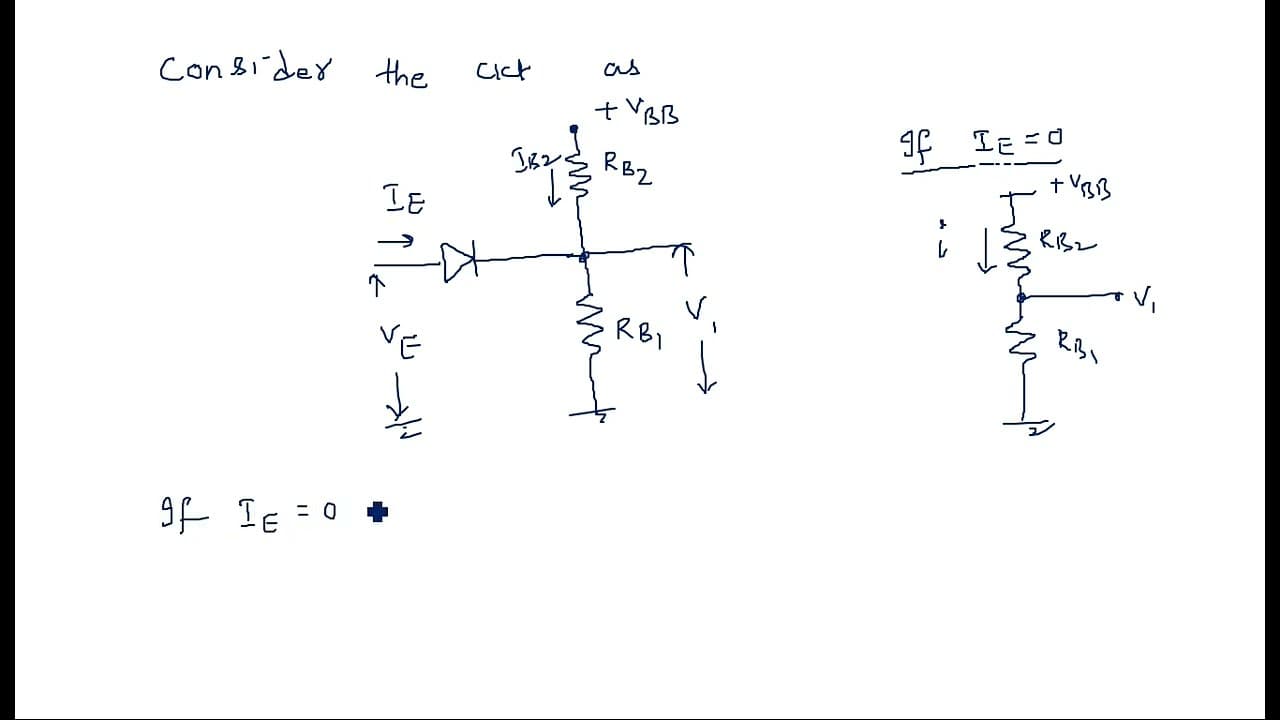
Q: How does the UJT circuit respond when the emitter current is zero?
When the emitter current (IE) is zero, the UJT circuit operates solely based on the resistances at the base terminals. The current through the two resistors can be calculated using the voltage across them, demonstrating a fundamental property of UJT behavior in the absence of an active emitter current.
Q: What differentiates a Uni Junction Transistor from a Bipolar Junction Transistor?
A Uni Junction Transistor has one junction and three terminals (one emitter and two bases) as opposed to a Bipolar Junction Transistor, which contains two junctions (emitter-collector and base-emitter). This results in differing operational principles and applications in electronic circuits.
Summary & Key Takeaways
-
The Uni Junction Transistor (UJT) features one junction and three terminals: an emitter and two base terminals, distinguishing it from Bipolar Junction Transistors (BJTs).
-
UJTs are commonly utilized in oscillator applications due to their ability to produce sawtooth waveforms, functioning as saturated waveform generators.
-
The video illustrates UJT circuitry, explaining characteristics such as peak and valley voltages, along with current-voltage relationships essential for understanding UJT operations.
Read in Other Languages (beta)
Share This Summary 📚
Summarize YouTube Videos and Get Video Transcripts with 1-Click
Try YouTube Summary with ChatGPT & Claude or YouTube Transcript Generator