SRAM technology | FPGA technologies | VLSI | Lec-77
TL;DR
This video explains SRAM technology in FPGA programming and its functionalities.
Transcript
hi everyone in this video you are going to learn about various fpga programming Technologies in that you are going to learn the first programming technology that is SRAM okay so what do you mean by fpga technology is fpga Technologies are nothing but which are used to store the memory elements memory cells fpga Technologies are used to store the da... Read More
Key Insights
- 😕 FPGA programming technologies include SRAM, anti-fuse, and EEPROM, each catering to different programmable functionalities.
- 🍉 SRAM is characterized by its short-term storage feature, making it essential for tasks needing rapid access to changing data.
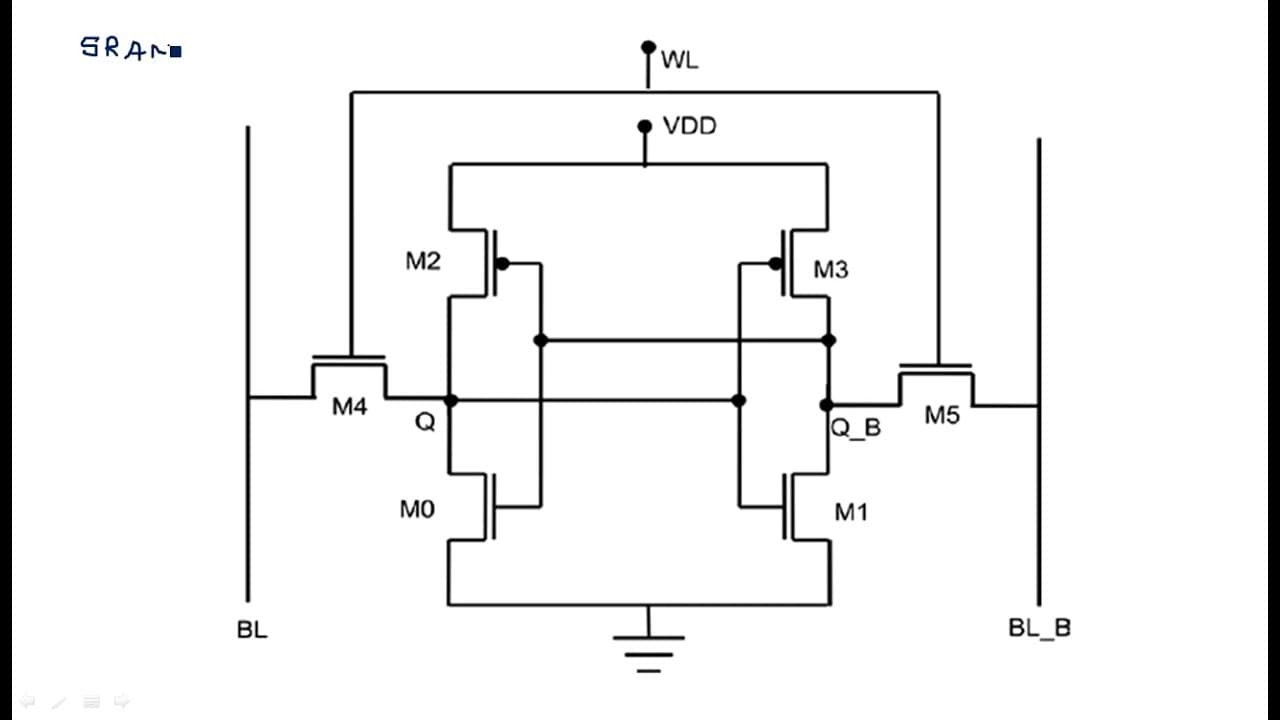
- ❓ The six-transistor SRAM cell configuration is crucial for effective data management in FPGA systems, affecting the overall performance.
- ✊ SRAM's volatility requires frequent reprogramming, making power management critical in FPGA applications to maintain function and data integrity.
- 👻 The dynamic reconfiguration capability of SRAM-based FPGAs allows for on-the-fly updates to operational configurations, enhancing flexibility.
- 🎮 The video outlines the practical implications of SRAM technology within VLSI processes, simplifying fabrication and integration into FPGA designs.
- 🦾 Understanding the operational mechanics of SRAM helps engineers optimize FPGA configurations for specific applications, improving efficiency and performance.
Install to Summarize YouTube Videos and Get Transcripts
Explore YouTube Video Summarizer or Get YouTube Transcript Extractor
Questions & Answers
Q: What are the primary programming technologies discussed in the video?
The video highlights three main programming technologies used in FPGAs: SRAM (Static Random Access Memory), anti-fuse technology, and EEPROM (Electrically Erasable Programmable Read-Only Memory). SRAM is known for its volatile nature, anti-fuse for its one-time programmable capability, and EEPROM allows data to be erased and reprogrammed multiple times.
Q: What is the significance of SRAM in FPGA technology?
SRAM plays a critical role in FPGA technology as it allows for temporary data storage and easy reprogramming. It is volatile, meaning that the stored data is lost when power is removed, requiring reprogramming during each power-up. Its configuration facilitates dynamic reconfiguration, enabling changes to logic functions without needing to halt operations.
Q: How many transistors are involved in a standard SRAM cell as explained in the video?
Each SRAM cell is composed of six transistors, which include two CMOS inverters connected back to back and additional pass transistors. This configuration not only stores data temporarily but also allows for effective data transfer and operation within the FPGA architecture.
Q: What happens to SRAM data when power is lost?
When power is lost, the data stored in SRAM is erased, as it is classified as volatile memory. This means that, upon power restoration, the SRAM needs to be reprogrammed to establish the necessary logic functions again since the previous data cannot be retrieved.
Summary & Key Takeaways
-
The video discusses various FPGA programming technologies, focusing on SRAM, which is a volatile memory type essential for temporary data storage in FPGAs.
-
Three primary programming technologies are explored: SRAM, anti-fuse, and EEPROM, each with unique characteristics affecting data storage and reprogramming.
-
The SRAM cell is explained with detailed diagrams, emphasizing its operation, the configuration of memory cells, and its role in dynamic reconfiguration during system operation.
Read in Other Languages (beta)
Share This Summary 📚
Summarize YouTube Videos and Get Video Transcripts with 1-Click
Try YouTube Summary with ChatGPT & Claude or YouTube Transcript Generator