How to Calculate the Z-Parameter Matrix
TL;DR
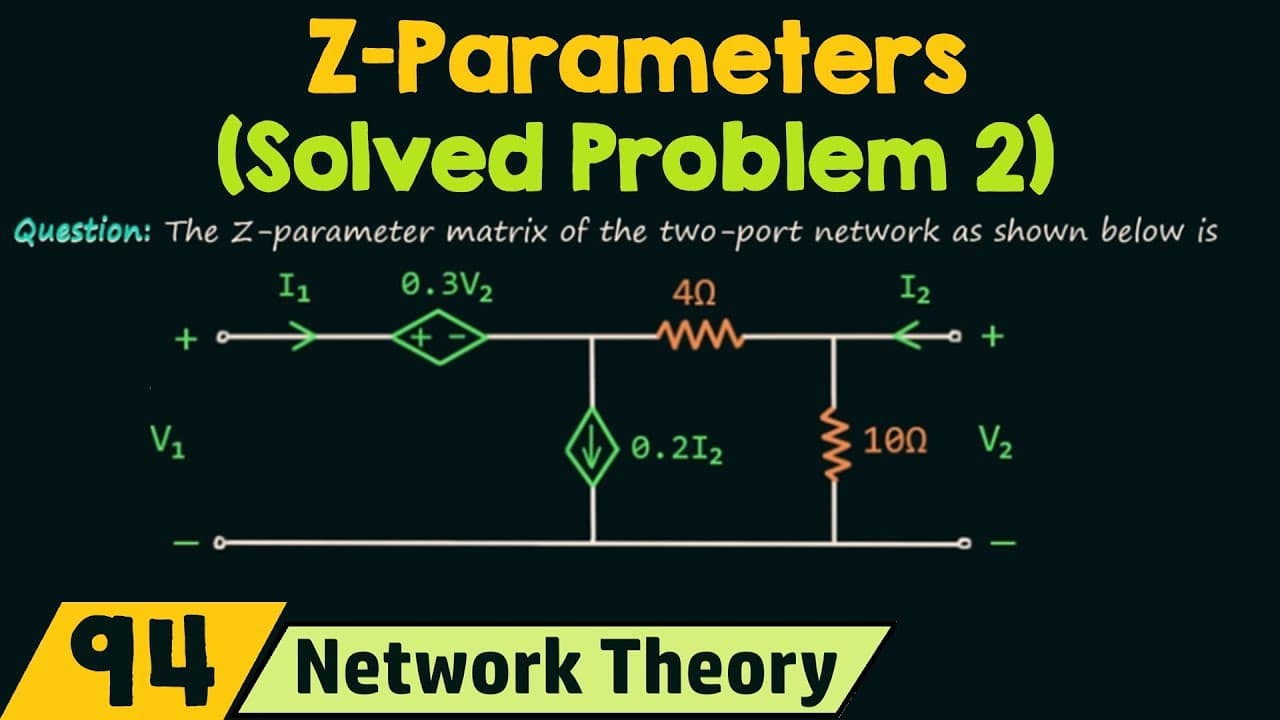
Assign branch currents using node-current relationships, write input and output KVL equations, and eliminate the V2 term from the input equation. The resulting equations are V1 = 17I1 + 9.6I2 and V2 = 10I1 + 8I2, giving the Z-parameter matrix with rows [17, 9.6] and [10, 8].
Transcript
now we are going to solve our problem number two on the calculation of Z parameters and according to the problem we are required to find the Z parameter matrix of the two-port Network has shown below so this is the given Network and we are required to find the Z parameter matrix and the Z parameter matrix is a 2 by 2 matrix having the elements z11 ... Read More
Key Insights
- The Z-parameter matrix is a 2 by 2 matrix containing Z11, Z12, Z21, and Z22. Each element is identified by expressing the two port voltages as linear combinations of the input current I1 and output current I2.
- The first branch-current relationship is I1 minus 0.2I2. It follows from I1 entering a node while 0.2I2 leaves that node, so the remaining current leaving through the connected branch equals their difference.
- The second derived branch current is I1 plus 0.8I2. The current I1 minus 0.2I2 and the port current I2 enter the same node, so their sum leaves through the next branch.
- The input KVL equation avoids the path containing the current source because its voltage is unknown. The selected path produces V1 minus 0.3V2 minus 4 times the first derived branch current minus 10 times the second derived branch current equal to zero.
- The simplified input equation is V1 minus 0.3V2 minus 14I1 minus 7.2I2 equal to zero. It is not yet in standard Z-parameter form because it still includes the output voltage V2.
- The output KVL equation directly gives V2 = 10I1 + 8I2. This equation is already in standard form, allowing the coefficients of I1 and I2 to be identified as Z21 and Z22.
- The standard input equation is obtained by substituting V2 = 10I1 + 8I2 into the input equation. Simplification then gives V1 = 17I1 + 9.6I2, exposing the coefficients Z11 and Z12.
- The final Z-parameter matrix has first row [17, 9.6] and second row [10, 8]. These entries come from directly comparing the two simplified voltage equations with the standard Z-parameter equations.
Install to Summarize YouTube Videos and Get Transcripts
Explore YouTube Video Summarizer or Get YouTube Transcript Extractor
Questions & Answers
Q: How do you calculate the Z-parameter matrix?
Calculate the matrix by first assigning currents to every branch using the node-current relationships. Next, develop separate input and output KVL equations. Use the output equation to replace V2 in the input equation, then express both voltages in standard form. Comparing coefficients gives Z11 = 17, Z12 = 9.6, Z21 = 10, and Z22 = 8.
Q: What branch currents are used in the Z-parameter solution?
The first derived branch current is I1 minus 0.2I2 because I1 enters the node and 0.2I2 leaves it. At the next node, I1 minus 0.2I2 and I2 both enter. Their sum gives the outgoing branch current I1 plus 0.8I2. These two expressions are then used in the KVL equations.
Q: Why does the input KVL path avoid the current source?
The input KVL equation follows a path that avoids the current source because the voltage across that source is unknown. The chosen path instead uses known voltage and resistor-current terms, including V1, 0.3V2, the factor 4 applied to I1 minus 0.2I2, and the factor 10 applied to I1 plus 0.8I2.
Q: What is the input KVL equation for the network?
The input KVL equation is V1 minus 0.3V2 minus 4 times I1 minus 0.2I2, minus 10 times I1 plus 0.8I2, equal to zero. After collecting the current terms, it becomes V1 minus 0.3V2 minus 14I1 minus 7.2I2 equal to zero. This equation still requires substitution to reach standard form.
Q: What is the output KVL equation for the network?
The output KVL equation is formed from V2 and the voltage associated with the branch current I1 plus 0.8I2. It is written as V2 minus 10 times I1 plus 0.8I2 equal to zero. Rearranging and expanding gives V2 = 10I1 + 8I2, which is already in standard Z-parameter form.
Q: How is the input voltage equation converted to standard form?
Replace V2 in the simplified input equation with the output result, V2 = 10I1 + 8I2. The equation becomes V1 minus 0.3 times 10I1 plus 8I2, minus 14I1 minus 7.2I2, equal to zero. Collecting and moving the current terms gives V1 = 17I1 + 9.6I2.
Q: How are the four Z parameters identified?
Compare V1 = 17I1 + 9.6I2 with the standard relationship V1 = Z11I1 + Z12I2. This gives Z11 = 17 and Z12 = 9.6. Then compare V2 = 10I1 + 8I2 with V2 = Z21I1 + Z22I2, giving Z21 = 10 and Z22 = 8.
Q: What is the final Z-parameter matrix?
The final impedance matrix has 17 and 9.6 in its first row, followed by 10 and 8 in its second row. Therefore, the Z-parameter matrix is [[17, 9.6], [10, 8]]. The entries follow from the standard-form equations V1 = 17I1 + 9.6I2 and V2 = 10I1 + 8I2.
Summary & Key Takeaways
-
The solution begins by assigning currents throughout the two-port network. Applying current relationships at successive nodes gives one branch current as I1 minus 0.2I2 and another as I1 plus 0.8I2. These expressions provide the branch-current terms required to construct the input and output KVL equations correctly.
-
The input KVL equation initially contains both port voltages and simplifies to V1 minus 0.3V2 minus 14I1 minus 7.2I2 equal to zero. The output KVL equation gives V2 = 10I1 + 8I2, which is already in the standard form needed for identifying impedance parameters.
-
Substituting V2 = 10I1 + 8I2 into the input equation produces V1 = 17I1 + 9.6I2. Comparing both port-voltage equations with the standard Z-parameter relationships gives Z11 = 17, Z12 = 9.6, Z21 = 10, and Z22 = 8, completing the required matrix.
Read in Other Languages (beta)
Share This Summary 📚
Summarize YouTube Videos and Get Video Transcripts with 1-Click
Try YouTube Summary with ChatGPT & Claude or YouTube Transcript Generator
Explore More Summaries from Neso Academy 📚




Summarize YouTube Videos and Get Video Transcripts with 1-Click
Try YouTube Summary with ChatGPT & Claude or YouTube Transcript Generator