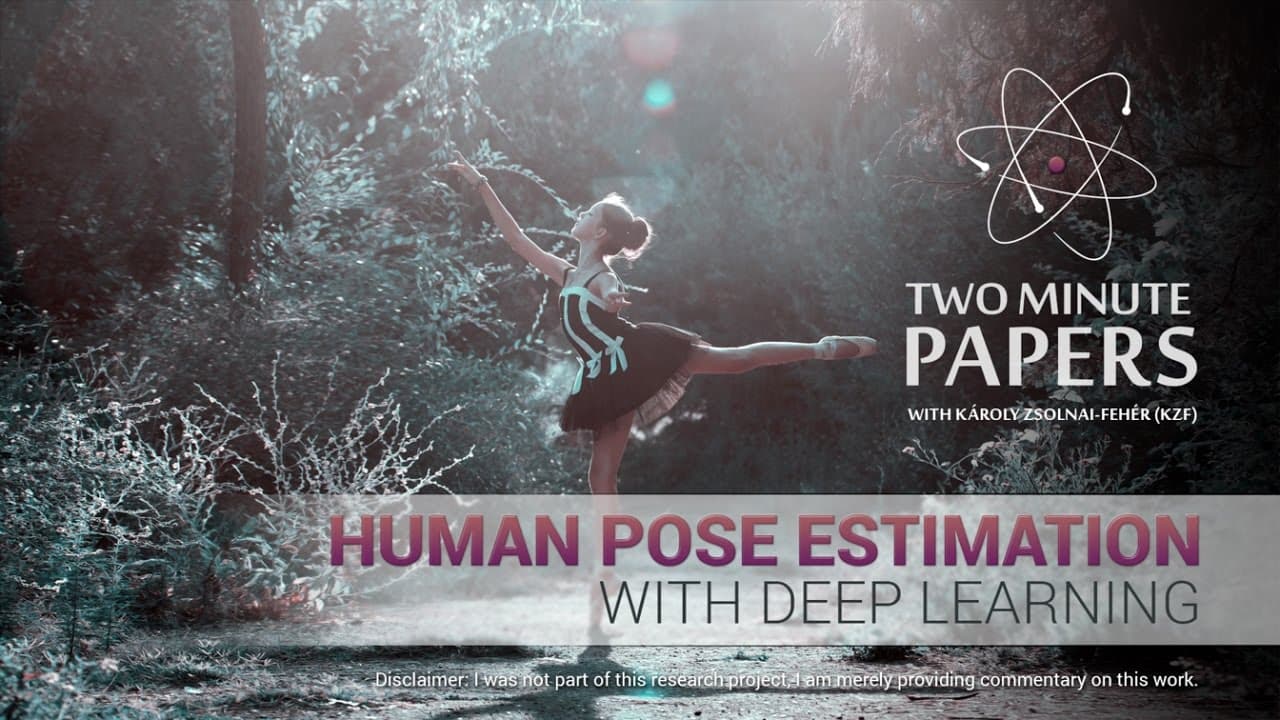
How Does Human Pose Estimation With Deep Learning Work? | Two Minute Papers #106
TL;DR
Human pose estimation with deep learning predicts individual joint positions from mostly 2D images, then uses optimization to reconstruct a coarse but faithful 3D human body, including its pose and body type. Constraints that prevent unnatural knee and elbow bends or self-intersections substantially reduce the solution space. Read on to understand the challenges, method, results, applications, and possible future of pose transfer.
Transcript
Dear Fellow Scholars, this is Two Minute Papers with Károly Zsolnai-Fehér. Pose estimation is an interesting area of research where we typically have a few images or video footage of humans, and we try to automatically extract the pose this person was taking. In short, the input is mostly a 2D image, and the output is typically a skeleton of the pe... Read More
Key Insights
- "In short, the input is mostly a 2D image, and the output is typically a skeleton of the person." (0:16)
- "It is coarse geometry, so don't expect a ton of details, but it's 3D geometry, more than what most other competing techniques can offer." (1:45)
- "If we use these constraints, the space in which we have to look for possible solutions shrinks considerably." (2:08)
- "The results show that this algorithm outperforms several other state of the art techniques by a significant margin." (2:14)
Install to Summarize YouTube Videos and Get Transcripts
Explore YouTube Video Summarizer or Get YouTube Transcript Extractor
Questions & Answers
Q: What is human pose estimation?
Human pose estimation automatically extracts the pose a person was taking from images or video footage. The input is mostly a 2D image, while the output is typically a skeleton of the person.
Q: How does deep learning estimate a 3D human pose from a 2D image?
A previously proposed convolutional neural network predicts the positions of individual joints. Optimization then uses those predicted positions to create a faithful representation of the 3D human body.
Q: What does the pose estimation method produce?
The method infers both the person's pose and body type. Its output is therefore full 3D geometry rather than only a skeleton, although that geometry is coarse and does not contain extensive detail.
Q: Why is reconstructing a human pose from a 2D image difficult?
The method must reconstruct 3D information from a simple 2D image. It must also handle ambiguous lighting, occlusions, and clothing that covers the body.
Q: How does the optimization reduce the computational burden?
The optimization assumes constraints that apply to healthy human bodies. These constraints avoid unnatural knee and elbow bends and self-intersections, considerably shrinking the space of possible solutions.
Q: How does this algorithm compare with other pose estimation techniques?
The reported results show that the algorithm outperforms several other state-of-the-art techniques by a significant margin. It also provides coarse full 3D geometry, which the transcript says is more than most competing techniques can offer.
Q: What are the applications of human pose estimation?
Applications include automatically creating assets for computer games and digital media, analyzing and coaching athletic techniques, and helping computers interpret visual scenes for robotics and machine learning. The technique could also help preserve and recreate historic events digitally and support artists.
Q: What future applications could pose and skeleton transfer enable?
Future machine learning applications could take a real-world video of a person and transfer or modify the person's pose or skeleton. This could make it possible to edit the video and manipulate how its characters move, and exploratory work in this area already exists.
Summary & Key Takeaways
-
Pose estimation involves extracting the pose of a person from 2D images or video footage.
-
This paper proposes using a convolutional neural network to predict joint positions and optimize them to create a 3D representation of the human body.
-
The algorithm outperforms other state-of-the-art techniques and has potential applications in digital preservation, computer games, and art.
Read in Other Languages (beta)
Share This Summary 📚
Summarize YouTube Videos and Get Video Transcripts with 1-Click
Try YouTube Summary with ChatGPT & Claude or YouTube Transcript Generator
Explore More Summaries from Two Minute Papers 📚


Summarize YouTube Videos and Get Video Transcripts with 1-Click
Try YouTube Summary with ChatGPT & Claude or YouTube Transcript Generator