How Do MRI Machines Work?
TL;DR
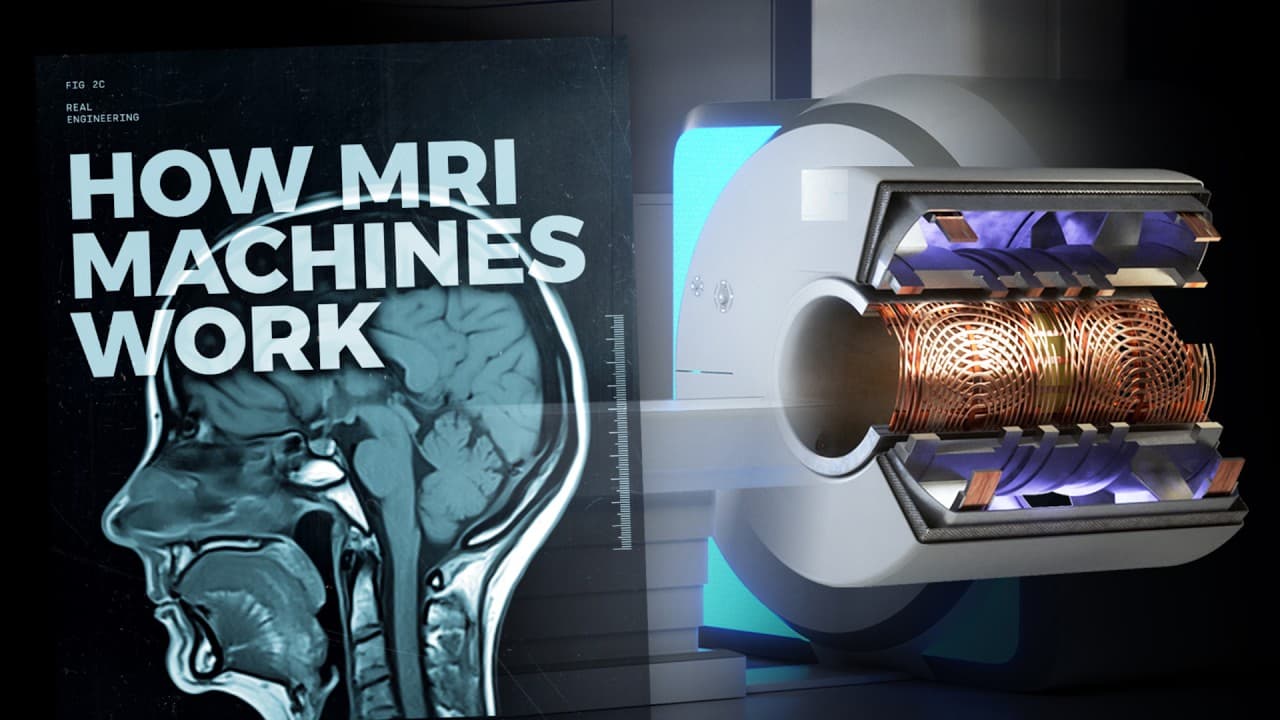
MRI machines use strong magnetic fields and radio waves to image the body's internal structures. They exploit the quantum properties of hydrogen atoms, aligning them in a magnetic field and detecting signals from their decay. This non-invasive method provides high-resolution images without harmful radiation, revolutionizing medical diagnostics and treatment.
Transcript
You are probably familiar with magnetic resonance imaging machines, either through the claustrophobic sensation of being inside one or from seeing the incredibly high detail cross sections of the human body they provide. . MRIs have completely changed how we view and understand our bodies. It has never been easier to visualize organs with such high... Read More
Key Insights
- MRI machines use strong magnetic fields and radio waves to image the body.
- Hydrogen atoms in the body are aligned in a magnetic field for imaging.
- The MRI signal is derived from the quantum property called spin.
- Superconducting magnets are crucial for creating strong magnetic fields.
- MRI machines use liquid helium to maintain superconducting temperatures.
- Gradient coils create magnetic field variations for imaging slices.
- MRIs exploit T1 and T2 relaxation times to contrast different tissues.
- Fourier analysis helps reconstruct 2D images from MRI signals.
Install to Summarize YouTube Videos and Get Transcripts
Explore YouTube Video Summarizer or Get YouTube Transcript Extractor
Questions & Answers
Q: How do MRI machines create images?
MRI machines create images by using strong magnetic fields and radio waves to align hydrogen atoms in the body. The quantum property called spin is exploited, and signals from the atoms' decay are detected. Gradient coils create variations in the magnetic field, allowing the machine to image specific slices. Fourier analysis is then used to reconstruct 2D images from these signals.
Q: What role do superconducting magnets play in MRI machines?
Superconducting magnets are essential in MRI machines as they create the strong magnetic fields necessary for imaging. These magnets are made from materials like Niobium-titanium, which exhibit zero electrical resistance at extremely low temperatures. Liquid helium is used to maintain these low temperatures, allowing the magnets to operate continuously without power consumption.
Q: Why is liquid helium used in MRI machines?
Liquid helium is used in MRI machines to maintain the superconducting state of the magnets. Superconducting materials require extremely low temperatures to exhibit zero electrical resistance. Liquid helium, at minus 269 degrees Celsius, provides the necessary cooling, ensuring the magnets remain superconducting and allowing the MRI machine to operate efficiently without consuming power.
Q: How do MRI machines contrast different tissues?
MRI machines contrast different tissues by exploiting the T1 and T2 relaxation times of hydrogen atoms. T1 relaxation measures how quickly atoms realign with the magnetic field, while T2 decay measures the dephasing of spins due to interactions. By adjusting the pulse repetition and listening times, technicians can emphasize either T1 or T2 signals, highlighting different tissue types in the images.
Q: What is the significance of the spin property in MRI imaging?
The spin property is significant in MRI imaging as it is a quantum characteristic of hydrogen atoms that makes them behave like tiny magnets. When placed in a magnetic field, these spins align, and their subsequent decay produces a signal that can be detected. This signal is the basis for creating detailed images of the body's internal structures, making spin a crucial element in MRI technology.
Q: How does Fourier analysis contribute to MRI imaging?
Fourier analysis contributes to MRI imaging by deconstructing complex signals into simpler components. In MRI, this mathematical framework is used to reconstruct 2D images from the sum of signals collected from spinning hydrogen atoms. By analyzing these signals as combinations of simpler waves, Fourier analysis allows the MRI machine to create detailed visualizations of internal body structures.
Q: What advancements have been made in MRI technology?
Advancements in MRI technology include the development of zero boil-off machines that eliminate the need for regular helium refills, and the use of stronger superconducting magnets for higher resolution imaging. Researchers are also working on making MRI machines smaller and more affordable, which could revolutionize medical imaging by making it more accessible in various settings.
Q: Why is MRI considered a revolutionary tool in medicine?
MRI is considered a revolutionary tool in medicine because it provides high-resolution, non-invasive imaging of the body's internal structures without the use of harmful radiation. This allows for safer and more accurate diagnosis and treatment planning. The ability to visualize organs and tissues in detail has significantly improved medical diagnostics and has expanded the possibilities for patient care.
Summary & Key Takeaways
-
MRI machines utilize strong magnetic fields and radio waves to create detailed images of the body's internal structures. They exploit the quantum properties of hydrogen atoms, aligning them in a magnetic field and detecting signals from their decay. This high-resolution imaging technique is non-invasive and free from harmful radiation, making it a revolutionary tool in medical diagnostics.
-
The technology behind MRI machines involves superconducting magnets and gradient coils, which are essential for creating strong magnetic fields and imaging slices. MRI machines use liquid helium to maintain the superconducting state of the magnets, allowing for continuous operation without power consumption.
-
MRI imaging relies on the quantum property of spin in hydrogen atoms, with T1 and T2 relaxation times used to contrast different tissues. Fourier analysis is employed to reconstruct 2D images from the MRI signals, enabling detailed visualization of the body's internal structures.
Read in Other Languages (beta)
Share This Summary 📚
Summarize YouTube Videos and Get Video Transcripts with 1-Click
Try YouTube Summary with ChatGPT & Claude or YouTube Transcript Generator
Explore More Summaries from Real Engineering 📚






Summarize YouTube Videos and Get Video Transcripts with 1-Click
Try YouTube Summary with ChatGPT & Claude or YouTube Transcript Generator