How to Build High-ROI AI Agents That Work
TL;DR
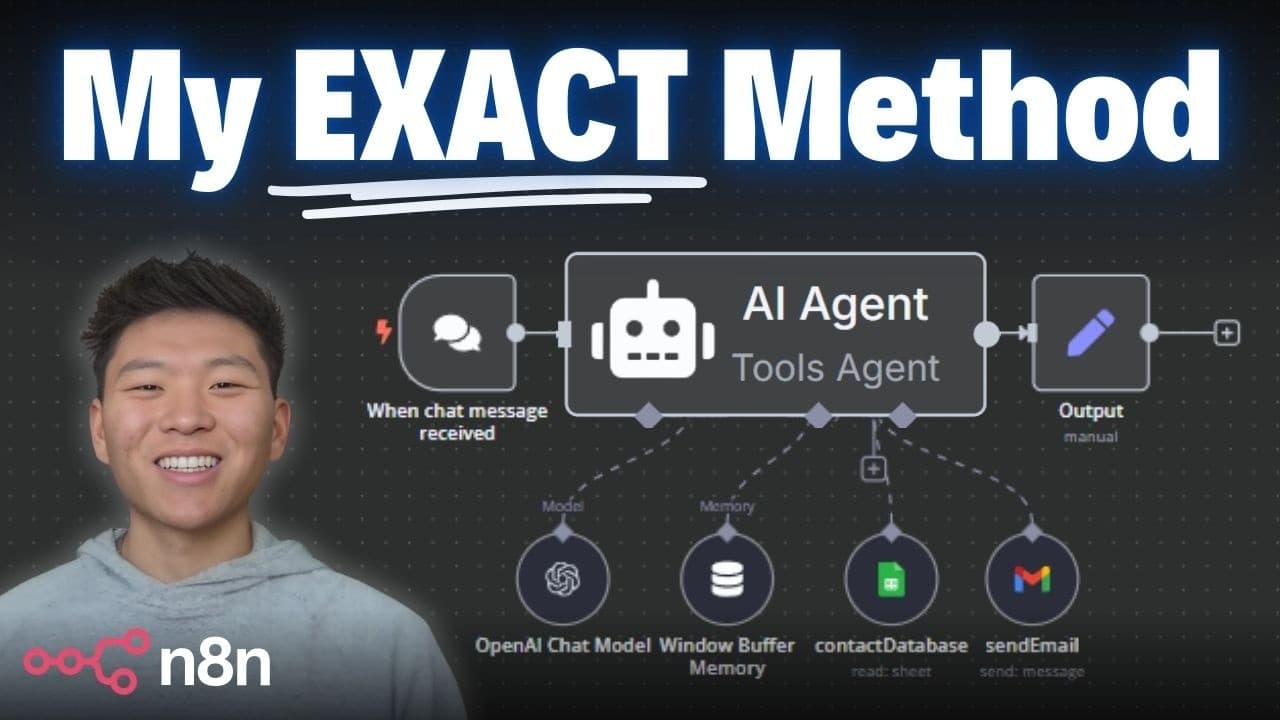
Build effective AI agents by learning the foundations, selecting a repetitive and scalable business process, mapping every step, planning the architecture, and testing a proof of concept with guardrails. Focus on producing practical value rather than mastering every technical detail, and use JSON, APIs, retrieval, and suitable language models only where the mapped process requires them.
Transcript
These are the five steps I always use when building AI agents, and they've helped me generate over $240,000 in the past 6 months. In this video, I'm going to be giving you the exact framework that I use so you can start to build some powerful AI systems, even if you're not technical. I used this method to build all of the automations you've seen on... Read More
Key Insights
- AI agent development starts with foundational knowledge of language models, data, APIs, HTTP requests, JSON, retrieval-augmented generation, and vector databases. Attempting a complex system before understanding a basic API call creates avoidable difficulty during implementation and troubleshooting.
- Large language models predict the next word or token but cannot independently take action in external systems. Builders must determine when AI is actually needed, then connect the model to appropriate tools or services when the process requires real-world actions.
- Model selection depends on the client, the automation, and the required capability. Open-source and closed-source model families have different strengths and weaknesses, so an automation may switch models instead of treating one language model as universally suitable.
- Retrieval-augmented generation uses semantic similarity to find relevant text stored in a vector database. Documents are divided into chunks, processed by an embedding model, and stored according to meaning, allowing an agent to answer from supplied material instead of relying only on training data.
- Practical understanding is more important than mastering every internal calculation. A builder needs to know how inputs affect outputs and how prompts or parameters improve performance, but does not need detailed knowledge of model weights or the mathematical formulas behind semantic search.
- JSON and APIs are essential for moving information beyond a no-code automation environment. Most API interactions send and receive JSON, whose objects use key-value pairs and whose arrays hold lists, making JSON literacy valuable for connecting services such as Gmail or HubSpot.
- High-ROI automation opportunities are repetitive, time-consuming, error-prone, and scalable. Scalability matters because the system can process more work as the business grows, increasing the amount of employee time and money saved rather than delivering only a fixed benefit.
- Process mapping is an instruction manual for implementation. Listing every step, decision, alternate path, data source, action, and destination reveals bottlenecks and edge cases before development, improves modularity, and reduces hands-on build time in the chosen automation platform.
Install to Summarize YouTube Videos and Get Transcripts
Explore YouTube Video Summarizer or Get YouTube Transcript Extractor
Questions & Answers
Q: How do you build a high-ROI AI agent?
Build a high-ROI AI agent through five stages: learn the foundations, identify a valuable automation opportunity, map the entire process, plan the architecture, and create a proof of concept with guardrails. The target process should be repetitive, time-consuming, error-prone, and scalable. Mapping every trigger, decision, data source, action, alternate path, and destination before development makes the final system clearer and more efficient to implement.
Q: What foundations are needed before building AI agents?
The required foundations include a high-level understanding of large language models, data, JSON, APIs, HTTP requests, retrieval-augmented generation, and vector databases. Builders should understand that language models predict tokens and cannot take external action by themselves. They should also be able to read JSON and configure API requests, since these skills allow an automation platform to exchange data with external servers and services.
Q: Why are JSON and APIs important for AI automation?
JSON and APIs allow an automation to communicate with external services rather than remain confined to its original platform. API requests commonly send and return data as JSON, which represents information through key-value pairs and arrays. Understanding that structure makes it easier to connect systems such as Gmail or HubSpot, search the web, inspect responses, diagnose errors, and ask a language model for targeted help when JSON becomes confusing.
Q: How does retrieval-augmented generation use vector databases?
Retrieval-augmented generation searches a supplied text collection by semantic similarity rather than relying only on keyword matches. Documents are divided into chunks, passed through an embedding model, and placed in a vector database according to their meaning. An AI agent can retrieve relevant chunks and use that material to prepare an answer, reducing its dependence on information contained only in the language model's training data.
Q: How do you identify a good process for AI automation?
A good process for AI automation meets four tests: it is repetitive, time-consuming, error-prone, and scalable. The scalable test is especially important because the benefit can increase with business volume. A system connected to a growing sales process, for example, may handle progressively more leads and return more working hours to the sales team for activities that have a greater impact on growth.
Q: Why does scalability increase automation ROI?
Scalability increases automation ROI because time and money savings grow as more work passes through the system. The example describes a sales automation processing 50 leads and saving five hours per week. If volume rises to 200 leads, the savings could rise to 20 hours per week. Those recovered hours can support higher-impact activities, which may contribute to additional business growth and further system usage.
Q: How should an AI automation process be mapped?
Map the process by documenting every step in the way a person or team currently completes the work, including small actions. Begin with the event that triggers the process, then identify data sources, decisions, alternate paths, required actions, and the final data destination. This creates an implementation guide, reveals bottlenecks and edge cases early, improves scalability and modularity, and reduces time spent improvising during development.
Q: How can customer support email automation be designed?
A customer support email automation can begin when a new email arrives. A text classifier determines whether the message concerns support and routes unrelated messages to the correct team. For support requests, an AI agent retrieves relevant information from a Pinecone vector database and drafts a helpful response. The workflow then applies a tracking label and sends the reply through Gmail, preserving explicit decision paths and a defined final destination.
Summary & Key Takeaways
-
The five-step method begins with foundational knowledge of language models, data, JSON, APIs, HTTP requests, retrieval-augmented generation, and vector databases. Builders need enough understanding to connect systems and improve their outputs, but they do not need to master the mathematics, training parameters, or internal weights behind every technology.
-
A strong automation opportunity is repetitive, time-consuming, error-prone, and scalable. Scalability is especially valuable because savings can increase as the business grows. A sales system handling more leads, for example, can return progressively more time to employees for higher-impact work that supports further business growth.
-
Before development, the entire manual process should be mapped in detail, including triggers, data sources, decisions, alternate paths, actions, and final destinations. The resulting instruction manual exposes bottlenecks and edge cases, supports modularity, and makes implementation more efficient. Architecture planning, proof-of-concept testing, and guardrails complete the five-step framework.
Read in Other Languages (beta)
Share This Summary 📚
Summarize YouTube Videos and Get Video Transcripts with 1-Click
Try YouTube Summary with ChatGPT & Claude or YouTube Transcript Generator
Explore More Summaries from Nate Herk | AI Automation 📚




Summarize YouTube Videos and Get Video Transcripts with 1-Click
Try YouTube Summary with ChatGPT & Claude or YouTube Transcript Generator