How Do Foundational LLMs Generate Text?
TL;DR
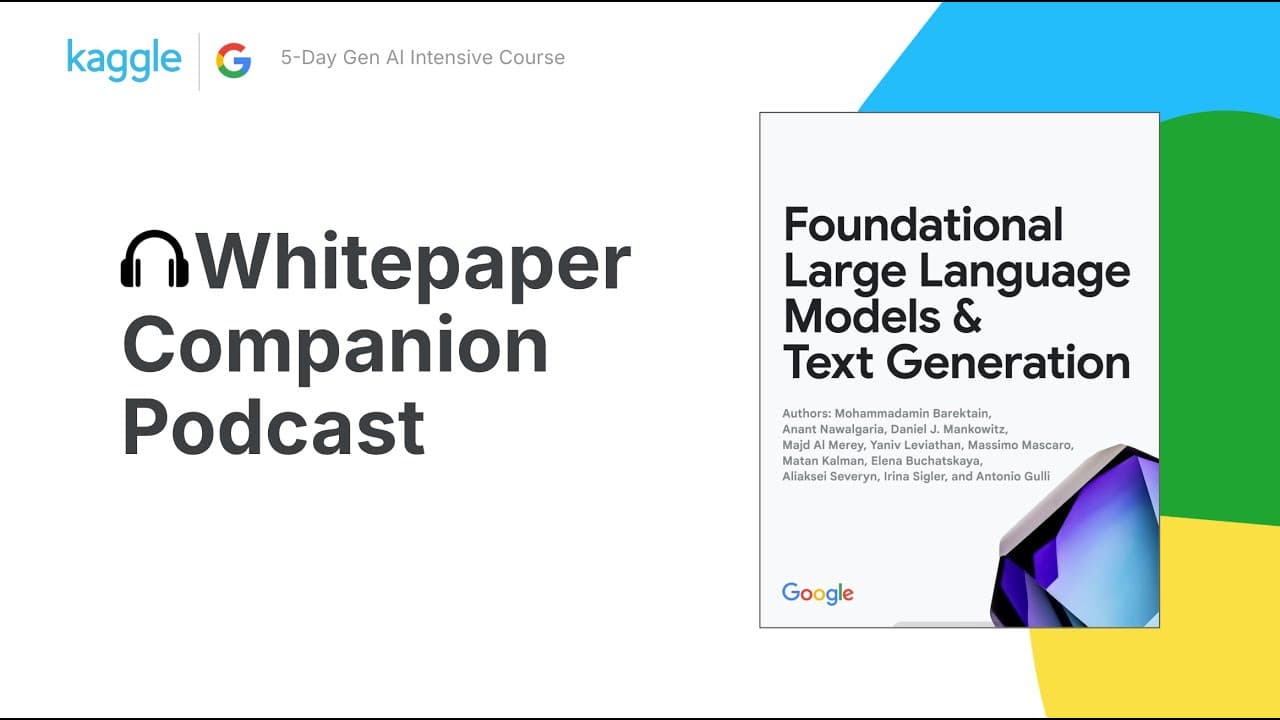
Large Language Models (LLMs) are transforming text generation by using Transformer architecture, which processes text as tokens with embeddings. Key features include multi-head attention, layer normalization, and residual connections. These models evolve through pre-training on vast datasets and fine-tuning for specific tasks, with techniques like parameter-efficient tuning and prompt engineering enhancing efficiency and adaptability.
Transcript
all right welcome everyone to the Deep dive today we're uh taking a deep dive into something pretty huge foundational large language models or llms and how they create text I mean it seems like they're popping up everywhere right changing how we write code how we even write stories yeah the advancements have been uh incredibly fast it's hard to kee... Read More
Key Insights
- Transformers are foundational to modern LLMs, originating from a 2017 Google project for language translation.
- Tokens are the basic units of text processing in LLMs, converted into embeddings to capture meaning.
- Multi-head attention allows models to focus on different relationships within text, enhancing understanding.
- Pre-training involves learning language patterns from massive datasets, while fine-tuning specializes models for tasks.
- Parameter-efficient fine-tuning techniques reduce computational costs by training only parts of the model.
- Prompt engineering optimizes input design to improve the relevance and quality of model responses.
- Evaluation of LLMs involves multifaceted metrics, including human-like judgment and AI-powered evaluators.
- Inference optimization techniques, like quantization and speculative decoding, enhance model response speed.
Install to Summarize YouTube Videos and Get Transcripts
Explore YouTube Video Summarizer or Get YouTube Transcript Extractor
Questions & Answers
Q: How do transformers process text in LLMs?
Transformers process text by converting it into tokens, which are then transformed into dense vectors called embeddings that capture their meaning. The model uses multi-head attention to analyze relationships between tokens, allowing it to understand context and generate coherent text. This parallel processing makes transformers highly effective for language tasks.
Q: What is the role of pre-training in LLMs?
Pre-training in LLMs involves exposing the model to vast amounts of text data without labels, allowing it to learn general language patterns and structures. This phase is resource-intensive but crucial for building a foundational understanding of language, which can then be fine-tuned for specific tasks like translation or summarization.
Q: How does fine-tuning enhance LLM performance?
Fine-tuning adapts a pre-trained LLM to specific tasks by training it on a smaller, targeted dataset with labeled examples. This process refines the model's abilities, making it an expert in particular areas such as question answering or creative writing, while also shaping its behavior to be more aligned with human expectations.
Q: What is parameter-efficient fine-tuning?
Parameter-efficient fine-tuning is a method that allows LLMs to be adapted to new tasks without retraining the entire model. Techniques like adapter-based fine-tuning and low-rank adaptation modify only a small part of the model, significantly reducing computational costs while maintaining or improving performance on specific tasks.
Q: Why is prompt engineering important in LLMs?
Prompt engineering is crucial because it involves crafting the input to the LLM in a way that elicits the desired output. Effective prompts can significantly enhance the relevance and quality of the model's responses, making it a key skill for leveraging LLM capabilities in practical applications across various domains.
Q: How are LLMs evaluated for performance?
LLMs are evaluated using a combination of traditional metrics, human judgments, and AI-powered evaluators. These evaluations consider factors like fluency, coherence, and creativity. The process often involves comparing model outputs to ground truth answers and assessing their quality based on task-specific criteria and real-world applicability.
Q: What techniques optimize LLM inference speed?
Inference speed in LLMs is optimized through techniques like quantization, which reduces numerical precision, and speculative decoding, which uses smaller models to predict future tokens. Other methods include flash attention, prefix caching, and parallelization, all aimed at reducing latency and improving the efficiency of model responses.
Q: What are some applications of LLMs in practice?
LLMs are used in diverse applications such as code generation, machine translation, text summarization, and content creation. They enhance conversational AI, enable more natural dialogue, and assist in fields like education and research. With multimodal capabilities, LLMs also integrate text with images, audio, and video, broadening their impact.
Summary & Key Takeaways
-
Large Language Models (LLMs) use Transformer architecture to process and generate text, transforming AI's role in language tasks. Key features include multi-head attention and embeddings, which allow models to understand complex text relationships. Pre-training and fine-tuning enable models to learn language patterns and specialize in specific tasks, respectively.
-
Techniques like parameter-efficient fine-tuning and prompt engineering make LLMs adaptable and efficient. These methods allow for targeted training and improved input design, enhancing model performance while reducing computational costs. Evaluation frameworks assess model quality through diverse metrics, including human and AI judgments.
-
Inference optimization is crucial for practical LLM applications, with methods like quantization and speculative decoding speeding up response times. LLMs are used in various fields, including code generation, translation, and content creation, with multimodal capabilities expanding their potential applications across text, images, audio, and video.
Read in Other Languages (beta)
Share This Summary 📚
Summarize YouTube Videos and Get Video Transcripts with 1-Click
Try YouTube Summary with ChatGPT & Claude or YouTube Transcript Generator
Explore More Summaries from Kaggle 📚
Summarize YouTube Videos and Get Video Transcripts with 1-Click
Try YouTube Summary with ChatGPT & Claude or YouTube Transcript Generator