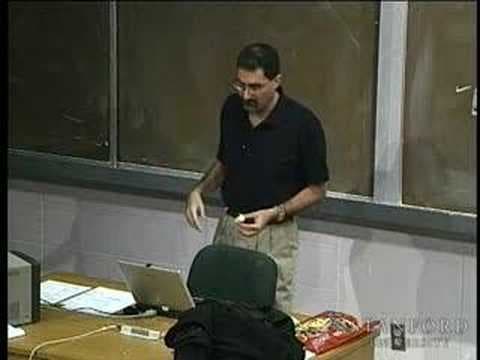
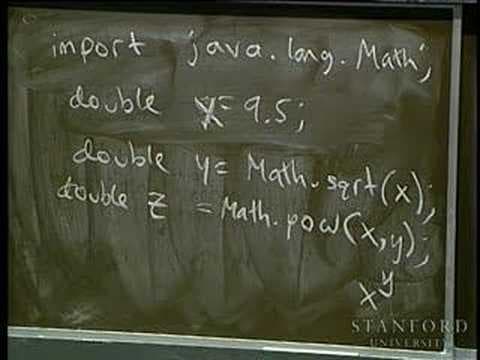
Lecture 5 | Programming Methodology (Stanford)

Transcript
this presentation is delivered by the Stanford center for professional development all right today we're actually going to go over some more of the graphic stuff you saw talk a little bit more about objects and classes and get into variables and values and all kinds of goodies any questions all righty then let's just Dive Right In so one of the mai... Read More
Install to Summarize YouTube Videos and Get Transcripts
Explore YouTube Video Summarizer or Get YouTube Transcript Extractor
Summary
In this video, the presenter discusses variables, types, and objects in the context of computer programming. They explain how variables are boxes that store data, and how they are given a name, a type, and a value. They also discuss the rules for naming variables in Java and the importance of using descriptive names. The presenter explains different types of variables, such as int, double, boolean, and char. They also explain how variables can be assigned and manipulated using assignment statements. The video then introduces objects, which are instances of classes. The presenter demonstrates how to declare variables of object types and how to use methods to interact with objects. They also discuss object hierarchies and how objects can have different behaviors depending on their class. Finally, the presenter shows examples of how to create and manipulate graphical objects using the GLabel, GRect, and GOval classes.
Questions & Answers
Q: What is a variable and how is it used in computer science?
A variable is a box that stores data in computer science. It has a name, a type, and a value. It can be assigned a value, and that value can be changed. Variables are used to store and manipulate data in computer programs.
Q: How are variable names determined in Java?
Variable names in Java must start with a letter or an underscore, followed by any number of letters, numbers, or underscores. They cannot be the same as reserved keywords in Java and should be descriptive to aid understanding of their purpose.
Q: What are some of the basic types of variables in computer science?
Some basic types of variables in computer science are int (for integers), double (for real numbers), boolean (for logical values), and char (for characters). These types determine the kind of data that can be stored in the variable.
Q: How are values assigned to variables in Java?
Values can be assigned to variables in Java using assignment statements. The value is specified on the right-hand side of the equals sign (=), and the variable name is specified on the left-hand side. The value is then stored in the variable.
Q: What is the significance of the type in a variable declaration?
The type of a variable determines the kind of data that can be stored in it. It also dictates what operations can be performed on the variable. The type ensures that the variable is used in a meaningful and consistent way.
Q: What are objects in computer programming?
Objects are instances of classes in computer programming. They encapsulate data and behavior together. They have their own properties and can perform specific actions or methods. Objects can be created from classes and can interact with each other.
Q: How are objects represented in variable declarations?
Objects can be represented in variable declarations by using the class name as the type of the variable. The variable holds a reference to the object, which can be used to interact with its properties and methods.
Q: What is the purpose of a constructor?
A constructor is a special method in a class that is used to create and initialize objects. It is called when a new object is created and can take parameters to set initial values for the object's properties.
Q: How can objects of different classes have different behaviors?
Objects of different classes can have different behaviors because they have different methods defined in their respective classes. Each class can have its own set of methods that define how the object behaves and interacts with other objects.
Q: How can graphical objects be created and manipulated in Java?
Graphical objects can be created and manipulated in Java using specialized classes such as GLabel, GRect, and GOval. These classes have methods that allow you to set properties like color, location, and font, as well as methods for adding the objects to a graphics canvas.
Takeaways
Variables are boxes that store data and can be assigned and manipulated in computer programs. They have a name, a type, and a value. In Java, variable names must follow specific rules and it is recommended to use descriptive names. There are different types of variables, such as int, double, boolean, and char, which determine the kind of data that can be stored. Objects are instances of classes and can have different behaviors depending on their class. Objects can be created and manipulated using methods specific to their class. Graphical objects can be created and manipulated using specialized classes like GLabel, GRect, and GOval.
Read in Other Languages (beta)
Share This Summary 📚
Summarize YouTube Videos and Get Video Transcripts with 1-Click
Try YouTube Summary with ChatGPT & Claude or YouTube Transcript Generator
Explore More Summaries from Stanford 📚


Summarize YouTube Videos and Get Video Transcripts with 1-Click
Try YouTube Summary with ChatGPT & Claude or YouTube Transcript Generator