Statistical Mechanics Lecture 2
TL;DR
Temperature is not a fundamental quantity but a measure of energy, and the Boltzmann constant is just a conversion factor linking human temperature units to energy. The kinetic energy of a molecule in a dilute gas equals three-halves the Boltzmann constant times temperature, and its value is about 1.4 x 10^-23 Joules per degree Kelvin.
Transcript
Stanford University let's spend a few minutes talking about units um in particular the boltzman constant what is the boltzman constant the boltzman constant like most or like many constants in uh in physics are conversion factors uh the speed of light is a conversion factor you know that and um the conversion factor from uh distances to uh to times... Read More
Key Insights
- The Boltzmann constant is a conversion factor, much like the speed of light, that translates human-scale units into more fundamental physical units. It bridges everyday temperature measurements, convenient for human access, and the underlying energy scale of individual molecules.
- Temperature is really a measure of energy, not a fundamental quantity of its own. The temperature of a gas determines the kinetic energy of its molecules, so the natural units for temperature are energy units such as Joules.
- At thermal equilibrium at a fixed temperature, all atoms have basically the same kinetic energy regardless of type. In a mix of helium and oxygen, both species share the same kinetic energy, a result the lecture says will be proven later.
- A bowling ball suspended in a gas or liquid at finite temperature has the same kinetic energy as a single oxygen atom, but moves far slower because its mass is much larger. Since mv-squared is equal, the heavier object moves slower.
- The kinetic energy of a molecule in a dilute gas equals three-halves the Boltzmann constant times temperature. The factor of three comes from the three dimensions of space (x, y, z axes), while the half is a definitional glitch.
- The Boltzmann constant is about 1.4 x 10^-23 Joules per degree Kelvin, a very small number. This smallness reflects how tiny a single molecule's energy is at room temperature, which is 300 degrees Kelvin.
- Redefining temperature as capital T equal to the Boltzmann constant times Kelvin temperature gives temperature units of energy and removes the Boltzmann constant from all equations. You recover human units by treating capital T as k_Boltzmann times Kelvin temperature.
- Boltzmann's entropy equals one over the Boltzmann constant times Carnot's entropy. Carnot, a steam engineer, defined entropy in energy-over-temperature units (Joules per Kelvin), while modern physics measures entropy in dimensionless bits, with a fundamental unit of logarithm of two.
Install to Summarize YouTube Videos and Get Transcripts
Explore YouTube Video Summarizer or Get YouTube Transcript Extractor
Questions & Answers
Q: What is the Boltzmann constant?
The Boltzmann constant is a conversion factor, like the speed of light, that converts what the lecture calls human units into more fundamental physical units. Human units are convenient for scales that people can access easily. Specifically, the Boltzmann constant converts between human-scale temperature measurements and the underlying energy of molecules. Its value is about 1.4 x 10^-23 Joules per degree Kelvin, a very small number reflecting how little energy a single molecule carries.
Q: Why is temperature considered a form of energy?
Temperature is really a measure of an amount of energy rather than a fundamental quantity of its own. For example, the temperature of a gas determines the kinetic energy of its molecules, so one measure of a gas's temperature is simply the kinetic energy of those molecules. Because of this, the natural units for temperature are energy units such as Joules. Historically the scale was defined before anyone realized temperature had to do with the energy of a basic constituent.
Q: How does the kinetic energy of a molecule relate to temperature in a dilute gas?
The kinetic energy of a single molecule in a dilute gas equals three-halves the Boltzmann constant times the temperature. The gas is taken as dilute so interactions between molecules can be ignored. The factor of three comes from the three dimensions of space, since the molecule has kinetic energy for moving along the x, y, and z axes. The half is described in the lecture as just a glitch of definition.
Q: Do different types of atoms in a gas have the same kinetic energy at a fixed temperature?
Yes. At thermal equilibrium at a fixed temperature, all of the atoms have basically the same kinetic energy regardless of their type. In a gas that is a composite of helium and oxygen, for instance, the helium atoms and oxygen atoms share the same kinetic energy even though they are different. The lecture notes this will be proven eventually. Helium is chosen in the example specifically because it will not explode when mixed with oxygen.
Q: Why does a bowling ball in a gas move slower than a molecule if they share the same energy?
A bowling ball suspended at finite temperature in a gas or liquid has exactly the same kinetic energy as a single oxygen atom, but it moves much slower because its mass is far larger. Since mv-squared for the bowling ball equals mv-squared for the oxygen molecule, and the bowling ball's mass is much larger, its velocity must be much smaller. The main point remains that temperature measures an amount of energy shared equally at equilibrium.
Q: What is the value of the Boltzmann constant and why is it so small?
The Boltzmann constant is about 1.4 x 10^-23 Joules per degree Kelvin. It is very small because at room temperature, which is 300 degrees Kelvin, the energy of a single molecule is extremely tiny. Since 300 is a fairly large number and the molecular energy is so small, the Boltzmann constant that connects them must be very small. The lecture notes it is no accident that Avogadro's number is also roughly 10 to the 23rd.
Q: How can the Boltzmann constant be removed from physics equations?
You can redefine a new unit of temperature, called capital T, as the Boltzmann constant times the human temperature in Kelvin. Once you do this, capital T has units of energy, and the Boltzmann constant disappears from all equations and is never seen again. To convert back to human units, whenever you see capital T you think of it as the Boltzmann constant times temperature in Kelvin. You just have to remember this temperature differs from thermometer temperature by a very small factor.
Q: How does Carnot's entropy relate to Boltzmann's statistical entropy?
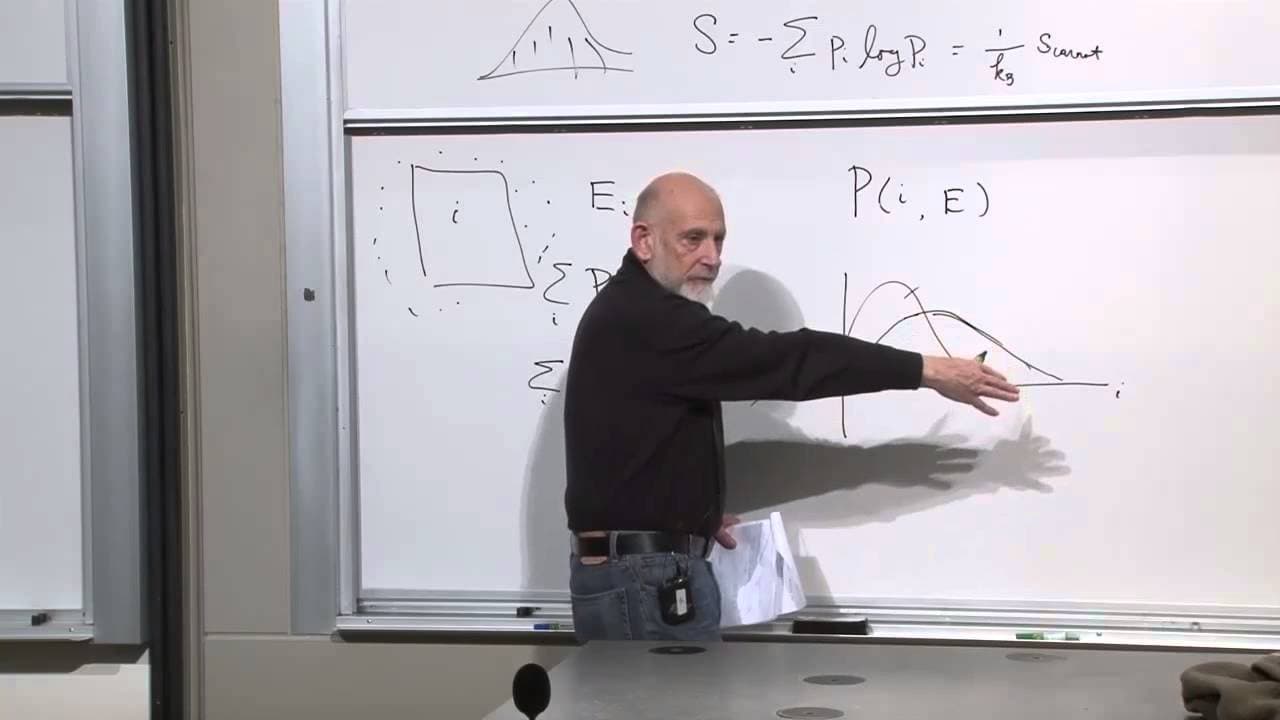
Boltzmann's entropy equals one over the Boltzmann constant times Carnot's entropy. Carnot, a steam engineer who designed steam engines, defined entropy in units of energy divided by temperature, or Joules per Kelvin, without knowing its microscopic basis. In modern physics entropy is measured in bits and is dimensionless, with a fundamental unit of the logarithm of two. Boltzmann's statistical entropy is defined as minus the sum over states of P_i times the logarithm of P_i, and it is enormous, roughly proportional to the number of molecules, when Carnot's entropy is a normal number like six.
Summary
In this video, the speaker discusses the Boltzmann constant and temperature, explaining their definitions and connections. He describes how temperature is a derived quantity and introduces the concept of entropy. The speaker also explains the relationship between energy and temperature, as well as the monotonically increasing functions of energy and entropy. He then defines temperature in terms of energy and entropy, showing how they are related.
Questions & Answers
Q: What is the connection between the Boltzmann constant and temperature?
The Boltzmann constant, like other constants in physics, is a conversion factor. It helps us convert between human units and more fundamental units. In the case of temperature, the Boltzmann constant acts as a conversion factor from human units to energy units. Temperature is related to the kinetic energy of molecules in a gas, and the Boltzmann constant allows us to measure and compare temperature in terms of energy.
Q: Why is temperature typically measured in Kelvin units or centigrade?
Temperature is measured in Kelvin units because it is relative to absolute zero. Centigrade is another term for Celsius, and it is also relative to the freezing point and boiling point of water, which are arbitrary choices. Kelvin and Celsius scales are related by a linear equation, making them equivalent. The choice of water as the reference point for temperature is convenient, but it could have been any other substance.
Q: What are human units of temperature?
Human units of temperature are units that were invented for convenience in measuring and understanding temperature. They are easy to measure with human-scale thermometers that are made up of many atoms. The degree Kelvin is a human construct invented for convenience in measuring temperature changes. It is a reference point for energy and a unit of temperature change that can be easily manipulated and understood.
Q: Why is temperature a measure of energy?
Temperature is a measure of energy because the temperature of a gas, for example, determines the kinetic energy of its molecules. The temperature of a gas can be viewed as the average kinetic energy of its molecules. Although different types of molecules may have different kinetic energies, in thermal equilibrium at a fixed temperature, all atoms have roughly the same kinetic energy. Thus, temperature is a measure of the amount of energy present in a system.
Q: How is temperature defined in terms of energy and entropy?
Temperature is defined as the rate of change of energy with respect to entropy. It represents the amount of energy required to change the entropy of a system by a certain amount. This relationship can be expressed as de = T * ds, where de is the change in energy, ds is the change in entropy, and T is the temperature. Alternatively, it can be written as ds = 1/T * de. This equation shows that temperature is inversely proportional to the change in entropy with respect to energy.
Q: Why does the Boltzmann constant cancel out in the definition of temperature?
The Boltzmann constant cancels out in the definition of temperature because it is included in both the energy and entropy terms. In the definition de = T * ds, the Boltzmann constant appears in both the energy and entropy parts. When converting to more fundamental units, such as joules for energy, the Boltzmann constant cancels out, leaving only the units of temperature in the equation. This cancellation is why the Boltzmann constant is not seen in temperature-related formulas in standard thermodynamics textbooks.
Q: How does the entropy of a system change with the temperature?
The entropy of a system changes with temperature because it is directly related to the energy and the probability distribution of the system's states. When the temperature increases, the probability distribution of the states spreads out, leading to a higher entropy. Conversely, if the temperature decreases, the probability distribution becomes more focused, resulting in a lower entropy. This relationship between temperature and entropy allows us to understand how energy and randomness are connected.
Q: What happens when two systems of different temperatures are connected?
When two systems of different temperatures are connected, the energy will flow from the hotter system to the cooler system. This is a fundamental concept of temperature and is known as heat transfer. In thermal equilibrium, the rate of energy exchange between the systems becomes equal, and the two systems reach a stable, balanced state. The direction of energy transfer is determined by the difference in temperatures, with energy flowing from the higher temperature system to the lower temperature system.
Q: What does it mean for entropy to be additive?
Entropy is additive because it is a logarithmic measure of probabilities, and probabilities multiply. When two systems are combined, the total entropy of the combined system is the sum of the entropies of the individual systems. This additivity property allows us to analyze the entropy of complex systems by considering the entropies of their individual components. It also implies that the total entropy of an isolated system, which does not exchange energy or matter with its surroundings, will always increase over time.
Q: How does the change in energy relate to temperature and entropy when two systems equilibrate?
When two systems equilibrate, the change in energy is related to the temperature and entropy changes of each system. In the case of system A, the change in energy is equal to the temperature of system A times the change in entropy of system A. Similarly, for system B, the change in energy is equal to the temperature of system B times the change in entropy of system B. This relationship shows the close connection between energy, temperature, and entropy in describing the behavior of systems in thermal equilibrium.
Takeaways
Temperature is a derived quantity that measures the rate of change of energy with respect to entropy. It provides a measure of how much energy needs to be exchanged to change the entropy of a system by a certain amount. The Boltzmann constant is involved in the conversion between human units and more fundamental energy units. The relationship between temperature and entropy allows us to understand heat transfer and the equilibration of systems at different temperatures. Additionally, entropy is additive, and the change in energy during equilibration depends on the temperatures and entropy changes of the individual systems.
Summary & Key Takeaways
-
Constants like the Boltzmann constant and the speed of light are conversion factors between human-scale units, convenient for everyday measurement, and more fundamental units. Temperature scales such as Kelvin and Centigrade were invented before scientists understood that temperature is really energy, so the units were arbitrary human constructs based on things like the freezing and boiling of water.
-
Temperature measures the kinetic energy of molecules. In a dilute gas the kinetic energy of a molecule equals three-halves the Boltzmann constant times temperature, where three counts the dimensions of space. At thermal equilibrium all particles, from oxygen atoms to a bowling ball, share the same kinetic energy, differing only in speed because of mass.
-
The Boltzmann constant, about 1.4 x 10^-23 Joules per degree Kelvin, is very small because a single molecule's energy at 300 Kelvin room temperature is tiny. Redefining temperature as k_Boltzmann times Kelvin temperature makes temperature an energy and removes the constant from equations. The same conversion links Carnot's steam-engine entropy to Boltzmann's statistical entropy.
Read in Other Languages (beta)
Share This Summary 📚
Summarize YouTube Videos and Get Video Transcripts with 1-Click
Try YouTube Summary with ChatGPT & Claude or YouTube Transcript Generator
Explore More Summaries from Stanford 📚




Summarize YouTube Videos and Get Video Transcripts with 1-Click
Try YouTube Summary with ChatGPT & Claude or YouTube Transcript Generator