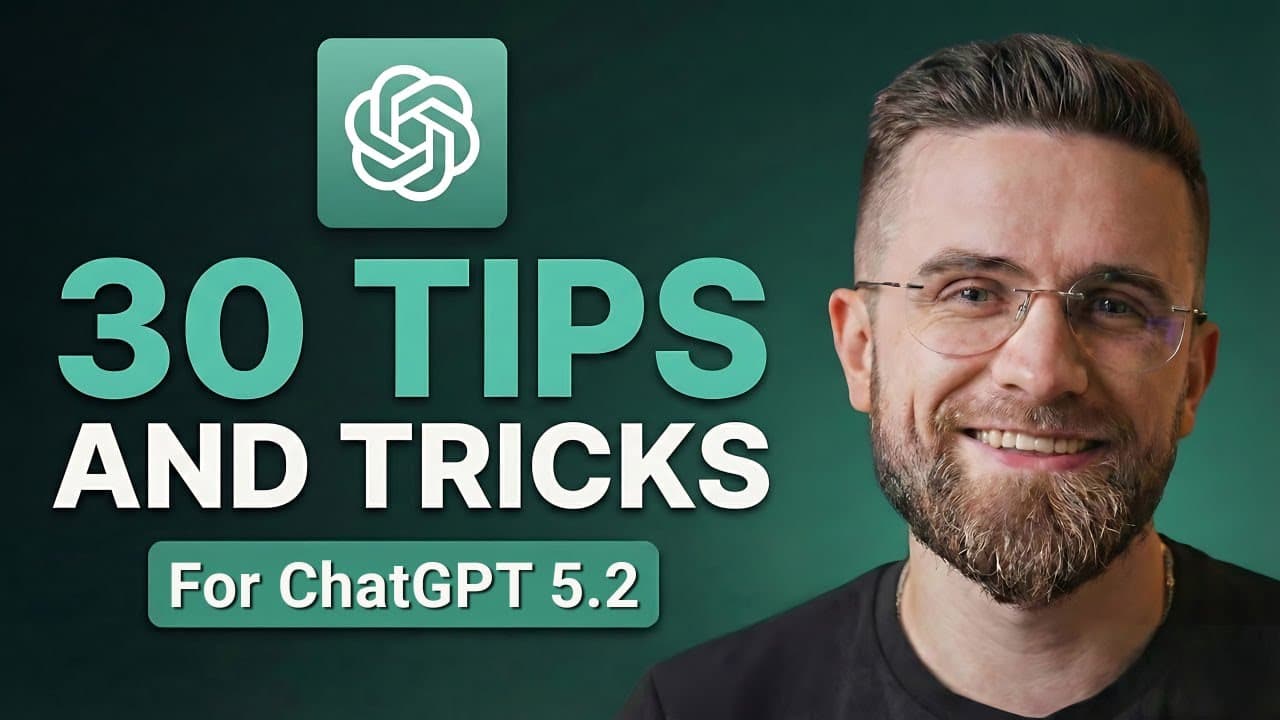
What Are the 30 ChatGPT 5.2 Hacks You Need to Know in 2026?
TL;DR
Better ChatGPT 5.2 prompts explicitly define the task, context, constraints, audience, tone, structure, and response length. The model is described as highly literal, so vague instructions often produce generic answers, while reasoning nudges, XML sections, and concrete requirements improve control. Read on for practical techniques covering deeper analysis, verbosity, complex workflows, and structured image prompts.
Transcript
After GBT 5.2 launched, millions of users reported something weird. They were getting worse results with the exact same prompts that worked perfectly on GBT5 and GPT4. Same questions, same instructions, worse outputs. Turns out, OpenAI made fundamental changes to the next GPT5's model architecture that broke the old prompting cookbook. The model no... Read More
Key Insights
- ChatGPT 5.2 is described as highly literal, with stronger instruction following and more disciplined execution than GPT-5 and GPT-5.1. That precision makes it important to state requirements directly because the model is less likely to infer missing expectations from a vague request.
- Vague prompts are likely to produce generic answers because they omit decisions about audience, length, tone, structure, and scope. A stronger prompt explicitly identifies these dimensions and requests useful considerations such as tax implications, liquidity risks, second-order effects, edge cases, and trade-offs.
- Explicit reasoning nudges are recommended for tasks where overlooked details could cost time, money, or credibility. The transcript identifies “think hard about this,” “think deeply about this,” and “think carefully about this” as phrases intended to trigger more extensive analysis.
- Output length is controllable through direct constraints rather than implied expectations. The examples request a bottom line in 100 words or less, a concise three-to-five-paragraph explanation, or a comprehensive 600-to-800-word breakdown for documentation, research summaries, and project briefs.
- XML tags work as labeled containers that distinguish background information from instructions. Sections such as task, context, constraints, output format, and tone reduce ambiguity by showing the model what each piece of supplied information represents and how it should influence the response.
- A structured interview-preparation prompt separates the requested task, resume, job description, output format, and tone. This organization lets the model relate candidate information to role requirements while producing a defined number of likely interview questions from the perspective of a hiring manager.
- Effective image prompts contain six components: subject, action, environment, art style, lighting, and details. The formula applies the same principles of specificity, structure, and constraints used for text prompts, allowing the user to exert greater control over the generated scene.
- Specific visual descriptions provide more control than broad labels. Instead of requesting an unspecified woman, the example defines a young woman in her late twenties with freckles and curly red hair, demonstrating how age, appearance, texture, color, and other concrete attributes guide image generation.
Install to Summarize YouTube Videos and Get Transcripts
Explore YouTube Video Summarizer or Get YouTube Transcript Extractor
Questions & Answers
Q: How do I write better prompts for ChatGPT 5.2?
State the task, context, constraints, audience, tone, structure, and desired length explicitly. ChatGPT 5.2 is described as highly literal, so it follows clear instructions precisely but does not reliably fill gaps in vague requests.
Q: Why can old prompts produce worse results with ChatGPT 5.2?
Prompts that worked with earlier models may leave important requirements unstated. The transcript says ChatGPT 5.2 is less likely to guess the intended length, tone, structure, or audience, which can make its answer technically correct but generic.
Q: How can I make ChatGPT 5.2 reason more deeply?
Add a direct reasoning nudge such as “think hard about this.” The transcript says ChatGPT 5.2 normally applies low or medium reasoning, while specific phrases can push it toward deeper analysis.
Q: What should a structured financial comparison prompt include?
Ask for the pros and cons, second-order effects, tax implications, and liquidity trade-offs. The example also requests a concise 3 to five paragraph explanation comparing a low-cost index fund with a money market account.
Q: How do I control the length of a ChatGPT 5.2 response?
Specify the desired length instead of leaving it for the model to infer. The transcript demonstrates this by requesting a concise 3 to five paragraph explanation.
Q: How do XML tags improve ChatGPT prompts?
XML structuring separates different prompt components into clearly labeled sections. The transcript presents it as a way to eliminate ambiguity, helping the model distinguish instructions, context, constraints, and formatting requirements.
Q: What advanced ChatGPT 5.2 prompting techniques does the video cover?
The video introduces router nudges, XML structuring, verbosity control, chain-of-thought workflows, image prompting formulas, viewshot techniques, meta prompting, roleplaying, and advanced formatting tricks. These techniques are presented as part of 30 hacks based on OpenAI prompting and image documentation.
Q: What should an effective AI image prompt specify?
The existing page fields identify six components: subject, action, environment, art style, lighting, and details. Adding concrete textures, colors, physical features, and scene elements gives the image tool clearer constraints.
Summary & Key Takeaways
-
Definition: ChatGPT 5.2 prompting means stating requirements explicitly because the model is described as precise, disciplined, and highly literal.
-
Number: The video presents 30 prompting hacks based on OpenAI's GPT 5.2 prompting guide and GPT Image 1.5 cookbook documentation.
-
Compare: GPT-4 is described as guessing missing intent, while GPT 5.2 follows the user's exact words more literally.
-
Step 1: Define the task and provide the context needed to complete it.
-
Step 2: Specify constraints, audience, tone, structure, and desired response length.
-
Step 3: Request deeper analysis with a phrase such as “think hard about this.”
-
Step 4: Name considerations such as second-order effects, tax implications, liquidity trade-offs, and risks.
-
Step 5: Use XML structuring to separate prompt components and eliminate ambiguity.
-
Number: The structured comparison example requests a concise 3 to five paragraph explanation.
-
Tool: Image prompts can specify subject, action, environment, art style, lighting, and concrete details.
Read in Other Languages (beta)
Share This Summary 📚
Summarize YouTube Videos and Get Video Transcripts with 1-Click
Try YouTube Summary with ChatGPT & Claude or YouTube Transcript Generator
Explore More Summaries from AI Master 📚


Summarize YouTube Videos and Get Video Transcripts with 1-Click
Try YouTube Summary with ChatGPT & Claude or YouTube Transcript Generator