How Could AI and Spaceflight Transform 2026?
TL;DR
AI is predicted to turn additional computing power into mathematical discoveries, potentially solving one of the six remaining Millennium Prize problems in 2026. The panel also expects an intensified space race, with Blue Origin attempting an uncrewed lunar cargo landing near Shackleton Crater while SpaceX demonstrates orbital refueling and prepares Starship for a Mars launch window.
Transcript
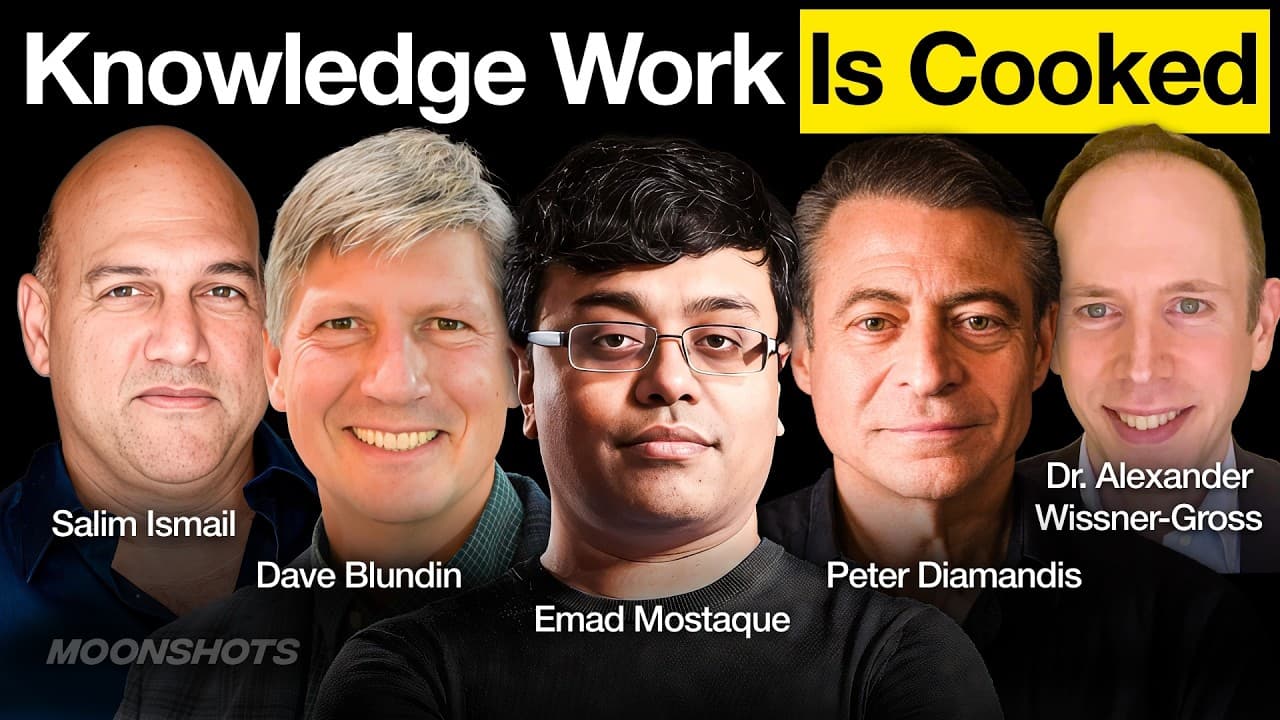
Hey everybody, welcome to Moonshots. We have a special end of the year holiday episode for you with our 2026 predictions from the Moonshot mates. You must have inside scoop on this. We'll find out, won't we? He's got a Santa hat on. You got to take him seriously. Perfecting orbital refueling, getting ready. We're already leaking the prediction. You... Read More
Key Insights
- Technological acceleration is expected to become broadly visible in 2026, according to the panel. Participants characterize 2025 as a period of rapid progress but predict that the following year will bring substantially greater change that people and organizations can no longer ignore.
- The 2026 space race is predicted to involve Blue Origin, SpaceX, and China. The panel does not establish a confident ordering among all three, but Peter Diamandis specifically forecasts that Jeff Bezos will reach the moon before Elon Musk during the year.
- Blue Origin is predicted to attempt an uncrewed cargo landing near Shackleton Crater at the lunar south pole. The location matters because permanently shadowed craters can retain ice, which contains hydrogen and oxygen that could potentially support the production of rocket fuel.
- SpaceX is predicted to prepare Starship for a Mars launch during a favorable Earth-Mars proximity window. The forecast depends on the company demonstrating orbital refueling early in 2026, followed by an anticipated transit lasting approximately six to nine months.
- Starship still requires substantial development before a Mars mission, according to the discussion. The transcript contrasts more than 500 Falcon launches and 11 Starship launches with Blue Origin's two New Glenn flights, noting that New Glenn's second flight achieved a first-stage landing.
- AI is predicted to solve one of the six remaining Millennium Prize problems in 2026. Alexander Wissner-Gross identifies Navier-Stokes as the likeliest candidate and mentions the Riemann hypothesis as another possibility, while acknowledging uncertainty about which challenge might fall first.
- AI-generated mathematical proofs may be complex rather than short or elegant. The panel anticipates that mathematicians could criticize a successful result as brute force, overly long, or insufficiently beautiful, continuing a pattern in which standards shift after AI demonstrates new capabilities.
- The central economic question is whether computing power can be converted scalably into discoveries. Panelists believe early evidence from automated provers and work on Euler's problems suggests that applying more computation can explore solution spaces and sometimes produce more elegant results.
Install to Summarize YouTube Videos and Get Transcripts
Explore YouTube Video Summarizer or Get YouTube Transcript Extractor
Questions & Answers
Q: Why could 2026 feel like a major technological turning point?
The panel predicts that technological acceleration will become too visible to ignore in 2026. Participants describe 2025 as a year of substantial progress, but they expect the pace of change to increase further. They portray the singularity as an ongoing process rather than a single future event, with advances across AI, robotics, mathematics, science, engineering, medicine, and spaceflight making the shift more apparent.
Q: What spaceflight milestones are predicted for 2026?
Peter Diamandis predicts that Blue Origin will complete an uncrewed cargo landing near Shackleton Crater at the moon's south pole before SpaceX reaches that destination. At the same time, he expects SpaceX to prepare Starship for a Mars launch window. That preparation would require an orbital-refueling demonstration early in 2026 and significant additional work on a vehicle that is not yet ready for Mars.
Q: Why is Shackleton Crater important for lunar exploration?
Shackleton Crater is important because it lies near the lunar south pole and contains areas that remain permanently shadowed. The discussion says ice deposited elsewhere on the moon can sublimate, changing directly from solid to gas and escaping. In permanently dark craters, however, ice can remain. That ice contains hydrogen and oxygen, making it potentially valuable as a source of rocket fuel.
Q: What must Starship demonstrate before launching toward Mars?
Starship must demonstrate orbital refueling early in 2026 for the predicted Mars launch to become feasible, according to Peter Diamandis. The launch would target a period when Earth and Mars are in closest proximity, with the journey expected to take approximately six to nine months. The panel stresses that Starship's latest flight performed well but that the vehicle still requires considerable work before it is ready for Mars.
Q: How do Blue Origin and SpaceX compare in the discussion?
The discussion contrasts SpaceX's extensive launch experience with Blue Origin's more limited New Glenn flight history. Elon Musk is credited with more than 500 Falcon launches and 11 Starship launches. Blue Origin, which Jeff Bezos started a couple of years before SpaceX, had completed two New Glenn flights, with the second achieving a first-stage landing. Despite that gap, Diamandis predicts Blue Origin will land lunar cargo first.
Q: Which major mathematics problem could AI solve in 2026?
Alexander Wissner-Gross predicts that AI could solve one of the six remaining Millennium Prize problems during 2026. He identifies Navier-Stokes as the likeliest candidate and says a Google DeepMind team is reportedly working on it. He places the Riemann hypothesis second, partly because xAI has repeatedly expressed interest in resolving it. The prediction remains deliberately uncertain about which problem would actually be solved.
Q: What might an AI-generated mathematical proof look like?
An AI-generated proof could be extremely long and complex rather than short, elegant, and beautiful. Wissner-Gross expects that a successful result might trigger criticism from mathematicians who consider it brute force, insufficiently elegant, or otherwise unsatisfying. The panel sees such objections as another possible movement of the goalposts after AI completes a task that had previously been treated as exceptionally difficult.
Q: Can additional computing power produce new scientific discoveries?
The panel identifies scalable conversion of computing power into discoveries as a multi-trillion-dollar question. Participants lean toward yes, citing the emergence of automatic provers and AI systems working through Euler's problems one by one, sometimes with more elegant solutions. Their reasoning is that increasing computation allows systems to explore larger solution spaces and approach problems from first principles, potentially changing mathematics, science, engineering, and medicine.
Summary & Key Takeaways
-
The panel expects 2026 to make technological acceleration impossible to ignore. Participants describe the singularity as an unfolding process rather than a distant event, predicting substantially more change than in 2025. Their selected forecasts focus on consequential developments in spaceflight, artificial intelligence, mathematics, engineering, medicine, and scientific discovery.
-
Peter Diamandis predicts an intensified contest involving Blue Origin, SpaceX, and China. He expects Blue Origin to reach the lunar south pole first with an uncrewed cargo mission, while SpaceX prepares Starship for Mars. The Mars effort would require an orbital-refueling demonstration early in 2026 before a six-to-nine-month journey.
-
Alexander Wissner-Gross predicts that AI will solve one of the six remaining Millennium Prize problems in 2026, with Navier-Stokes presented as his leading candidate and the Riemann hypothesis as another possibility. The discussion argues that automated provers and scalable computation could reshape mathematics, although AI-generated proofs may be complex and controversial.
Read in Other Languages (beta)
Share This Summary 📚
Summarize YouTube Videos and Get Video Transcripts with 1-Click
Try YouTube Summary with ChatGPT & Claude or YouTube Transcript Generator
Explore More Summaries from Peter H. Diamandis 📚

Summarize YouTube Videos and Get Video Transcripts with 1-Click
Try YouTube Summary with ChatGPT & Claude or YouTube Transcript Generator