How to Use Video in a Mobile Marketing Strategy
TL;DR
Use controlled experiments to determine how mobile video experiences affect meaningful business outcomes, rather than optimizing only for views or clicks. In tests for a dieting membership offer, treatment A increased conversions by 34% on phones and 52% on tablets, showing that the presentation surrounding an identical video can substantially influence customer response.
Transcript
welcome back to another marketing experiments web Clinic today's topic is very interesting we're going to be looking at incorporating video into your mobile strategy now I've kind of grown up here around the labs and I've been able to kind of see the evolution of our web clinics I remember some of the first few web clinics we did were on on papercl... Read More
Key Insights
- Mobile video should be evaluated against meaningful business outcomes, such as completed memberships, rather than intermediate measures like video views or clicks. The dieting program experiment therefore measured how alternative page treatments affected membership conversion, keeping attention on the organization’s actual marketing objective.
- Treatment A increased phone conversions by 34% in the dieting membership experiment. Although every tested treatment improved conversion over the control, treatment A generated the strongest response, indicating that the way an unchanged video is presented can alter customer behavior.
- Treatment A increased tablet conversions by 52% and produced the best reported result among the tablet versions. The experiment compared a control with two treatments, while using the same video in every version so that presentation differences could be evaluated.
- Treatment B produced a reported 31.2% tablet conversion increase, but the result had not reached the full 95% confidence level. It was therefore described as trending upward rather than presented with the same degree of confidence as treatment A.
- The purpose of an experiment is to generate learning about customers, not merely to celebrate a lift in conversion. Asking why one treatment wins helps marketers turn an isolated result into a clearer understanding of customer response that can inform later decisions.
- Identical video content does not guarantee identical conversion performance across mobile experiences. Because the phone and tablet treatments used the same videos, the different results were connected to changes in the surrounding page treatments rather than changes to the video itself.
- Mobile strategy must account for both phones and tablets because the presentation evaluated separate experiments for these environments. Treatment A won in both cases, but the reported conversion increases differed, reaching 34% on phones and 52% on tablets.
- Marketing recommendations should be supported by experimentation because audience predictions did not consistently identify the winning treatment. Many webinar participants selected other versions, while treatment A ultimately produced the highest conversion response in both the phone and tablet tests.
Install to Summarize YouTube Videos and Get Transcripts
Explore YouTube Video Summarizer or Get YouTube Transcript Extractor
Questions & Answers
Q: How should marketers measure mobile video success?
Marketers should measure mobile video against the business action the campaign is intended to generate. In the dieting program experiment, the objective was not simply to increase video views or clicks. The researchers measured completed membership conversions, which allowed them to evaluate whether the video experience contributed to a meaningful customer response and organizational outcome.
Q: What conversion increase did treatment A produce on phones?
Treatment A produced a 34% increase in membership conversions in the phone experiment. All of the tested treatments improved conversion compared with the control, but treatment A generated the largest reported response. The videos were identical across the versions, so the test examined how differences in the surrounding mobile presentation affected conversion behavior.
Q: What conversion increase did treatment A produce on tablets?
Treatment A generated a 52% increase in conversions in the tablet experiment. It outperformed both the control and treatment B, while every version used the same video. The presentation also reported a high confidence level for the winning result, supporting treatment A as the strongest observed tablet experience among the versions tested.
Q: Was tablet treatment B also more effective than the control?
Tablet treatment B was trending upward, with a reported conversion increase of 31.2%. However, the result had not achieved the full 95% confidence level cited in the presentation. It therefore showed encouraging performance, but the evidence was less conclusive than the result for treatment A, which generated a 52% increase.
Q: Why did the experiments use the same video in every treatment?
Using the same video across all treatments helped focus the experiments on differences in the surrounding page experience. If both the video and presentation had changed, it would have been harder to determine what influenced conversion. The unchanged video showed that alternative mobile presentations could produce different membership conversion results even when the core video content remained constant.
Q: Why should marketers ask why an experiment won?
Marketers should ask why a treatment won because the goal of experimentation is to learn about customers, not merely to record a conversion increase. A lift shows that one experience performed better, but investigating the reason can produce a reusable insight about customer response. That learning can guide subsequent tests and broader marketing decisions.
Q: Should mobile video campaigns optimize for views or conversions?
Mobile video campaigns should optimize for the outcome that reflects the campaign’s real objective. The featured dieting program wanted more people to become members, so views and clicks were not sufficient success measures. Membership conversion was the relevant outcome because it demonstrated whether the complete video and page experience moved customers toward the intended action.
Q: Can marketers accurately predict the best mobile video design?
Marketers cannot assume that intuition will consistently identify the best mobile video design. During the webinar, many participants selected versions other than treatment A when asked to predict the winners. Treatment A nevertheless delivered the largest reported conversion increase in both experiments, with a 34% phone lift and a 52% tablet lift, demonstrating the value of testing predictions.
Summary & Key Takeaways
-
A dieting organization tested several mobile page designs to determine whether video could generate more membership conversions. Every version used the same video, allowing the experiment to focus on differences in presentation. On phones, all tested treatments improved conversion, but treatment A produced the largest reported increase at 34%.
-
The tablet experiment compared a control with two treatments while keeping the video unchanged. Treatment A increased conversions by 52% and had a high reported confidence level. Treatment B trended upward with a 31.2% increase, although its result did not reach the full 95% confidence level discussed during the presentation.
-
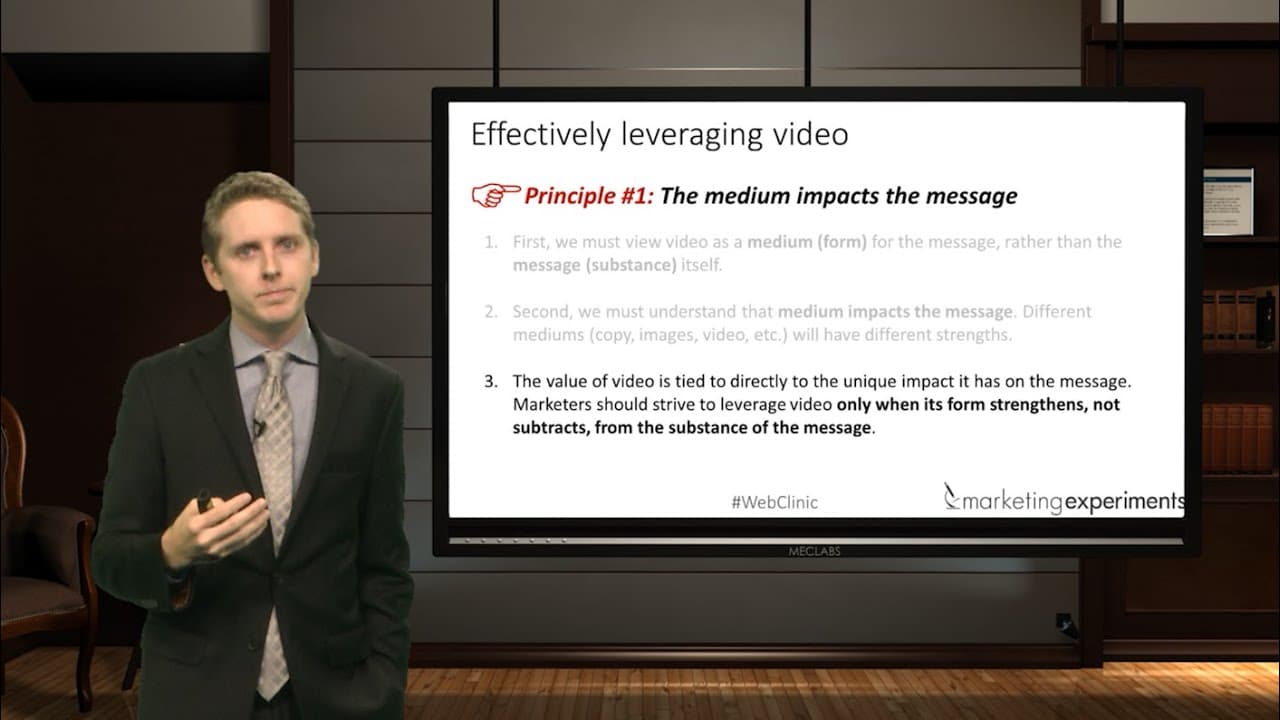
The central lesson is that experimentation should produce customer insight, not merely a conversion lift. Marketers must ask why a treatment outperformed alternatives and use the answer to understand customer behavior. The presentation introduces two foundational principles for mobile video, although the supplied transcript ends before those principles are explained.
Read in Other Languages (beta)
Share This Summary 📚
Summarize YouTube Videos and Get Video Transcripts with 1-Click
Try YouTube Summary with ChatGPT & Claude or YouTube Transcript Generator
Explore More Summaries from Flint McGlaughlin 📚


Summarize YouTube Videos and Get Video Transcripts with 1-Click
Try YouTube Summary with ChatGPT & Claude or YouTube Transcript Generator