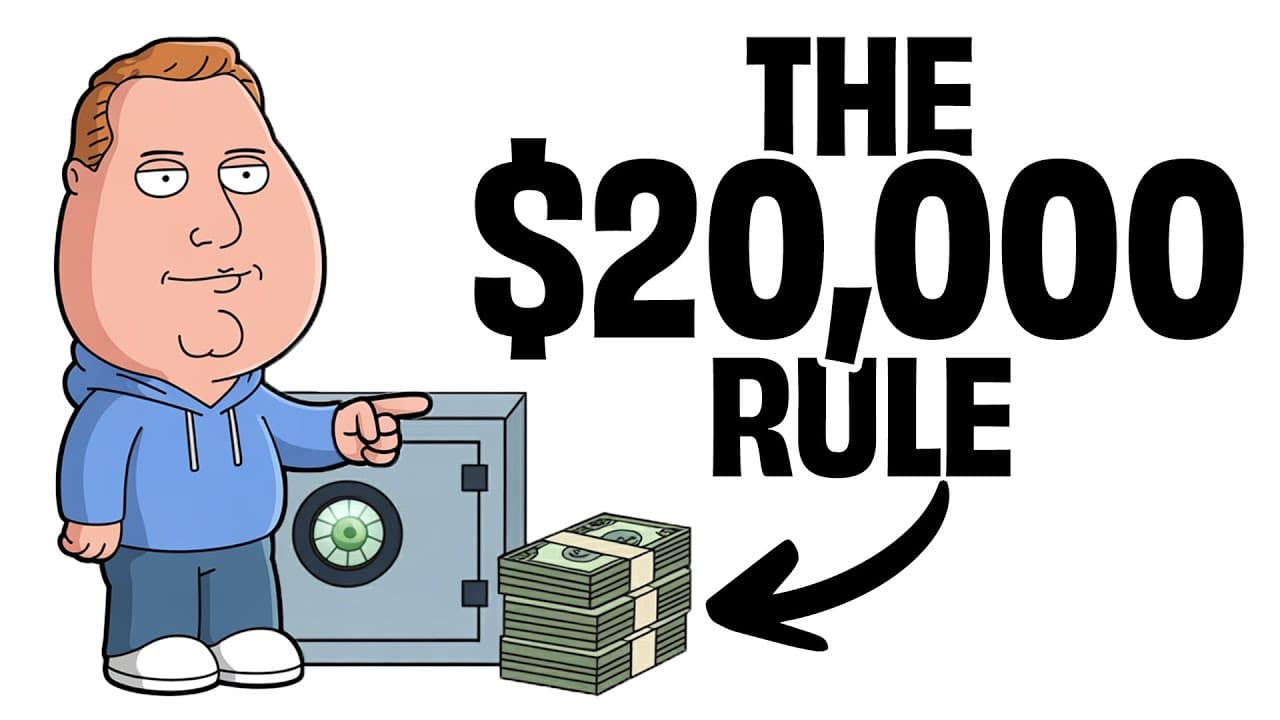
Why Saving Your First $20,000 Changes Everything
TL;DR
Saving your first $20,000 changes everything because it creates financial breathing room while making investment returns meaningful enough to accelerate further progress. The cited Vanguard research links $2,000 in emergency savings to a 21% increase in financial well-being, while saving $1,000 monthly at an 8% return reaches $20,000 in about 19 months. Read on to see how this milestone can reshape decisions, resilience, and wealth building.
Transcript
You know that feeling when you check your bank account and instead of immediately closing the app in horror, you actually smile. Like when you stop calculating whether you can afford that coffee or if buying groceries means eating ramen for the rest of the week. There's a specific number where this shift happens and it's not what most people think.... Read More
Key Insights
- $20,000 is described as the first major financial threshold that separates people who will build significant wealth from those who spend their lives living paycheck to paycheck, and most people have no idea the threshold exists.
- Survival mode is a psychological state where every financial decision is filtered through fear and scarcity, leading you to accept the first job offer, stay in situations you hate, and say yes to work you do not want because you need the money.
- Vanguard research cited in the video shows that holding just $2,000 in emergency savings increases financial well-being by 21%, a buffer smaller than what many people spend on a vacation or a laptop.
- Pushing an emergency fund to 3 to 6 months of living expenses, which for most people lands around $20,000, delivers another 13% boost in financial well-being and creates room to think about wealth building rather than wealth preservation.
- Saving $1,000 per month at an 8% return takes about 19 months to reach the first $20,000, but the second $20,000 takes only about 17 months because the first block is already generating its own returns alongside contributions.
- Once a portfolio reaches $400,000, it can generate the next $20,000 in roughly 5 months, meaning the same amount that took nearly two years of saving now happens automatically through investment returns.
- Scale, not sophistication, drives the difference. A 10% return on $1,000 is $100 while the same 10% on $10,000 is $1,000, using the same index funds, the same brokerages, and the same basic principles at any account size.
- Saving $20,000 builds an identity as someone who can delay gratification, because it requires tracking every dollar, refusing wants, and resisting impulse spending consistently for months or years, which is a life skill rather than just a financial one.
Install to Summarize YouTube Videos and Get Transcripts
Explore YouTube Video Summarizer or Get YouTube Transcript Extractor
Questions & Answers
Q: Why does saving your first $20,000 change everything?
The $20,000 milestone creates enough breathing room to shift attention from surviving until the next paycheck toward growing money. It also makes compounding more visible because investment returns become larger in absolute dollars. The video compares the change to pushing a boulder over the top of a hill, where momentum begins working in your favor.
Q: What does the cited Vanguard research say about emergency savings and financial well-being?
The cited research says that having $2,000 in emergency savings increases financial well-being by 21%. Building an emergency fund equal to 3 to 6 months of living expenses, described as around $20,000 for most people, provides another 13% boost.
Q: How long does it take to save the first $20,000 at $1,000 per month?
Saving $1,000 each month while earning an 8% investment return takes about 19 months to reach the first $20,000. The second $20,000 takes about 17 months because the original balance is generating returns alongside the continuing monthly contributions.
Q: How does having $20,000 affect financial decision-making?
Without savings, financial choices can be filtered through fear and scarcity, leading someone to accept a bad job offer or remain in an unwanted situation because change feels too risky. At $20,000, the video says that mental bandwidth can shift from reacting to immediate problems toward evaluating growth and opportunity.
Q: How much can $20,000 earn at an 8% annual return?
At an 8% annual return, $20,000 generates $1,600 in a year without additional contributions. This illustrates why returns begin to feel more meaningful once the invested balance grows.
Q: Why do investment returns feel more powerful at larger balances?
The same percentage return produces more money when it is applied to a larger balance. A 10% return produces $100 on $1,000, $1,000 on $10,000, and $2,000 on $20,000. The difference comes from scale rather than using different index funds, brokerages, or basic investing principles.
Q: How quickly can a $400,000 portfolio generate another $20,000?
The video says that a $400,000 investment portfolio can generate the next $20,000 in roughly 5 months. That is substantially faster than the approximately 19 months needed to accumulate the first $20,000 while saving $1,000 monthly at an 8% return.
Q: What habits and identity can saving $20,000 build?
Reaching $20,000 can establish an identity as someone capable of delaying gratification. The process requires consistently tracking money, declining wants, and resisting impulse purchases for months or years. Those habits represent a broader life skill, not merely a larger account balance.
Summary & Key Takeaways
-
Financial thresholds act like invisible barriers, and $20,000 is the first major one separating people who build significant wealth from those who stay stuck living paycheck to paycheck. Nick compares it to pushing a boulder uphill: everything before that point fights gravity, and everything after it has gravity working in your favor.
-
The shift is psychological as much as mathematical. Without savings, the brain runs in survival mode, filtering every decision through fear and scarcity, taking bad job offers and staying in situations you hate. Crossing $20,000 frees mental bandwidth to ask how to grow money rather than how to survive until the next paycheck.
-
The math compounds visibly at scale. A 10% return on $2,000 is $200, but the same 10% on $20,000 is $2,000, and $20,000 at 8% throws off $1,600 a year without extra work. At $400,000 invested, the next $20,000 arrives in about 5 months instead of the original 19.
-
Reaching $20,000 also builds an identity. It requires tracking every dollar, saying no to wants, and resisting shiny objects consistently for months or years, proving you can delay gratification. Afterward, car repairs and dead laptops become inconveniences instead of emergencies, and investment opportunities become things you can actually evaluate.
Read in Other Languages (beta)
Share This Summary 📚
Summarize YouTube Videos and Get Video Transcripts with 1-Click
Try YouTube Summary with ChatGPT & Claude or YouTube Transcript Generator
Explore More Summaries from Nick Invests 📚
Summarize YouTube Videos and Get Video Transcripts with 1-Click
Try YouTube Summary with ChatGPT & Claude or YouTube Transcript Generator