How to Write an AI-Friendly Résumé That Stands Out
TL;DR
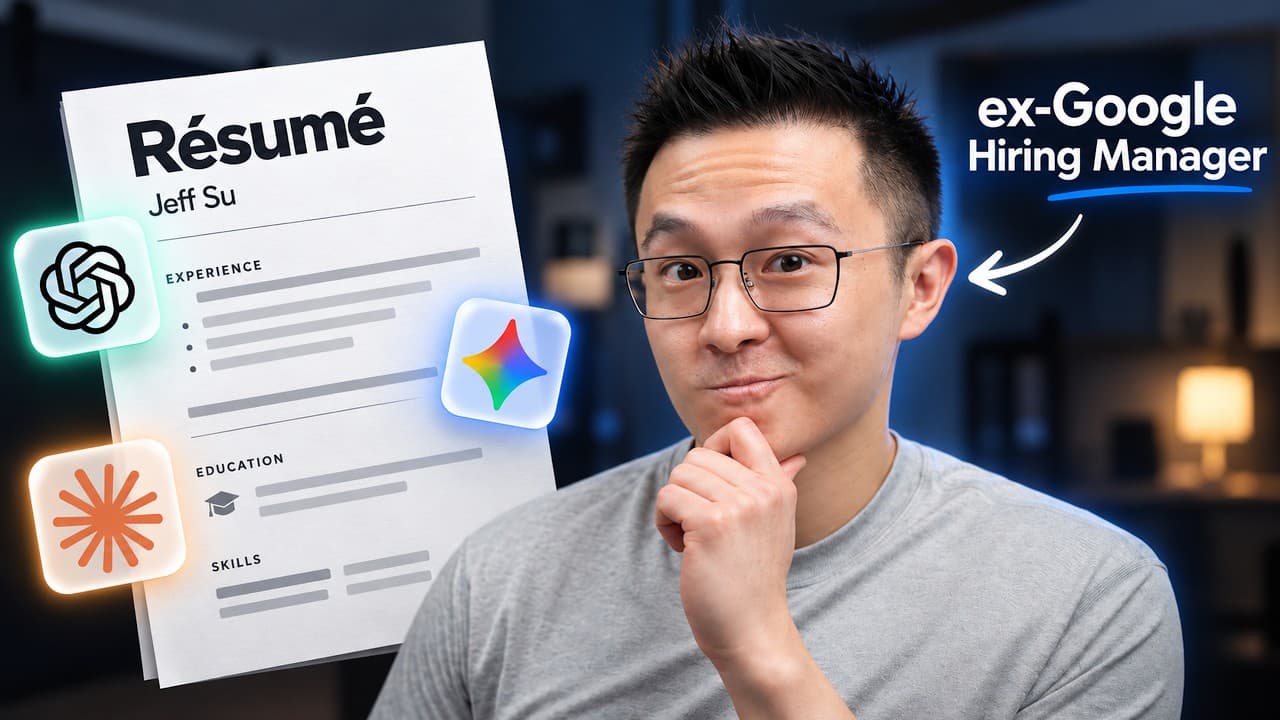
Build a simple, text-based résumé that AI can parse, then make your genuine fit and measurable impact obvious to human reviewers. Tailor relevant language without stuffing keywords, use AI to clarify facts rather than invent them, quantify verified results, and demonstrate AI skills through concrete work instead of merely listing tools.
Transcript
Finding reliable resume advice online was already hard enough. And now that employers are using AI to screen job applications, it's only fair to ask, "Do resumes even matter anymore?" And so, I spent weeks analyzing hiring reports and academic studies from institutions like MIT and Oxford, covering more than 4,000 hiring managers and nearly 2 milli... Read More
Key Insights
- A résumé must satisfy both automated screening and human evaluation. AI systems initially read, rank, and organize applications, but only 6% of hiring managers say AI makes the passing or rejection decision, so clear relevance and persuasive evidence remain essential for advancing.
- Simple, text-based résumés are read more accurately by AI hiring software, according to 87% of hiring managers cited. A one-column structure, conventional headings, minimal visual decoration, and selectable text make qualifications easier for automated systems to identify and organize.
- A selectable-text PDF should ideally remain below 2.5 megabytes because some hiring tools cannot parse larger files. Candidates can test readability by opening the PDF and attempting to highlight and copy its text. Failure suggests that important content may be trapped inside an image.
- Tailored résumés achieved an 84% higher interview rate in the cited research. Across nearly 2 million applications, the interview rate was 5.71% for tailored résumés and 3.09% for untailored ones, showing the value of connecting genuine experience to the employer's needs.
- Keyword mapping is the use of relevant job-description language to describe work a candidate has actually performed. Keyword stuffing is indiscriminate repetition without supporting experience. Résumés with the highest keyword coverage received 21% fewer interviews than those with moderate coverage.
- Thoughtful AI assistance can improve résumé language, but excessive automation can make candidates sound interchangeable. An MIT experiment involving nearly half a million job seekers found that AI help with spelling, grammar, and wording increased the probability of getting hired by 8%.
- Effective résumé bullets begin with factual raw material covering the final result, the candidate's specific contribution, and how the result was achieved. AI can then improve clarity and concision without changing facts, while the candidate retains only language they could explain naturally during an interview.
- Quantified impact distinguishes achievement from responsibility. Résumés that measured candidate impact received 75% higher interview rates, and relevant evidence can include time saved, speed, scale, accuracy, reduced complaints, fewer duplicate tickets, audience growth, or other verifiable results.
- More videos from this channel:
- More from this channel: Jeff Su
Install to Summarize YouTube Videos and Get Transcripts
Explore YouTube Video Summarizer or Get YouTube Transcript Extractor
Questions & Answers
Q: How do you make a résumé readable by AI screening software?
Use a simple, one-column résumé with conventional headings such as summary, experience, education, and skills. Avoid graphics, icons, large images, and skill bars that may obstruct automated parsing. Export the document as a selectable-text PDF, ideally below 2.5 megabytes, and confirm that its text can be highlighted and copied before submitting it.
Q: Why must a résumé appeal to both AI and human reviewers?
AI hiring systems commonly read, rank, and organize applications, so a résumé first needs clear structure and an obvious connection to the role. Human judgment still remains central because only 6% of hiring managers say AI makes the passing or rejection decision. Automated readability opens the door, while credible achievements and clear writing persuade the human reviewer to continue.
Q: How should you tailor a résumé without keyword stuffing?
Give AI the job description and a base résumé, then ask it to identify the employer's problems, important skills, and relevant keywords before suggesting revised bullets. Keep only language supported by real experience. This approach maps accurate evidence to the role instead of repeating every phrase, which matters because the highest keyword coverage received 21% fewer interviews than moderate coverage.
Q: What is the difference between keyword mapping and keyword stuffing?
Keyword mapping uses relevant terms from a job description to describe work the candidate has genuinely completed. Keyword stuffing inserts many phrases regardless of whether the candidate's experience supports them. The distinction is important because tailored résumés performed better, while résumés with the highest keyword coverage received 21% fewer interviews than those with moderate coverage in the cited study.
Q: How should job seekers use AI to improve résumé bullets?
Begin by writing rough factual notes for each experience, covering the final result, your specific contribution, and how you achieved it. Upload those notes with the job description and ask AI to strengthen the wording without altering the underlying facts. Review every suggestion and retain only statements and language that you could explain naturally and defend during an interview.
Q: Why should résumé achievements include numbers?
Numbers show the scale and effectiveness of work, while responsibilities alone cannot reveal how well someone performed. The cited research found that résumés quantifying candidate impact achieved 75% higher interview rates. Useful measures are not limited to revenue and can include time saved, speed, scale, accuracy, complaint reductions, ticket reductions, audience growth, or other verifiable outcomes.
Q: How can AI help identify and write measurable résumé achievements?
Upload the résumé and ask AI to identify relevant metrics for each experience, including measures such as time saved, speed, scale, and accuracy. Supply only numbers that can be verified. Then ask AI to rewrite each bullet using the structure, accomplished X as measured by Y by doing Z, while explicitly instructing it not to add or change facts or figures.
Q: How can candidates prove AI skills on a résumé?
Candidates should connect AI use to a specific task, method, and verified outcome instead of merely listing AI as a skill. For example, the transcript describes reducing customer complaints by 31% by using AI to create an onboarding email sequence from help center documents. Concrete applications demonstrate capability more convincingly, which aligns with the 60% of hiring managers who want proof of AI skills.
Summary & Key Takeaways
-
A résumé must pass two stages: automated screening and human review. Use a one-column layout, conventional section headings, and a selectable-text PDF, ideally under 2.5 megabytes. Avoid graphics, icons, images, and skill bars that may interfere with parsing, while still following résumé conventions in the location where you apply.
-
Tailoring works when relevant language from the job description accurately describes work the candidate has performed. Across nearly 2 million applications, tailored résumés achieved a 5.71% interview rate, compared with 3.09% for untailored versions. However, the highest keyword coverage produced 21% fewer interviews than moderate coverage, showing the danger of stuffing.
-
AI should improve clarity without replacing the candidate's thinking. Start by recording the result, personal contribution, and method for each experience. Then ask AI to strengthen wording without changing facts. Add verified measures such as time saved, speed, scale, accuracy, or growth, and demonstrate AI ability through specific applications and outcomes.
Read in Other Languages (beta)
Share This Summary 📚
Summarize YouTube Videos and Get Video Transcripts with 1-Click
Try YouTube Summary with ChatGPT & Claude or YouTube Transcript Generator
Explore More Summaries from Jeff Su 📚

Summarize YouTube Videos and Get Video Transcripts with 1-Click
Try YouTube Summary with ChatGPT & Claude or YouTube Transcript Generator