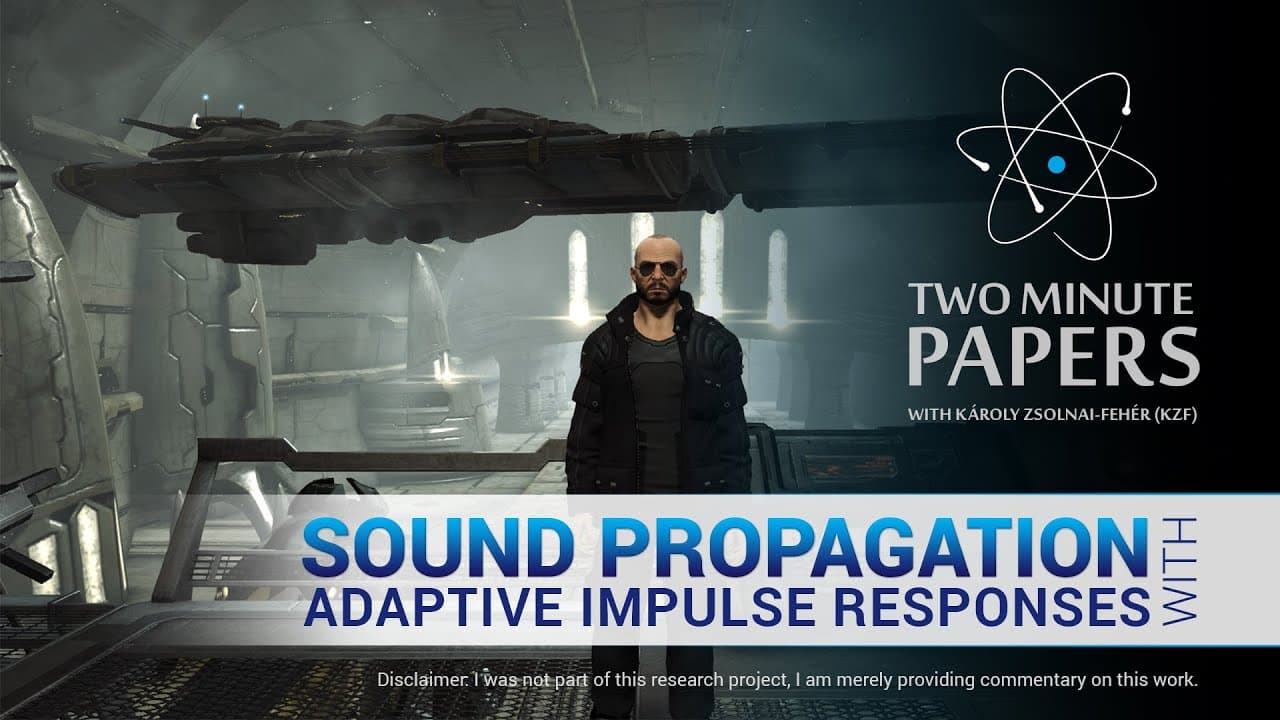
Sound Propagation With Adaptive Impulse Responses | Two Minute Papers #95
TL;DR
Adaptive impulse responses make virtual sound simulation faster by reusing information from recently computed responses as the listener moves. This temporal coherence requires tracing fewer sound paths while retaining high-quality results; in the best cases, the algorithm runs five times as quickly as previous techniques and has significantly more favorable memory requirements. Read on to understand path tracing, convolution, spatial variation, demonstrated scale, and the method’s audio limitations.
Transcript
Dear Fellow Scholars, this is Two Minute Papers with Károly Zsolnai-Fehér. Have you ever wondered how your voice, or your guitar would sound in the middle of a space station? A realistic simulation of sounds within virtual environments dramatically improves the immersion of the user in computer games and virtual reality applications. To be able to ... Read More
Key Insights
- 👾 Realistic sound simulations significantly enhance user immersion in computer games and virtual reality applications.
- 🙂 Path tracing techniques, similar to those used in light simulations, can be adapted for sound simulation.
- 🖐️ Impulse responses, which describe reverberation in a scene, play a crucial role in achieving convincing sound simulation results.
- 👂 Temporal coherence can be exploited to reduce computation time and improve efficiency in sound simulation.
- 📰 The new technique described in the paper executes five times faster than previous techniques in some cases.
- 👶 Memory requirements in the new technique are also more favorable compared to traditional methods.
- 🌸 Limitations of the technique include overly smooth audio signals and fidelity loss in the lower frequency domains.
Install to Summarize YouTube Videos and Get Transcripts
Explore YouTube Video Summarizer or Get YouTube Transcript Extractor
Questions & Answers
Q: How do adaptive impulse responses improve sound propagation simulation?
The method exploits temporal coherence by reusing information from the previous few impulse responses as the listener changes location. This allows it to trace far fewer rays while still producing high-quality results.
Q: What is an impulse response in sound simulation?
An impulse response is a mathematical function describing the reverberation heard when a sound, such as a gunshot, occurs in a particular scene. It is obtained by simulating the paths of many sound waves through the scene.
Q: How is path tracing used to simulate sound?
Path tracing calculates how sound waves interact with a scene’s geometry and materials. Knowledge and some equations from light transport can be reused because light and sound simulation involve similar propagation problems.
Q: How does convolution create convincing simulated audio?
After computing an impulse response, the system convolves it with an input signal such as a voice. The resulting signal reproduces how that voice would reverberate in the simulated environment.
Q: Why does an impulse response change as the listener moves?
An impulse response depends on both the scene and the listener’s exact position within it. For example, reverberation in the middle of a concert arena differs from reverberation at the back.
Q: How much faster is the adaptive sound simulation technique?
In the best cases, the algorithm executes five times as quickly as previous techniques. Its memory requirements are also significantly more favorable.
Q: How many sound sources can the demonstrated scenes simulate?
Some scenes shown in the footage contain up to 24 distinct sound sources. Every source is simulated against the geometry and materials present in the scene.
Q: What are the limitations of the adaptive impulse response method?
The reported limitations include audio signals that can sound a bit overly smooth. The method also experiences some fidelity loss in lower-frequency domains.
Summary & Key Takeaways
-
Realistic simulation of sounds within virtual environments enhances user immersion in computer games and VR applications.
-
Path tracing techniques, similar to those used in light simulations, can be employed to calculate the interaction between sound waves and the scene's geometry and materials.
-
Temporal coherence can be utilized to exploit previous calculations and reduce computation time while maintaining high-quality results.
Read in Other Languages (beta)
Share This Summary 📚
Summarize YouTube Videos and Get Video Transcripts with 1-Click
Try YouTube Summary with ChatGPT & Claude or YouTube Transcript Generator
Explore More Summaries from Two Minute Papers 📚





Summarize YouTube Videos and Get Video Transcripts with 1-Click
Try YouTube Summary with ChatGPT & Claude or YouTube Transcript Generator