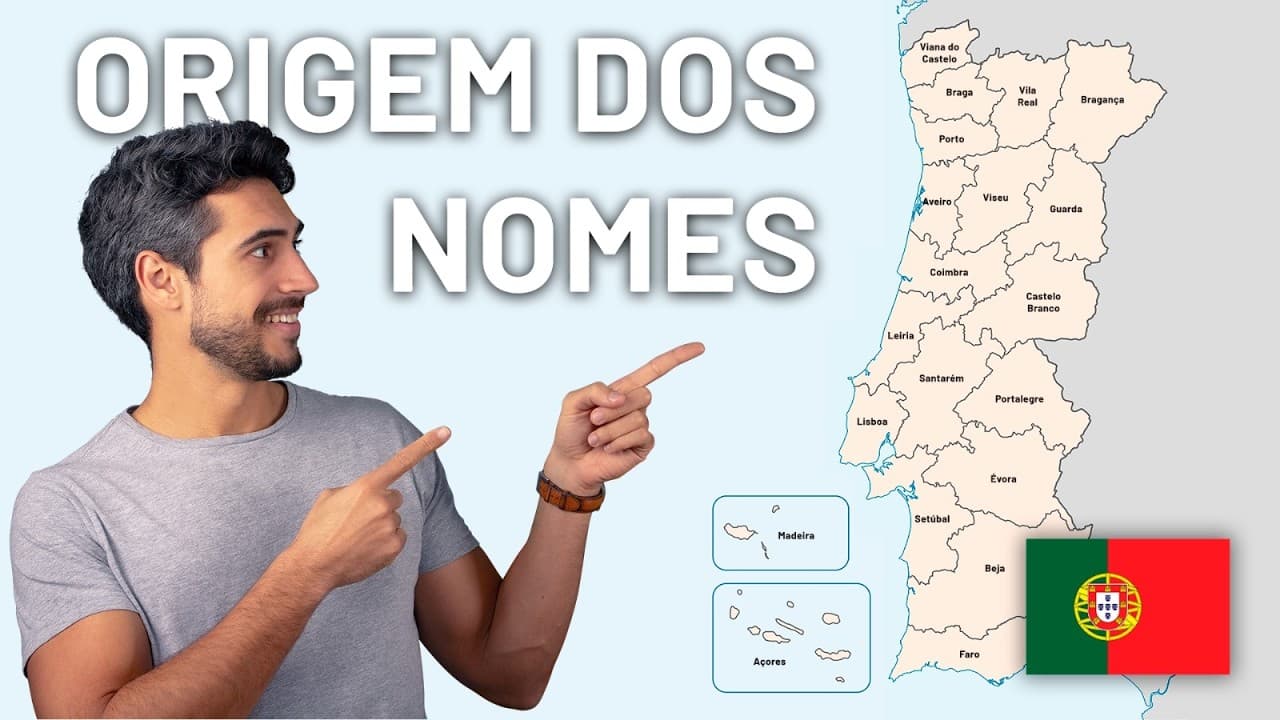
Origem dos nomes dos Distritos e Regiões de Portugal
TL;DR
Explores the historical origins of Portuguese district names.
Transcript
Hello and welcome to Portuguese With Leo. My name is Leonardo, and on this channel I talk about the Portuguese language and culture. Throughout its history, Portugal has been divided internally in several different ways: first we had 6 provinces, which later became 10 and then 11, and finally, in 1976, the country was divided into 18 districts ... Read More
Key Insights
- Portugal's administrative divisions evolved from 6 provinces in the 15th century to 18 districts and 2 autonomous regions by 1976.
- The Minho River's name may derive from ancient roots meaning 'to walk' or 'mountainous,' while the Douro River's name has Celtic origins meaning 'water.'
- Trás-os-Montes means 'beyond the mountains,' referring to its location relative to the Alvão and Marão mountain ranges.
- Beira, meaning 'edge,' historically marked the eastern frontier of Portugal during its territorial expansion.
- Estremadura's name may derive from 'land of the extreme,' indicating its borderland status during the Christian Reconquista.
- Alentejo, meaning 'beyond the Tagus,' highlights its location south of Portugal's largest river, the Tagus.
- Algarve's name, from Arabic 'al-Gharb,' signifies 'the west,' reflecting its position in the Muslim territory of al-Andalus.
- The districts are named after their capitals, with names often rooted in ancient, Roman, or Arabic origins, reflecting the region's diverse history.
Install to Summarize YouTube Videos and Get Transcripts
Explore YouTube Video Summarizer or Get YouTube Transcript Extractor
Questions & Answers
Q: What is the significance of the Minho and Douro rivers in Portuguese history?
The Minho and Douro rivers have significant historical importance as they form natural boundaries and have influenced the naming of regions. The Minho River's name likely stems from ancient roots meaning 'to walk' or 'mountainous,' while the Douro's name is derived from Celtic origins, meaning 'water.' These rivers have played crucial roles in shaping the cultural and geographical landscape of Portugal.
Q: How did the historical province of Beira get its name?
The province of Beira derives its name from the word meaning 'edge' or 'margin.' Historically, Beira marked the eastern frontier of Portugal, serving as a strategic border region with the Spanish kingdoms. During the Middle Ages, as Portugal expanded southward, Beira occupied a central position along the border, making it a significant limit of the kingdom.
Q: What are the origins of the name Estremadura?
Estremadura's name is believed to originate from the expression 'land of the extreme,' indicating its role as a borderland during the Christian Reconquista. This term described territories at the edges of the Christian kingdoms, bordering Al-Andalus to the south. The name reflects the region's historical significance as a frontier zone during medieval times.
Q: Why is Alentejo named as such?
Alentejo, meaning 'beyond the Tagus,' is named for its location south of the Tagus River, Portugal's largest and most important river. The name highlights the geographical position of the region relative to the river, which has historically been a major landmark and natural divider within the country.
Q: What is the historical background of the Algarve's name?
The name Algarve originates from the Arabic 'al-Gharb,' meaning 'the west.' This reflects the region's position as the western part of the Muslim territory of al-Andalus during the Middle Ages. The Arabic influence in the name underscores the historical Muslim presence in southern Portugal and the cultural exchanges that occurred there.
Q: How did the city of Coimbra get its name?
Coimbra's name has Roman origins, initially known as Aeminium. It was close to the larger city of Conimbriga. When Conimbriga was destroyed during barbarian invasions, many inhabitants relocated to Aeminium, which eventually inherited the name of Conimbriga, evolving into the modern name Coimbra. This reflects a transfer of both population and cultural significance.
Q: What does the name 'Faro' signify, and what are its possible origins?
The name 'Faro' has two potential origins. One theory suggests it evolved from the Arabic family name Banu Harun, who ruled the city, transforming from Harun to Faron to Faro. Another theory links it to the Greek word 'pharos,' meaning 'lighthouse,' appropriate given its coastal location. Both theories highlight the city's historical significance and strategic position.
Q: What role do the autonomous regions of Madeira and the Azores play in Portugal's administrative division?
The autonomous regions of Madeira and the Azores are integral parts of Portugal's administrative division, each consisting of an archipelago in the Atlantic Ocean. Madeira's name comes from the dense forests encountered by Portuguese navigators, while the Azores' name originates from a mistaken identification of birds. These regions have distinct cultural and historical identities, contributing to Portugal's diverse national character.
Summary & Key Takeaways
-
Portugal's internal divisions have changed over time, evolving from six historical provinces to the current 18 districts and two autonomous regions. Each district's name originates from its capital city, often with historical roots in ancient, Roman, or Arabic influences.
-
The video explores the etymology of district names, such as Minho and Douro's river-based origins, Trás-os-Montes' geographic reference, and Algarve's Arabic heritage. These names reflect the complex cultural and historical tapestry of Portugal.
-
In addition to historical insights, the video promotes language learning through italki, emphasizing the importance of practicing with native speakers. Viewers are encouraged to explore more about Portugal's districts in a related video.
Read in Other Languages (beta)
Share This Summary 📚
Summarize YouTube Videos and Get Video Transcripts with 1-Click
Try YouTube Summary with ChatGPT & Claude or YouTube Transcript Generator
Explore More Summaries from Portuguese With Leo 📚




Summarize YouTube Videos and Get Video Transcripts with 1-Click
Try YouTube Summary with ChatGPT & Claude or YouTube Transcript Generator