How to Pronounce Difficult Portuguese Tongue Twisters
TL;DR
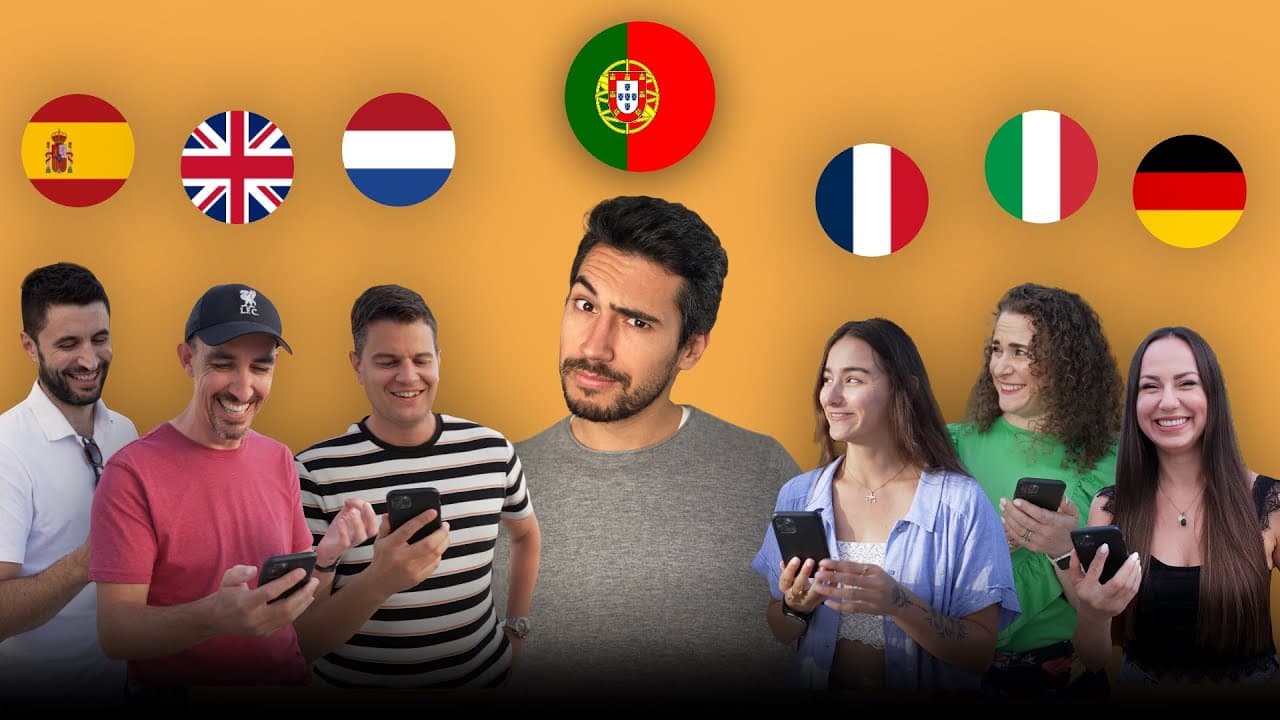
Polyglots attempt to pronounce challenging Portuguese tongue twisters, highlighting the complexities of Portuguese phonetics. Each tongue twister presents unique challenges, such as the pronunciation of the [ʁ], [ɾ], [s], [z], [ʃ], [ʒ], and [ʎ] sounds. The video illustrates the role of regional accents and language backgrounds in pronunciation.
Transcript
Concentration. The mouse gnawed through the cork of the king of Russia's bottle of rum. Does it have to be with a Portuguese accent? Or a Brazilian accent? With whatever accent you want! Three sad tigers swallowed three plates of wheat. I was recently on a retreat with other content creators from the world of languages, and I took the opportunity ... Read More
Key Insights
- Portuguese tongue twisters can be challenging even for native speakers due to complex phonetics.
- The [ʁ] sound in Portuguese is similar to sounds in French and Dutch, aiding speakers of these languages.
- Regional accents and age influence the pronunciation of the Portuguese R sound.
- The [ɾ] sound in Portuguese is similar to the R sound in Spanish, aiding Spanish speakers.
- Sibilant sounds [s], [z], [ʃ], and [ʒ] are difficult to pronounce close together due to their similarity.
- The [ʎ] sound in Portuguese is uncommon in many languages, requiring practice to master.
- Polyglots often excel in pronunciation due to their experience with multiple languages.
- Using a VPN like NordVPN can help access content restricted by geographic location.
Install to Summarize YouTube Videos and Get Transcripts
Explore YouTube Video Summarizer or Get YouTube Transcript Extractor
Questions & Answers
Q: How do regional accents affect Portuguese pronunciation?
In Portuguese, regional accents significantly influence pronunciation, particularly the R sound. Coastal cities and younger speakers often use the [ʁ] sound, while the interior and older individuals tend to use the [r] sound. This variation is due to regional linguistic trends and age-related language changes.
Q: What challenges do polyglots face with Portuguese tongue twisters?
Polyglots face challenges with Portuguese tongue twisters due to complex phonetic sounds like [ʁ], [ɾ], and [ʎ]. These sounds may not exist in their native languages, requiring them to adapt and learn new phonetic rules. Their multilingual background helps them recognize and correct pronunciation errors more effectively.
Q: Why are sibilant sounds difficult in Portuguese tongue twisters?
Sibilant sounds [s], [z], [ʃ], and [ʒ] are difficult in Portuguese tongue twisters because they are acoustically similar and occur in close proximity. This can cause confusion, leading to mispronunciation, even among native speakers. The challenge lies in distinguishing and accurately producing each sound quickly.
Q: How does a VPN help access restricted content?
A VPN, like NordVPN, helps access restricted content by changing the virtual location of a user's device. This allows users to bypass geographic restrictions and access content available in other regions. For example, changing the location to the UK can provide access to UK-exclusive content on platforms like Netflix.
Q: What is the significance of learning phonetics in language acquisition?
Learning phonetics is crucial in language acquisition as it helps learners understand the sound system of a language. This knowledge enables them to pronounce words correctly, recognize phonetic patterns, and distinguish between similar sounds, improving their overall language proficiency and communication skills.
Q: What role does multilingualism play in language learning?
Multilingualism enhances language learning by improving cognitive flexibility, phonetic awareness, and the ability to recognize and produce new sounds. Polyglots often have better pronunciation skills and can adapt to new linguistic environments more easily, making it easier for them to learn additional languages.
Q: Why is the [ʎ] sound challenging for language learners?
The [ʎ] sound is challenging for language learners because it is not present in many languages, requiring learners to develop new articulatory skills. Mastery of this sound involves understanding its unique placement and manner of articulation, which can be difficult without exposure and practice.
Q: How do age and region influence language pronunciation?
Age and region influence language pronunciation by dictating exposure to specific linguistic features and trends. Younger speakers may adopt newer pronunciations, like the [ʁ] sound in Portuguese, prevalent in urban areas, while older speakers might retain traditional sounds, such as the [r], common in rural regions.
Summary & Key Takeaways
-
Polyglots tackle Portuguese tongue twisters, facing challenges with sounds like [ʁ], [ɾ], and [ʎ]. Regional accents and language backgrounds influence pronunciation. The video emphasizes the importance of understanding phonetics for accurate pronunciation.
-
Tongue twisters reveal the complexity of Portuguese phonetics, with sounds like [s], [z], [ʃ], and [ʒ] causing confusion even for native speakers. Polyglots benefit from their multilingual experience, improving their ability to recognize and produce new sounds.
-
The video highlights the role of a VPN in accessing geographically restricted content. NordVPN, the sponsor, offers a solution for users seeking to bypass content restrictions, with a special offer available through the video's link.
Read in Other Languages (beta)
Share This Summary 📚
Summarize YouTube Videos and Get Video Transcripts with 1-Click
Try YouTube Summary with ChatGPT & Claude or YouTube Transcript Generator
Explore More Summaries from Portuguese With Leo 📚




Summarize YouTube Videos and Get Video Transcripts with 1-Click
Try YouTube Summary with ChatGPT & Claude or YouTube Transcript Generator