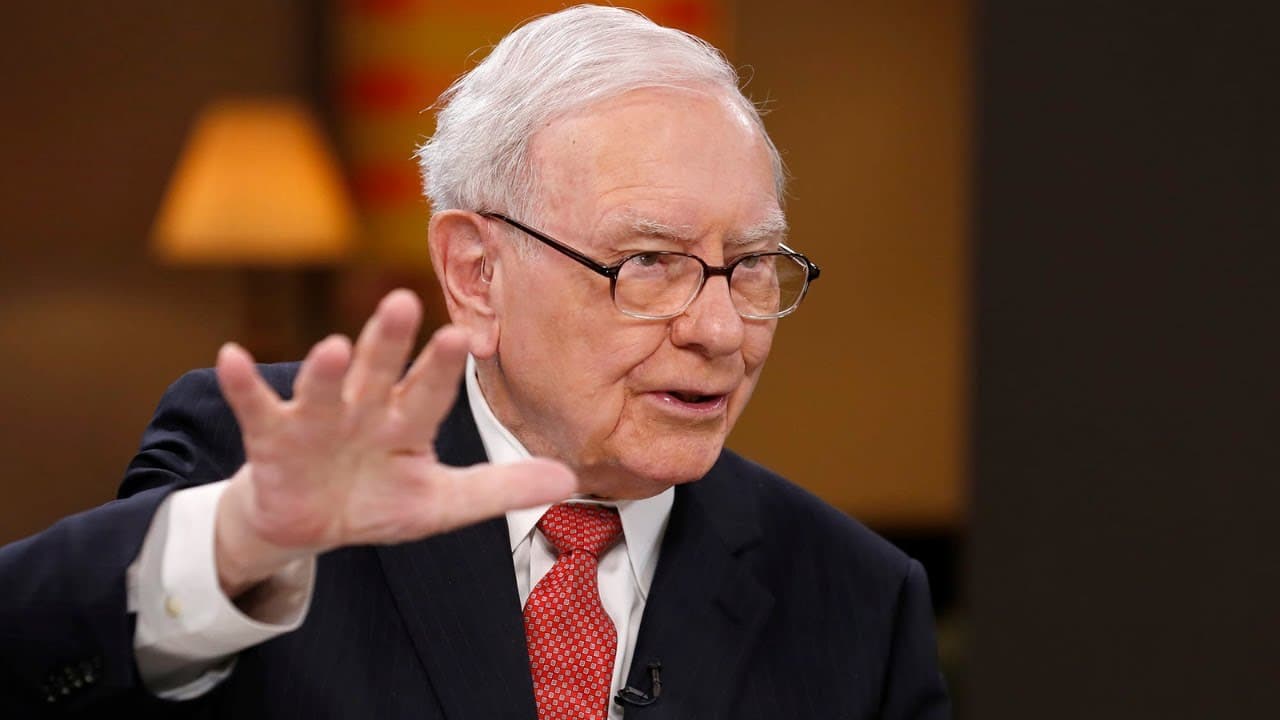
Warren Buffett On The Problems With American Healthcare | February 26, 2018
TL;DR
Haven represents a private sector attempt to reform health care brought up by Buffett alongside Amazon and JPMorgan. The discussion also covers Berkshire’s 2017 net worth rise driven by tax changes and deferred taxes, plus how new accounting rules will move unrealized gains through income statements, potentially altering how results are read by investors.
Transcript
let's get right to the news with our newsmaker of the morning berkshire hathaway's chairman and ceo warren buffett is with us and warren you're here or we're here i should say we're here in omaha because you just put out your annual letter to shareholders and you've sat down with us for seven or eight years at this point and let us come out and hav... Read More
Key Insights
- Buffett notes the annual letter format was changed after 53 years because he is in a different phase of life.
- The 2017 net worth increase was driven largely by tax related adjustments and reductions in deferred tax liabilities.
- Deferred taxes arise from stock gains and depreciation timing and can shift where a liability or asset is recognized.
- The tax reform provides a broad tailwind for corporations by lowering ongoing tax rates to 21 percent.
- There is a distinction between cash tax savings and accounting tax effects that do not immediately affect cash.
- The upcoming accounting change will require unrealized gains and losses to flow through the income statement, affecting net income as a misleading metric of operating performance.
- Buffett emphasizes that Berkshire’s bottom line will be more volatile under the new rules, but operating results may be more stable.
- The Haven initiative represents a private sector approach to healthcare questions, developed with Amazon and JPMorgan, signaling a shift toward private sector solutions.
Install to Summarize YouTube Videos and Get Transcripts
Explore YouTube Video Summarizer or Get YouTube Transcript Extractor
Questions & Answers
Q: What prompted Buffett to change the format of Berkshire's annual letter after 53 years
Buffett explained that after many years of using the same format, he felt worn out by it and wanted to try a different approach. He indicated that including the full 10K with the letter would reduce repetition and provide more comprehensive information to shareholders. The change is also described as a way to refresh the communication style to match his current stage in life.
Q: How did 2017 tax changes affect Berkshire's net worth
Buffett stated that the net worth increase was 65.3 billion with about 29 billion coming from tax changes. The tax reforms reduced deferred tax liabilities on unrealized gains in equities and on depreciation for fixed assets, which boosted net worth. The cash impact will come over time as investments are realized.
Q: What is the role of deferred taxes in Buffett’s explanation of earnings
Deferred taxes arise from differences between book and tax accounting, such as temporary deductions from depreciation and bonus depreciation rules. Buffett explained that reductions in these deferred tax liabilities increase net worth without immediate cash effects. He emphasized that the accounting treatment can significantly affect reported figures without reflecting current cash earnings.
Q: What does Buffett say about the overall impact of tax reform on the economy
Buffett described tax reform as a large tailwind for American corporations, particularly for companies with heavy depreciation upfront. He noted that ongoing corporate tax rates at 21 percent compared to 35 percent in the past would reduce ongoing tax burdens, allowing more capital to be allocated by private companies rather than the government.
Q: What accounting change is Buffett warning shareholders about
Buffett warned that new accounting rules will require gains and losses on marketable securities to be reported in the income statement, making net income less correlated with operating performance. He said investors will need to distinguish between operating results and these non-operating fair value changes and that Berkshire will explain this distinction clearly.
Q: What is Haven and how does Buffett relate it to healthcare issues
Haven is described as a health care initiative involving Berkshire Hathaway, Amazon, and JPMorgan. Buffett discussed the problems with American healthcare and suggested Haven as a private sector attempt to address these issues, signaling his interest in private sector-led healthcare solutions rather than relying solely on government-driven models.
Q: How did Buffett describe the effect of the format change on reader understanding
Buffett indicated that simplifying the letter and appending the 10K would reduce repetition and potentially improve reader comprehension by providing more complete information in a single place. He suggested that readers should refer to the 10K for detailed data, while the letter would offer a clearer, more streamlined narrative.
Q: What does Buffett say about private sector efficiency in allocating capital under tax reform
Buffett argued that keeping capital within Berkshire and the private sector could be beneficial, as opposed to extensive government allocation. He noted that the decision would depend on how tax savings are utilized and that shareholders would likely prefer to allocate capital through Berkshire, given the governance and incentives that come with private ownership.
Summary
In this video, Berkshire Hathaway CEO Warren Buffett discusses various topics including his annual letter to shareholders, the tax changes in the US, accounting changes, and his thoughts on Wells Fargo and General Electric. He also addresses questions about corporate social responsibility and gun ownership.
Questions & Answers
Q: Why did Warren Buffett decide to break from the usual formatting of his annual letter to shareholders?
Warren Buffett decided to break from the usual formatting because he felt that the previous format had become repetitive and there was information in the letter that was already included in the 10k report. He decided to append the entire 10k report to address this issue.
Q: How significant was the $65.3 billion increase in Berkshire Hathaway's net worth in 2017?
The increase in net worth was significant due to two primary factors. One was the reduction in deferred tax liability, which came from the tax reform, and the other was a reduction in deferred income taxes related to fixed assets. These factors resulted in a lower tax rate for the company and an increase in net worth.
Q: How does Warren Buffett view the impact of the tax reform on American business overall?
Warren Buffett sees the tax reform as a significant tailwind for American business, especially for companies that have had substantial depreciation and taken bonus depreciation upfront. It means that corporations will pay significantly less in taxes, which will have a positive impact on their profitability.
Q: Does Warren Buffett think American business was previously overtaxed?
Warren Buffett has previously stated that American business was not overtaxed. However, he believes that the lower tax rate resulting from the tax reform will benefit corporations and the economy in general.
Q: What accounting change will affect Berkshire Hathaway's reported earnings?
The accounting change requires unrealized gains or losses on stocks to be reflected in the income account, rather than just the balance sheet. This means that the reported net income figure will be deceptive and not a reflection of operating results for the company.
Q: Does Warren Buffett have confidence in Wells Fargo CEO Tim Sloan?
Warren Buffett has confidence in Tim Sloan and believes that he has been working hard to clean up the company. However, he acknowledges that Wells Fargo had significant issues with its incentive system, which encouraged bad behavior.
Q: Is Wells Fargo out of the woods in terms of uncovering misconduct?
While Warren Buffett believes that Wells Fargo has tried to uncover and address the misconduct, he acknowledges that with a large number of employees, it is difficult to be certain that all problems have been resolved.
Q: Would Warren Buffett consider buying parts of General Electric (GE)?
Warren Buffett would consider buying parts of GE if the businesses align with Berkshire Hathaway's criteria, such as being understandable and having adequate management. However, he points out that GE may not be interested in selling its bigger businesses.
Q: What is Warren Buffett's favorite stock other than Berkshire Hathaway?
Warren Buffett has bought more shares of Apple than any other stock over the past year. However, he does not consider it his favorite stock overall.
Q: How does Warren Buffett feel about corporate social responsibility?
Warren Buffett believes in corporate social responsibility but does not dictate investment decisions regarding controversial industries like gun manufacturers. However, Berkshire Hathaway does not own any gun manufacturers.
Q: Does gun ownership affect property and casualty insurance premiums?
Warren Buffett states that gun ownership does not typically impact property and casualty insurance premiums from an actuarial perspective.
Takeaways
In summary, Warren Buffett discusses various topics in this video, including his annual letter to shareholders, the tax reform, accounting changes, Wells Fargo, General Electric, and corporate social responsibility. He emphasizes the positive impact of the tax reform on American businesses and addresses concerns about gun ownership and insurance premiums. Overall, Buffett remains confident in Berkshire Hathaway and its investment decisions while acknowledging the challenges faced by companies such as Wells Fargo and GE.
Summary & Key Takeaways
-
Warren Buffett discusses changing the traditional Berkshire annual letter format after 53 years and why he chose to append the 10K instead. The move signals a shift in how information is presented to shareholders while maintaining core transparency. This reflects Buffett's interest in improving accessibility and efficiency of corporate reporting.
-
The interview highlights that 2017 net worth grew due to tax changes and reductions in deferred tax liabilities, including benefits to customers of utilities and depreciation timing. Buffett explains how these factors affect reported profitability and Berkshire’s financial position without implying immediate cash gains.
-
A key point is the upcoming accounting change that will require unrealized gains on marketable securities to pass through the income statement, making net income less indicative of operating performance. Buffett notes investors should look beyond bottom-line figures to assess operating results.
Read in Other Languages (beta)
Share This Summary 📚
Summarize YouTube Videos and Get Video Transcripts with 1-Click
Try YouTube Summary with ChatGPT & Claude or YouTube Transcript Generator
Explore More Summaries from Investor Archive 📚

Summarize YouTube Videos and Get Video Transcripts with 1-Click
Try YouTube Summary with ChatGPT & Claude or YouTube Transcript Generator