How Does EUV Lithography Work in Chip Making?
TL;DR
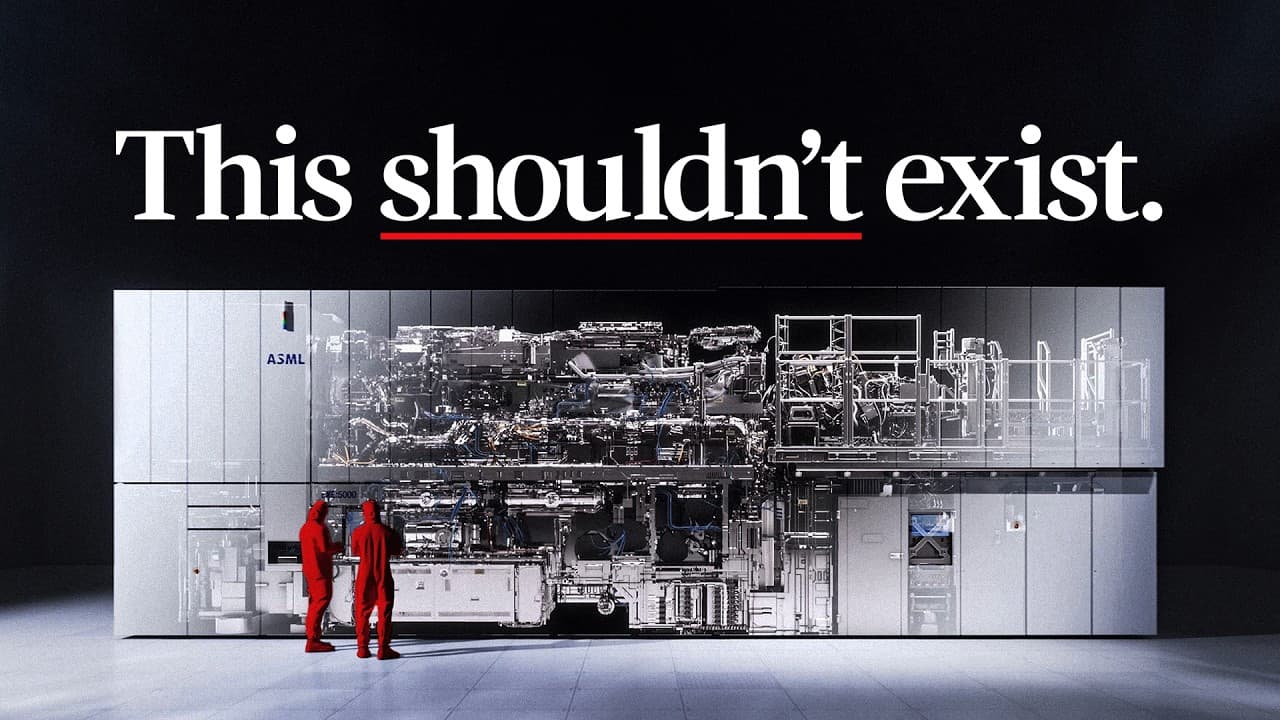
Extreme ultraviolet (EUV) lithography is essential for producing advanced microchips by enabling the printing of smaller features on silicon wafers. The process involves using a high-powered laser to create plasma from tin droplets, generating EUV light. This light is then focused using ultra-smooth mirrors to etch intricate patterns on silicon, allowing for the creation of powerful and efficient microchips.
Transcript
- This is a microchip. When you zoom in, you find a nanoscopic computing city, skyscrapers hundreds of layers tall with hundreds of kilometers of wires connecting everything. And at the very bottom is this, transistors, billions of them. They are the ones and zeros of our computer. The chip works by whizzing electrons from transistor to transistor,... Read More
Key Insights
- EUV lithography is crucial for making advanced microchips by allowing smaller features to be printed on silicon wafers.
- The process uses a high-powered laser to create plasma from tin droplets, generating EUV light with a wavelength of 13.5 nanometers.
- Ultra-smooth mirrors are used to focus the EUV light, which is essential for etching intricate patterns on silicon wafers.
- ASML is the only company capable of manufacturing EUV lithography machines, making it a key player in the tech industry.
- The development of EUV lithography took over 30 years, overcoming numerous technological challenges to become commercially viable.
- The machines are incredibly complex, costing around $400 million each, and require precise engineering to function effectively.
- EUV lithography has allowed Moore's Law to continue, enabling the doubling of transistors on a chip approximately every two years.
- The technology relies on a combination of advanced optics, precision engineering, and innovative solutions to manage the challenges of generating and focusing EUV light.
Install to Summarize YouTube Videos and Get Transcripts
Explore YouTube Video Summarizer or Get YouTube Transcript Extractor
Questions & Answers
Q: How does EUV lithography contribute to microchip production?
EUV lithography enables the printing of smaller features on silicon wafers, which is essential for producing advanced microchips. It uses a high-powered laser to create plasma from tin droplets, generating EUV light. This light is focused using ultra-smooth mirrors to etch intricate patterns on silicon, allowing for the creation of powerful and efficient microchips.
Q: What role does ASML play in the EUV lithography market?
ASML is the only company capable of manufacturing EUV lithography machines, making it a key player in the tech industry. The company's machines are essential for producing advanced microchips, and its technological advancements have allowed Moore's Law to continue by enabling the doubling of transistors on a chip approximately every two years.
Q: What technological challenges were overcome to develop EUV lithography?
The development of EUV lithography involved overcoming numerous challenges, such as generating EUV light with a wavelength of 13.5 nanometers, creating ultra-smooth mirrors to focus the light, and managing the complexity of the machines. The process required innovative solutions to handle the high energy of EUV light and the precise engineering needed to etch intricate patterns on silicon wafers.
Q: How does the EUV lithography process work?
EUV lithography uses a high-powered laser to create plasma from tin droplets, generating EUV light. This light is then reflected and focused using a series of ultra-smooth mirrors, which are crucial for etching intricate patterns onto silicon wafers. The process allows for the production of microchips with smaller, more efficient features.
Q: Why is EUV lithography important for Moore's Law?
EUV lithography is important for Moore's Law because it enables the production of microchips with smaller features, allowing for more transistors to be packed onto a single chip. This technological advancement has allowed the continuation of Moore's Law, which predicts the doubling of transistors on a chip approximately every two years, leading to more powerful and efficient computing devices.
Q: What makes EUV lithography machines so complex and expensive?
EUV lithography machines are complex and expensive due to the intricate engineering required to generate and focus EUV light. The machines use high-powered lasers to create plasma from tin droplets, ultra-smooth mirrors to focus the light, and precise control systems to etch intricate patterns on silicon wafers. These factors contribute to the machines' high cost, around $400 million each.
Q: How does ASML's EUV lithography machine work?
ASML's EUV lithography machine works by using a high-powered laser to create plasma from tin droplets, generating EUV light. This light is then focused using a series of ultra-smooth mirrors, which are essential for etching intricate patterns on silicon wafers. The machine's precise engineering allows for the production of microchips with smaller, more efficient features.
Q: What advancements have been made in EUV lithography?
Advancements in EUV lithography include the development of ultra-smooth mirrors to focus EUV light, the use of high-powered lasers to create plasma from tin droplets, and the precise engineering required to etch intricate patterns on silicon wafers. These advancements have made EUV lithography commercially viable and essential for producing advanced microchips, continuing the trend predicted by Moore's Law.
Summary & Key Takeaways
-
EUV lithography is a vital technology for producing advanced microchips, enabling the printing of smaller features on silicon wafers. It uses a high-powered laser to create plasma from tin droplets, generating EUV light, which is then focused using ultra-smooth mirrors to etch intricate patterns on silicon.
-
ASML is the only company capable of manufacturing EUV lithography machines, positioning it as a leader in the tech industry. The development of this technology took over 30 years, overcoming numerous challenges to become commercially viable and essential for continuing Moore's Law.
-
The complexity of EUV lithography machines, costing around $400 million each, showcases the intricate engineering required to harness EUV light. This technology relies on advanced optics and precision to manage challenges in generating and focusing light for chip production.
Read in Other Languages (beta)
Share This Summary 📚
Summarize YouTube Videos and Get Video Transcripts with 1-Click
Try YouTube Summary with ChatGPT & Claude or YouTube Transcript Generator
Explore More Summaries from Veritasium 📚



Summarize YouTube Videos and Get Video Transcripts with 1-Click
Try YouTube Summary with ChatGPT & Claude or YouTube Transcript Generator