[Eng Sub] Stealth Dicing
TL;DR
Stealth dicing uses focused lasers for precise, debris-free wafer cutting.
Transcript
Hello everyone, welcome to Semicon Talk! Today’s topic is stealth dicing. We already talked about blade dicing. It uses blade to cut wafer and uses water for cooling and cleaning. It also generates chipping and debris. We also talked about laser ablation. It uses laser to cut wafer by melting and evaporating and still uses wafer for cooling. It d... Read More
Key Insights
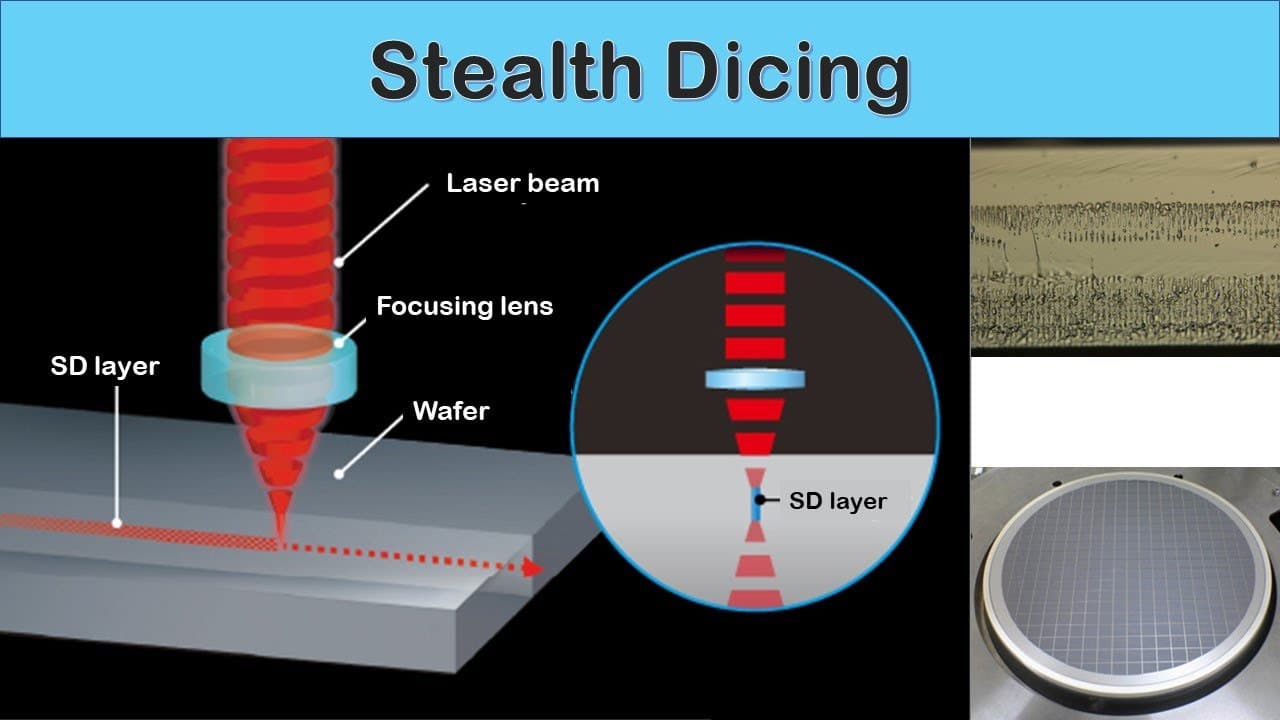
- Stealth dicing is a laser-based technology developed by Hamamatsu Photonics, differing from traditional laser ablation by focusing the laser inside the wafer rather than on its surface.
- The process involves two main steps: the laser process, which creates a modified layer inside the wafer, and the separation process, which uses mechanical stress to separate the dies.
- Unlike blade dicing, stealth dicing does not produce chipping or debris, making it ideal for fragile, low-K wafers and applications sensitive to mechanical stress.
- The laser process in stealth dicing does not require water, making it a dry process suitable for bioelectronic applications that must avoid liquids.
- Stealth dicing is particularly beneficial for MEMS wafers, as it prevents damage from mechanical stress and cooling water, which is a common issue with other dicing methods.
- The technology is also applicable to other materials such as LED wafers, glass wafers, and sapphire wafers, offering a cleaner and more precise cutting method.
- Stealth dicing machines are produced by companies like DISCO and Accretech, emphasizing its industrial relevance and widespread adoption.
- The stealth dicing process results in a cleaner cutting edge compared to blade dicing and laser ablation, due to its internal processing nature.
Install to Summarize YouTube Videos and Get Transcripts
Explore YouTube Video Summarizer or Get YouTube Transcript Extractor
Questions & Answers
Q: What is the main advantage of stealth dicing over traditional blade dicing?
The main advantage of stealth dicing over traditional blade dicing is its ability to cut wafers without generating chipping or debris. By focusing the laser inside the wafer, stealth dicing avoids mechanical stress on the wafer surface, making it ideal for fragile materials and applications requiring high precision.
Q: How does the stealth dicing process work?
Stealth dicing works in two main steps: the laser process and the separation process. In the laser process, the laser is focused inside the wafer to create a modified layer without surface damage. The separation process then applies mechanical stress to this fragile layer, causing it to crack and separate the dies cleanly.
Q: Why is stealth dicing considered a dry process?
Stealth dicing is considered a dry process because it does not use water for cooling or cleaning during the laser process. This is particularly beneficial for applications where liquid exposure must be avoided, such as bioelectronics, making it a versatile and clean cutting method.
Q: What types of wafers benefit most from stealth dicing?
Wafers that benefit most from stealth dicing include MEMS wafers, which are sensitive to mechanical stress, as well as LED, glass, and sapphire wafers. The method's precision and lack of surface damage make it suitable for applications requiring high cleanliness and minimal mechanical impact.
Q: Who are the main manufacturers of stealth dicing machines?
The main manufacturers of stealth dicing machines are companies like DISCO and Accretech. These companies are known for producing high-quality equipment that supports the precision and cleanliness required by the stealth dicing process, highlighting its industrial importance.
Q: What is the role of the laser in the stealth dicing process?
In the stealth dicing process, the laser plays a crucial role by focusing inside the wafer to create a modified layer. This layer is fragile and serves as the point where mechanical stress can be applied to separate the dies cleanly, without affecting the wafer's surface integrity.
Q: How does stealth dicing compare to laser ablation?
Stealth dicing differs from laser ablation by focusing the laser inside the wafer rather than on the surface. This approach avoids surface damage and debris, making it cleaner and more suitable for sensitive applications. In contrast, laser ablation melts and evaporates the wafer surface, which can lead to mechanical stress and chipping.
Q: What are the key applications of stealth dicing?
Key applications of stealth dicing include MEMS devices, bioelectronics, and various wafer types like LED, glass, and sapphire. Its precise and clean cutting capabilities make it ideal for industries where mechanical stress and debris must be minimized, ensuring high-quality and reliable end products.
Summary & Key Takeaways
-
Stealth dicing is a laser-based wafer cutting technology that focuses the laser inside the wafer to create a modified layer, avoiding surface damage and debris. This method is particularly useful for fragile and sensitive applications where precision and cleanliness are paramount.
-
The process consists of two steps: the laser process, which forms a fragile layer inside the wafer, and the separation process, which applies mechanical stress to separate the dies cleanly without chipping. This method is advantageous for MEMS, bioelectronics, and other sensitive applications.
-
Stealth dicing provides a dry, clean cutting solution that is superior to traditional methods like blade dicing and laser ablation, especially for materials like LED, glass, and sapphire wafers. Its adoption by major manufacturers like DISCO highlights its industrial significance.
Read in Other Languages (beta)
Share This Summary 📚
Summarize YouTube Videos and Get Video Transcripts with 1-Click
Try YouTube Summary with ChatGPT & Claude or YouTube Transcript Generator
Explore More Summaries from Semicon Talk 📚
![[Eng Sub] 5G Smartphone: Samsung Galaxy, Apple iPhone, Qualcomm thumbnail](/_next/image?url=https%3A%2F%2Fi.ytimg.com%2Fvi%2F6yGn0cJ18Kw%2Fhqdefault.jpg&w=750&q=75)
![[Eng Sub] PoP(Package on Package): Qualcomm, Apple, Samsung - MCeP, InFO, iPoP thumbnail](/_next/image?url=https%3A%2F%2Fi.ytimg.com%2Fvi%2FFU62n4S9VEk%2Fhqdefault.jpg&w=750&q=75)
![[Eng Sub] Cu Wire Bonding thumbnail](/_next/image?url=https%3A%2F%2Fi.ytimg.com%2Fvi%2F8XaobXIQueM%2Fhqdefault.jpg&w=750&q=75)
![[Eng Sub] Wafer Level Chip Scale Package (WLCSP) thumbnail](/_next/image?url=https%3A%2F%2Fi.ytimg.com%2Fvi%2FF0WLyZZDyeo%2Fhqdefault.jpg&w=750&q=75)
![[Eng Sub] Substrate - Flipchip Substrate Manufacturing Process, Core, Build-up, ABF thumbnail](/_next/image?url=https%3A%2F%2Fi.ytimg.com%2Fvi%2FHiJHMBPcOyg%2Fhqdefault.jpg&w=750&q=75)
![[Eng Sub] 2.5D Package Technology: GPU+HBM, AMD, nVIDIA, TSMC thumbnail](/_next/image?url=https%3A%2F%2Fi.ytimg.com%2Fvi%2FEuBRa3NWMPs%2Fhqdefault.jpg&w=750&q=75)
Summarize YouTube Videos and Get Video Transcripts with 1-Click
Try YouTube Summary with ChatGPT & Claude or YouTube Transcript Generator