What Is Package on Package (PoP) Technology and Its Benefits?
TL;DR
Package on Package (PoP) technology stacks a logic package and a memory package vertically, optimizing space and performance in high-end smartphones. It reduces the footprint on PCBs, allows for faster data exchange due to shorter electrical paths, and offers flexibility in memory sourcing from various suppliers like Samsung and Micron.
Transcript
Today I would like to talk about Package on Package. Package on Package is a Package technology to stack 2 different packages vertically. Typical combination is logic package at bottom and memory package on top. Most cases logic is processor like application processor in smartphone. It includes Apple A series, Qualcomm Snapdragon, and Samsung Exyn... Read More
Key Insights
- Package on Package (PoP) technology stacks two different packages vertically, typically a logic package at the bottom and a memory package on top, optimizing space and performance in high-end smartphones.
- PoP reduces the footprint on printed circuit boards (PCBs) by stacking packages vertically, allowing for more components and functionalities in high-end smartphones.
- The shorter electrical path in PoP improves performance, as data exchange between processor and memory is faster without needing to travel through the PCB.
- PoP offers flexibility in memory sourcing, allowing the use of memory from various suppliers like Samsung, SKHynix, and Micron, without being tied to a specific supplier.
- The assembly of PoP involves attaching a memory package on top of a processor package, which is then mounted on a PCB through the Surface Mount Technology (SMT) process.
- Early PoP structures included bare die fcCSP and molded packages, with real products like Texas Instrument's OMAP processor using these designs.
- Through Mold Via (TMV) technology enhances PoP by increasing I/O count and reducing solder ball pitch, preventing adjacent solder ball contact, and was used in Apple iPhones before TSMC's InFO.
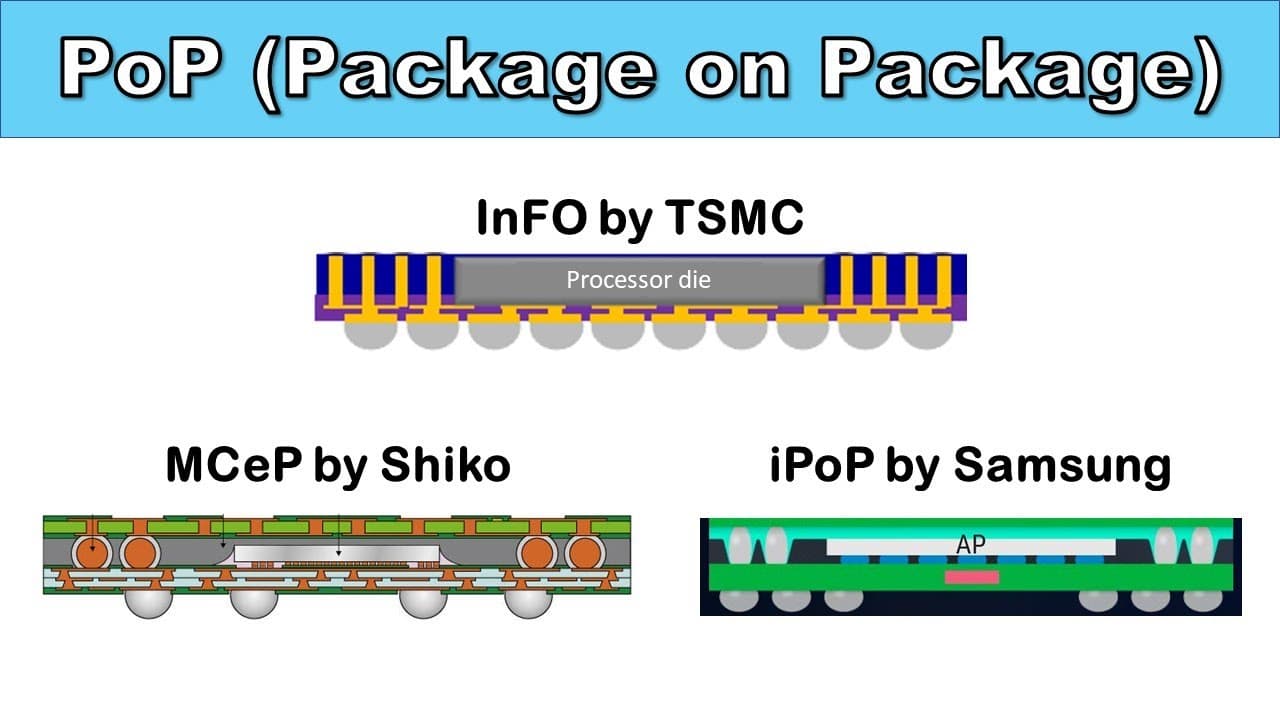
- Current PoP structures for high-end smartphones include MCeP by Shinko, Fan Out by TSMC, and Interposer PoP by Samsung, each with unique features and applications.
Install to Summarize YouTube Videos and Get Transcripts
Explore YouTube Video Summarizer or Get YouTube Transcript Extractor
Questions & Answers
Q: What is the main advantage of using Package on Package technology?
The main advantage of Package on Package (PoP) technology is its ability to reduce the footprint on printed circuit boards (PCBs) by stacking packages vertically. This allows for more components and functionalities in high-end smartphones, optimizing space and improving performance by shortening the electrical path for data exchange.
Q: How does PoP improve data exchange efficiency?
PoP improves data exchange efficiency by shortening the electrical path between the processor and memory. Unlike discrete packages where data travels through the PCB, in PoP, data only needs to travel between the top and bottom packages, resulting in faster data processing and better overall performance.
Q: What flexibility does PoP offer in terms of memory sourcing?
PoP offers flexibility in memory sourcing by allowing the use of memory from various suppliers such as Samsung, SKHynix, and Micron. This means the memory for the top package does not need to come from a specific supplier, providing manufacturers with more options and potentially reducing costs.
Q: What are the early structures of PoP technology?
Early structures of PoP technology included bare die flip-chip Chip Scale Package (fcCSP) and molded packages. These structures featured exposed flip-chip dies or mold areas at the center with ball pads at the periphery, allowing for the attachment of top packages. Texas Instrument's OMAP processor utilized these early PoP designs.
Q: What is Through Mold Via (TMV) technology in PoP?
Through Mold Via (TMV) technology in PoP is designed to increase the I/O count between the top and bottom packages by reducing the solder ball pitch. TMV fills the gap between solder balls with mold compound, preventing adjacent solder ball contact, which allows for narrower solder ball pitch and more data processing capabilities.
Q: What are the current major PoP structures used in smartphones?
The current major PoP structures used in smartphones include MCeP by Shinko for Qualcomm Snapdragon processors, Fan Out by TSMC for Apple iPhone A series processors, and Interposer PoP by Samsung for Samsung Exynos processors. Each structure has unique features that enhance performance and functionality in high-end smartphones.
Q: How is a PoP assembled and mounted on a PCB?
A PoP is assembled by attaching a memory package on top of a processor package. This assembled PoP is then mounted on a printed circuit board (PCB) through the Surface Mount Technology (SMT) process, which involves soldering the PoP onto the PCB for integration into electronic devices.
Q: What is the role of mold compound in PoP structures?
In PoP structures, mold compound plays a crucial role in filling the space between solder balls and providing structural support. It prevents adjacent solder balls from touching each other, which is essential for maintaining narrow solder ball pitch and increasing the I/O count, thereby enhancing data processing capabilities.
Summary & Key Takeaways
-
Package on Package (PoP) technology is used to stack a logic package and a memory package vertically, optimizing space and performance in devices like high-end smartphones. This structure allows for a smaller footprint on PCBs and better data exchange efficiency.
-
PoP technology offers flexibility in sourcing memory from various suppliers and is assembled by attaching a memory package on a processor package, which is then mounted on a PCB. Early PoP structures included bare die fcCSP and molded packages.
-
Modern PoP structures include MCeP by Shinko for Qualcomm Snapdragon, Fan Out by TSMC for Apple iPhone A series, and Interposer PoP by Samsung for Samsung Exynos, each enhancing performance and functionality in high-end smartphones.
Read in Other Languages (beta)
Share This Summary 📚
Summarize YouTube Videos and Get Video Transcripts with 1-Click
Try YouTube Summary with ChatGPT & Claude or YouTube Transcript Generator
Explore More Summaries from Semicon Talk 📚
Summarize YouTube Videos and Get Video Transcripts with 1-Click
Try YouTube Summary with ChatGPT & Claude or YouTube Transcript Generator