How to Prepare Benzaldehyde from Toluene in Two Steps
TL;DR
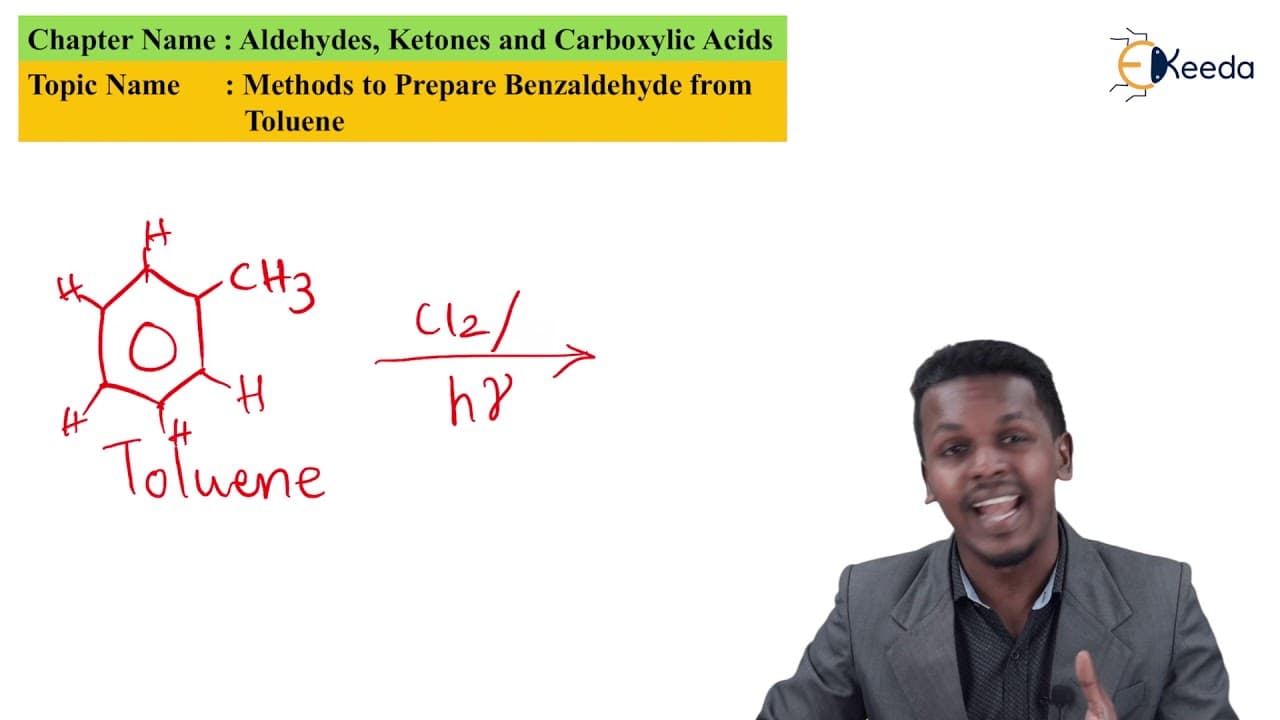
Benzaldehyde is prepared from toluene through a two-step process. First, toluene is chlorinated using chlorine gas and UV light to create benzyl chloride, which is then reacted with water to yield benzaldehyde and hydrochloric acid. This method effectively substitutes the methyl group in toluene with a benzaldehyde functional group.
Transcript
hello friends in the previous topic we have discussed about how we can prepare aldehyde and how we can prepare a ketone using different chemicals and now in this topic let me talk about how we can prepare aromatic aldehyde using toluene so how the reaction proceeds this is what I will talk about in this topic so now let's get started so friends the... Read More
Key Insights
- 💦 Toluene can be converted into benzaldehyde, an aromatic aldehyde, through a two-step process involving chlorination and reaction with water.
- 🙂 Chlorination of toluene occurs in the presence of chlorine gas and UV light, resulting in the formation of benzyl chloride.
- 🥺 Benzyl chloride is then reacted with water, leading to the formation of benzaldehyde and hydrochloric acid.
- 😋 The hydrogen atoms attached to the aromatic ring in toluene remain stable and are unaffected by the chlorination reaction.
- 🙂 UV light provides the necessary energy for the chlorination reaction to occur.
- 👥 The conversion of toluene to benzaldehyde involves the substitution of a methyl group with a benzaldehyde functional group.
- ❓ The process can be used to synthesize aromatic aldehydes from various starting materials.
Install to Summarize YouTube Videos and Get Transcripts
Explore YouTube Video Summarizer or Get YouTube Transcript Extractor
Questions & Answers
Q: How is toluene converted into benzaldehyde?
It takes two steps. First, toluene is chlorinated with chlorine gas (Cl2) under UV light, which converts the CH3 group into a CHCl2 group. That intermediate is then reacted with water and heated, and the oxygen replaces the two chlorine atoms to form benzaldehyde (a benzene ring with a CH=O group).
Q: What is the first step in the synthesis of benzaldehyde from toluene?
The first step is chlorination. The methyl group of toluene reacts with Cl2 in the presence of UV light, forming a product where the CH3 has become CHCl2. Two moles of HCl are released as a by-product in this step.
Q: Why can't the CH3 group in toluene be converted to CHO directly?
According to the video, the methyl group cannot be converted lightly into a CHO group in one move. That is why the two-step route is used: chlorinate the methyl group first, then hydrolyze the chlorinated intermediate with water to introduce the oxygen.
Q: What is the role of UV light in the chlorination reaction?
UV light provides the energy needed to start the reaction between chlorine and toluene. It drives the chlorine to react with the methyl group rather than the ring, allowing the CH3 group to be chlorinated.
Q: What happens to the hydrogen atoms on the aromatic ring during chlorination?
They remain unaffected. The hydrogen atoms attached to the aromatic ring are quite stable and are not removed easily, so chlorine reacts with the methyl group instead of the ring hydrogens.
Q: How is the chlorinated intermediate turned into benzaldehyde?
The CHCl2 intermediate is reacted with water (H-O-H) and heated. The two chlorine atoms leave with the two hydrogens of water as two moles of HCl, while the remaining oxygen attaches to the carbon on the ring, producing benzaldehyde.
Q: What by-product is formed when toluene is converted to benzaldehyde?
Hydrochloric acid (HCl) is the by-product. Two moles of HCl are released during the chlorination step, and two more moles of HCl are released when the chlorinated intermediate reacts with water.
Q: What type of compound is benzaldehyde in this reaction?
Benzaldehyde is an aromatic aldehyde. It is a benzene ring carrying a CH=O group, formed by replacing the methyl group of toluene through chlorination followed by reaction with water.
Summary & Key Takeaways
-
Toluene can be converted into benzyl chloride through a chlorination reaction using chlorine gas and UV light.
-
Benzyl chloride is then reacted with water, resulting in the formation of benzaldehyde and two moles of hydrochloric acid.
-
The process involves the substitution of a methyl group in toluene with a benzaldehyde functional group.
Read in Other Languages (beta)
Share This Summary 📚
Summarize YouTube Videos and Get Video Transcripts with 1-Click
Try YouTube Summary with ChatGPT & Claude or YouTube Transcript Generator
Explore More Summaries from Ekeeda 📚






Summarize YouTube Videos and Get Video Transcripts with 1-Click
Try YouTube Summary with ChatGPT & Claude or YouTube Transcript Generator