What Is the Purpose of React Context for Dependency Injection?
TL;DR
The purpose of React Context for dependency injection is to simplify component decoupling and enhance testing flexibility. By using context, you can easily mock APIs or services without needing to change your entire application structure, allowing for cleaner code and more robust unit testing.
Transcript
so I'm sure most of you have used context in react and the number one use case that you often hear is so that you can avoid prop drilling so if you have a parent that has multiple children and you need to share some State amongst all those you can use context to kind of take a dispatch functions and kind of share them amongst all these children com... Read More
Key Insights
- 👶 Using context in React helps manage shared state more effectively among child components, reducing the complexity of prop drilling.
- 👻 Dependency injection allows for greater flexibility in component design, enabling easy swapping of implementations for more robust unit testing.
- 💨 Wrapping API calls within classes or functions provides an organized way to manage and abstract away direct API interactions, thereby enhancing code legibility.
- 😄 When implementing context, it's crucial to set up interfaces that outline expected operations, promoting clear expectations and easing collaboration between team members.
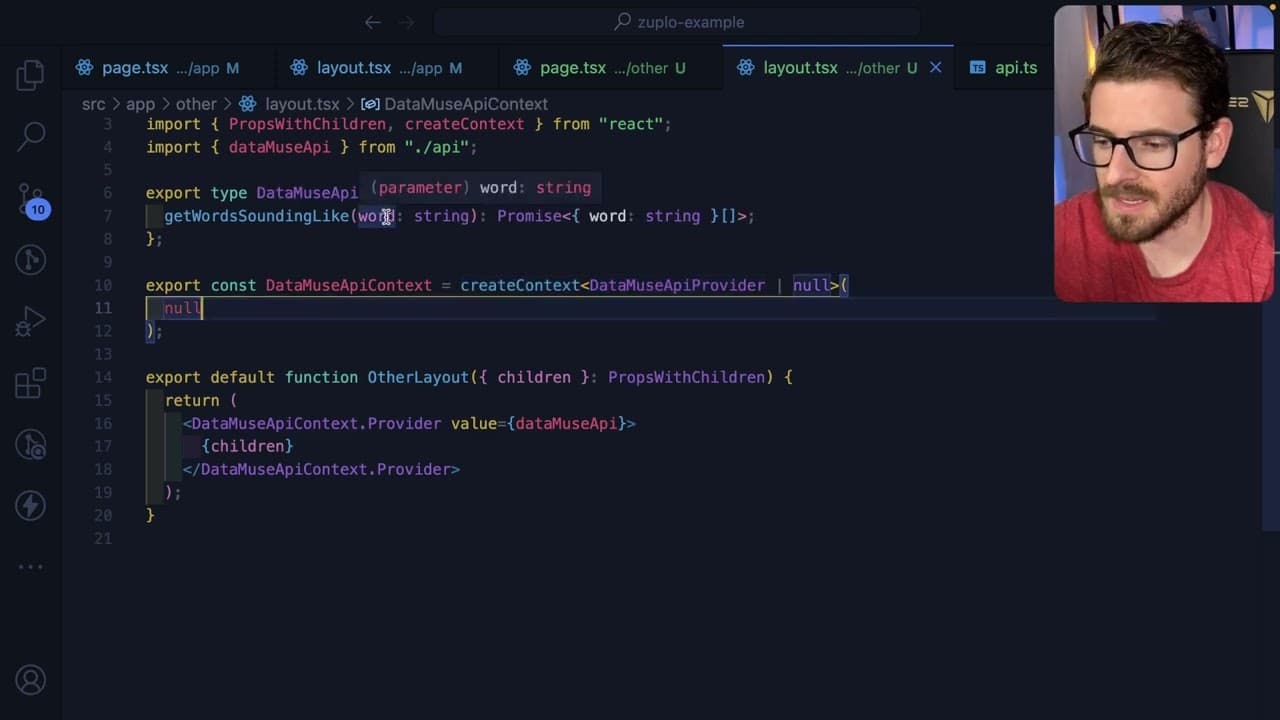
- 💨 The practice of creating a custom hook, such as
useDataMuseAPIContext, simplifies the consumption of context while abstracting away its internal logic, making the code more reusable. - 🏆 Testing components that rely on context becomes straightforward; mock providers can be easily created to simulate different behaviors and return values during tests.
- 👻 Proper separation of concerns is maintained when contexts are utilized correctly, allowing for cleaner code and less interdependence between components and their data.
Install to Summarize YouTube Videos and Get Transcripts
Explore YouTube Video Summarizer or Get YouTube Transcript Extractor
Questions & Answers
Q: What is the main advantage of using context in React?
The primary advantage of using context in React is to eliminate prop drilling, where props are passed through multiple layers of component hierarchy. This makes managing state across several components simpler and cleaner, allowing for a more organized code structure and improved readability.
Q: How does dependency injection improve the testing of React components?
Dependency injection enhances testing in React by allowing developers to substitute real implementations with mocks or stubs in their tests. This approach decouples components from external dependencies, enabling easier testing of components in isolation without worrying about the complexities introduced by the actual dependencies.
Q: Can you explain how to set up a context for an API in React?
To set up a context for an API in React, you first create a context using createContext(). Next, define a provider component that wraps your application, passing down the API instance through the context value. Components can then consume this context to invoke API methods without importing the API directly, promoting better separation of concerns.
Q: Why is it beneficial to define interfaces for context values?
Defining interfaces for context values in React is beneficial as it provides a contract that components must adhere to, ensuring type safety. This practice prevents tight coupling to specific implementations, allowing for easier code maintenance and flexibility, as developers can swap out implementations that satisfy the interface without breaking dependent components.
Summary & Key Takeaways
-
Context in React helps to avoid prop drilling by allowing the sharing of state among multiple child components, improving manageability and readability.
-
Dependency injection through context simplifies testing by enabling组件 decoupling, making it easier to mock APIs or services without changing the entire application structure.
-
Implementing context involves creating a provider that holds instantiated objects, allowing components to access shared functionality while adhering to defined interfaces, facilitating cleaner code and greater flexibility.
Read in Other Languages (beta)
Share This Summary 📚
Summarize YouTube Videos and Get Video Transcripts with 1-Click
Try YouTube Summary with ChatGPT & Claude or YouTube Transcript Generator
Explore More Summaries from Web Dev Cody 📚




Summarize YouTube Videos and Get Video Transcripts with 1-Click
Try YouTube Summary with ChatGPT & Claude or YouTube Transcript Generator