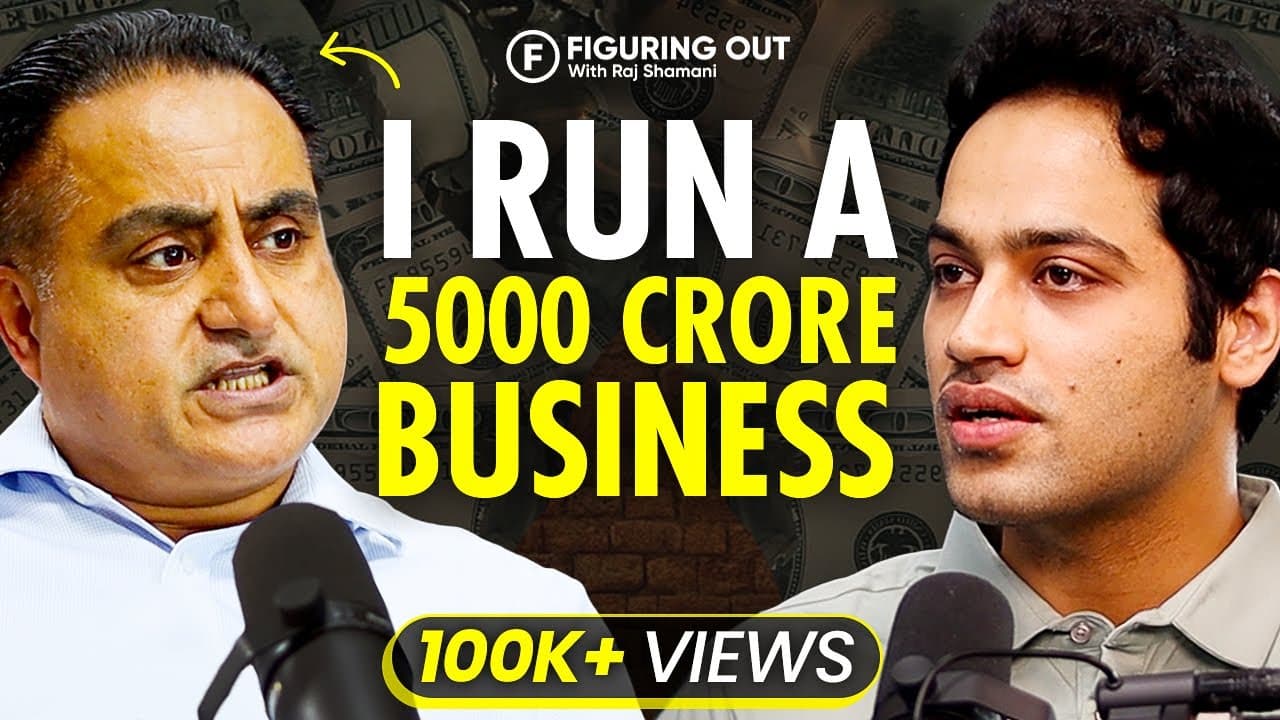
How to Raise Money, Create Wealth and Build Brands, Matrix Founder Avnish Bajaj on FO91 with Raj Shamani
TL;DR
Avnish Bajaj’s central argument is that founders raise money and build valuable companies by selling their vision continuously while understanding how India’s expanding income base changes demand. He connects Apple’s six billion dollars of Indian iPhone revenue with local manufacturing interest, explains why zero-interest-era valuations may not return for seven or eight years, and identifies conviction, customer understanding and forward-looking market analysis as essential. Read on for his specific reasoning about capital, consumption and company building.
Transcript
why is Tim Cook coming here into in 2016 he didn't because now I India has six billion dollars of revenue for iPhones why is Samsung Foxconn setting up plans because we tried the same policies in 2016-17 and we said if you want to sell in India you have to make in India why few Founders are able to raise better build better show better dreams and h... Read More
Key Insights
- Founders are always selling: Bajaj rejects the idea that entrepreneurship can be separated from selling. A founder sells continuously to investors, employees and customers, effectively operating in sales 24 hours a day, seven days a week. The ability to build and present a compelling dream therefore affects fundraising, recruitment and customer adoption at the same time.
- Conviction changes the pitch: The discussion links superior fundraising with founders who can build better, show better dreams and demonstrate stronger conviction. Capital does not depend only on describing a company. Founders must make other people believe in what they intend to build, because investors, employees and customers are all being asked to support an outcome that has not yet been achieved.
- Early and late stages differ: Bajaj does not describe the entire investment market as moving together. He sees early-stage activity in India as fairly steady, while later-stage capital is more sensitive to the return of international investors and their planning cycles. This distinction matters because a difficult later-stage environment does not automatically mean that early-stage fundraising has stopped.
- September is an informed guess: The predicted pickup from September onward is explicitly presented as Bajaj’s guess, not a certainty. His reasoning is that US market participants often leave around May, return by August and then plan for the next year. Asian investors may restart later-stage activity first, with American capital entering afterward.
- Cheap capital drove excess: Bajaj ties the previous valuation surge to zero percent interest rates and what he calls free money. When capital carried little cost, high-risk opportunities could command unusually aggressive prices. Once US interest rates reached five percent, the risk-reward calculation changed, making the earlier valuation environment unlikely to return on the same timetable.
- The reset may last years: The conversation gives a concrete horizon for the valuation shift. Bajaj says the wild valuations observed during the prior two years may not return for seven or eight years. His point is not merely that prices fell temporarily, but that the financial conditions supporting those prices have fundamentally changed.
- Current demand understates potential: Critics may be correct that India presently has only about five million people with meaningful paying capacity, yet Bajaj says that conclusion is wrong when used to define the future market. It measures the existing pyramid without accounting for rising income, broader consumption and the movement from poverty toward middle income.
- India’s scale needs context: A three-and-a-half-trillion-dollar economy spread across approximately 1.4 billion people produces a different consumer picture than the headline GDP alone suggests. Bajaj therefore focuses on income per person and its future growth. The opportunity emerges as the economic pyramid widens, not simply because the country already has a large aggregate economy.
- Middle income changes spending: Bajaj describes the middle-income journey as starting around two thousand to two thousand five hundred dollars of income per person and extending to roughly eight to ten thousand dollars. During that progression, more households satisfy basic needs, allowing a growing share of each additional rupee to fund discretionary purchases.
- Incremental income has leverage: Once basic human requirements are met, Bajaj says 30, 40 or 50 of every incremental rupee can shift toward discretionary spending. That change can cause categories to expand faster than observers expect. His argument for Indian consumption rests on where new income goes, not only on the total income consumers possess today.
- Luxury demand appears first: Bajaj uses luxury-car sales increasing 30 percent year over year as evidence that India’s currently affluent one percent is becoming wealthier and spending more. He expects luxury consumption to remain strong for the next decade. Broader demand follows as rising income reshapes the pyramid and enlarges the consuming population.
- Earlier luxury bets provide context: Matrix participated in bringing nine luxury brands to India through an investment made around 2006 or 2007, including Ferragamo among the brands mentioned. This example connects Bajaj’s long-running investment interest in Indian luxury consumption with his present belief that increasing affluence will continue supporting the category.
Install to Summarize YouTube Videos and Get Transcripts
Explore YouTube Video Summarizer or Get YouTube Transcript Extractor
Questions & Answers
Q: How should founders raise money from large investors, according to Avnish Bajaj?
Founders must recognize that fundraising is an act of selling. Bajaj says they are selling 24 hours a day, seven days a week, including to investors, employees and customers. The founders who raise better can build a stronger story, show a better dream and communicate greater conviction. This matters because investors are being asked to believe in a future outcome, not only the company’s present condition.
Q: Why are Apple, Samsung and Foxconn becoming more active in India?
Bajaj points to India’s growing domestic revenue and manufacturing requirements. Apple now generates six billion dollars of iPhone revenue in India, giving Tim Cook a stronger reason to visit than in 2016. Policies had already said that companies wanting to sell in India should make products in India. Samsung and Foxconn setting up plants reflects the combination of that manufacturing push and a deeper local market.
Q: Will startup valuations return to their previous highs soon?
Bajaj does not expect the wild valuations of the previous two years to return soon. He estimates that similar levels may be absent for seven or eight years. Those valuations were supported by free money and zero percent interest rates. With US interest rates at five percent, investors face a different risk-reward decision and allocate capital differently.
Q: When could later-stage startup investment activity improve?
Bajaj suggests that later-stage activity might begin picking up from September onward, while stressing that prediction is difficult. He links this estimate to US investors returning around August after their holiday period and starting plans for the next year. Asian investors may drive the first improvement. American investors, described as the largest pool of capital, may return later.
Q: Is early-stage funding in India also slowing sharply?
Bajaj distinguishes early-stage investment from the later-stage market. He describes early-stage activity in India as pretty steady, based partly on the background of the company involved. Later-stage activity depends more heavily on when Asian and American investors return. The distinction explains why founders should not treat every funding stage as if it follows the same cycle.
Q: Does India have a large enough consumer market for startups?
Bajaj accepts that the current group with strong paying capacity is limited, but says using that figure alone is backward-looking. He compares it to driving forward while watching the rear-view mirror. India’s opportunity depends on rising income per person and the economic pyramid becoming broader. As more people enter the middle-income journey, demand can expand across many markets.
Q: How does rising income change consumer spending in India?
Bajaj says basic needs absorb income at the lower end of the economic journey. Once those needs are met, 30, 40 or 50 of every additional rupee can move into discretionary spending. That shift allows categories people did not expect to grow rapidly. The mechanism is important because a modest rise in income can produce a much larger change in nonessential consumption.
Q: Why does Avnish Bajaj expect luxury consumption to keep growing?
Bajaj says India’s affluent one percent is receiving more income and spending more on luxury products. He cites luxury-car sales increasing 30 percent year over year as evidence of this pattern. He expects the luxury trend to continue for the next decade. Over time, rising income should broaden the economic pyramid and spread consumption across more markets.
Summary & Key Takeaways
-
Introducing India’s startup opportunity: Raj Shamani presents Avnish Bajaj of Matrix Partners India as an early investor in startups including Ola and Practo. Their FO91 conversation focuses on what large investors seek in small startups and founders, why certain entrepreneurs receive backing, and how founders can raise money. It also examines Apple’s growing interest in India, similarities between Indian and Chinese growth, wealth creation, brand building and the traits associated with winning entrepreneurs.
-
Reading the 2023 funding environment: Bajaj says predicting the market precisely is difficult, but offers a view that later-stage activity could begin improving around August or September. He connects that timing to US investors returning from holidays and beginning plans for the following year. He expects Asian investors to support the earlier pickup, while Americans, representing the largest pool of capital in his account, may return later. Early-stage activity in India, however, is described as comparatively steady.
-
Explaining the valuation reset: The unusually high valuations of the previous two years are not expected to return soon. Bajaj estimates that comparable conditions may not reappear for seven or eight years. He attributes those valuations to free money and zero percent interest rates, conditions last seen around 2008 or 2009 after the GRC. With US interest rates at five percent, investors must reconsider risk and reward, changing how capital is allocated across opportunities.
-
Looking beyond today’s market: Bajaj accepts that India currently has a limited group with strong paying capacity, but calls that observation backward-looking. He describes judging India only by its present consumer base as driving forward while looking in the rear-view mirror. India has a roughly three-and-a-half-trillion-dollar economy and about 1.4 billion people. Its movement from a poor country into the middle-income journey begins around two thousand to two thousand five hundred dollars of income per person.
-
Following income into consumption: Bajaj places the middle-income range between roughly two thousand and eight to ten thousand dollars of income per person, implying that India would need an economy around ten trillion dollars to progress through that journey. As basic needs are met, he says 30, 40 or 50 of each incremental rupee can move into discretionary spending. He points to luxury-car sales growing 30 percent year over year and expects luxury demand to continue for the next decade before consumption becomes broader across many markets.
Read in Other Languages (beta)
Share This Summary 📚
Summarize YouTube Videos and Get Video Transcripts with 1-Click
Try YouTube Summary with ChatGPT & Claude or YouTube Transcript Generator
Explore More Summaries from Figuring Out With Raj Shamani 📚


Summarize YouTube Videos and Get Video Transcripts with 1-Click
Try YouTube Summary with ChatGPT & Claude or YouTube Transcript Generator