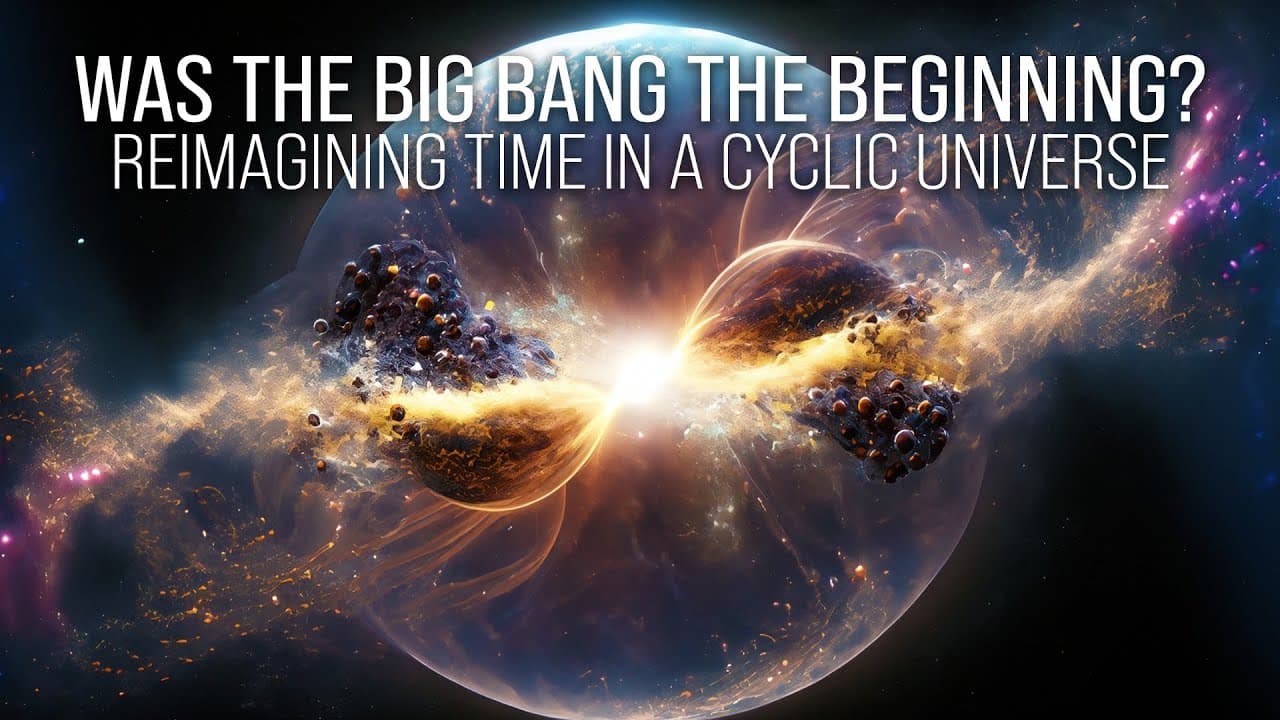
Was the Big Bang the Beginning? Reimagining Time in a Cyclic Universe
TL;DR
The Big Bang may not have been the absolute beginning if the universe passes through recurring cycles of expansion and contraction. Richard Tolman proposed a scientific cyclic model in the 1940s, while a more recent version argues that cycles could extend arbitrarily far into the past despite the entropy problem. Read on to see how observations, general relativity, and unresolved theoretical challenges shape this controversial alternative.
Transcript
the daily rising and setting of the Sun the annual transition between winter spring summer and fall the repeated stages of development of living systems from birth growth maturity aging and eventual death much of the world unfolds through processes like these that are cyclical so might such rhythmic Cycles extend beyond those we directly observe an... Read More
Key Insights
- 🏍️ Cyclic cosmology offers an alternative to the Big Bang theory, suggesting that the universe undergoes repeating cycles of expansion and contraction.
- ❓ The challenges of cyclic cosmology include addressing the entropy problem, developing a theoretical model for the contracting phase, and ensuring cosmological smoothness and uniformity.
- 🔬 Simulations using general relativity are instrumental in investigating the behavior and evolution of the universe during different phases.
- ⌛ The development of alternative theories, such as cyclic cosmology, challenges the established paradigms in cosmology and encourages further exploration of cosmological origins and the nature of time.
Install to Summarize YouTube Videos and Get Transcripts
Explore YouTube Video Summarizer or Get YouTube Transcript Extractor
Questions & Answers
Q: Was the Big Bang the beginning of the universe?
The dominant cosmological paradigm treats the Big Bang as a singular event from which everything emerged, but cyclic cosmology offers another possibility. In a recent cyclic model, cycles may extend arbitrarily far into the past, which would mean the universe had no beginning if the model's calculations describe reality.
Q: What is cyclic cosmology?
Cyclic cosmology proposes that the universe repeatedly passes through phases of spatial expansion and contraction. After contraction recreates a dense universe, another Big Bang begins a new expansion, and the cycle repeats.
Q: How does cyclic cosmology differ from the traditional Big Bang model?
The traditional account describes the Big Bang as a singular origin followed by cosmic expansion. Cyclic cosmology instead places a Big Bang within a repeating sequence of expansion, contraction, renewed density, and another expansion.
Q: Who introduced the scientific possibility of a cyclic universe?
Physicist Richard Tolman introduced the scientific possibility of a cyclic universe in the 1940s. He imagined expansion eventually ending, followed by contraction and the formation of a dense universe that expands again through another Big Bang.
Q: Why was an infinitely old cyclic universe considered impossible?
Further research applied the second law of thermodynamics, which dictates a relentless increase in entropy or disorder. That analysis indicated that the proposed cycles could not extend infinitely far into the past and therefore must themselves have had a beginning.
Q: How does the newer cyclic-universe model avoid a beginning?
Proponents of a more recent incarnation argue that its cycles could have occurred arbitrarily far back in time. If their calculations prove relevant to reality, the universe would not require an absolute beginning, and the current cycle could end sometime in the far future.
Q: What challenges must cyclic cosmology overcome?
The model must address the entropy problem and provide a theoretical account of the contracting phase. It must also explain how the universe remains smooth and uniform during the relevant stages of its evolution.
Q: How do general-relativity simulations contribute to cyclic cosmology?
Simulations using general relativity let scientists investigate the universe's behavior through different phases and test alternative cosmological scenarios. The existing analysis reports promising results related to contraction, smoothing, and uniformity, although cyclic cosmology remains a controversial competitor to mainstream thinking.
Summary & Key Takeaways
-
The concept of cyclic universes, where the universe undergoes repeated phases of expansion and contraction, has been proposed as an alternative to the Big Bang theory.
-
The challenges of cyclic cosmology are overcoming the entropy problem, finding a theoretical model for the contracting phase, and ensuring the smoothness and uniformity of the universe during the expanding phase.
-
Simulations using general relativity have shown promising results for resolving these challenges and providing a new perspective on the origins and evolution of the universe.
Read in Other Languages (beta)
Share This Summary 📚
Summarize YouTube Videos and Get Video Transcripts with 1-Click
Try YouTube Summary with ChatGPT & Claude or YouTube Transcript Generator
Explore More Summaries from World Science Festival 📚

Summarize YouTube Videos and Get Video Transcripts with 1-Click
Try YouTube Summary with ChatGPT & Claude or YouTube Transcript Generator