How to Find and Launch an AI Service Business
TL;DR
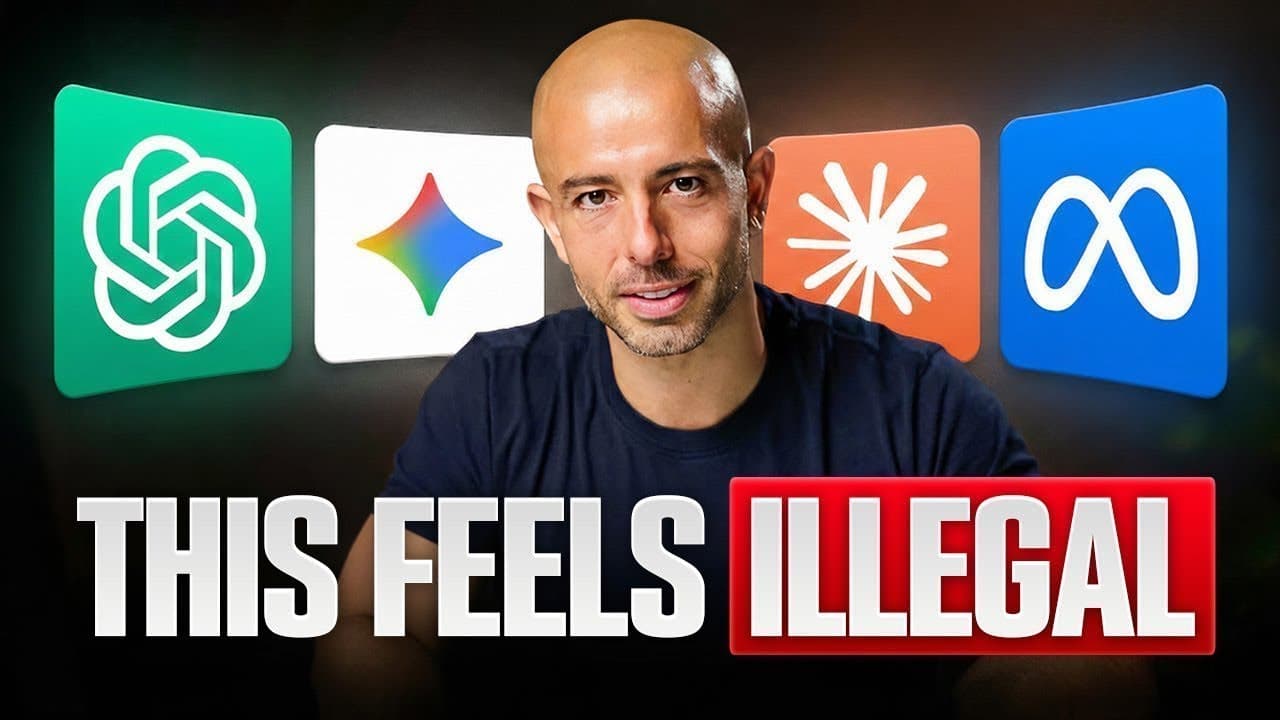
Use AI deep research to identify service businesses with proven demand, visible competition, urgent customer pain, and measurable outcomes. Validate each opportunity through existing providers, advertisements, case studies, testimonials, traffic, pricing, and social followings, then choose a focused service that can be delivered remotely with tools such as ChatGPT, Claude, Make.com, or Zapier.
Transcript
I've generated my clients over $7.8 billion. And it's all because I spent the last 17 years of my life mastering marketing. But AI has gotten so powerful that today I'm going to show you how to use it to go out there and actually find a business to start. Not only that, but to actually build the whole funnel for us and even how to write the ads tha... Read More
Key Insights
- Competition is presented as evidence that demand and commercial activity already exist. The recommended approach is to enter a market where businesses are already winning, rather than assuming that a market with no competitors represents an undiscovered opportunity.
- Urgent customer pain is the primary filter for choosing a market. The research process looks through forums such as Reddit to identify recurring fears, frustrations, hopes, and desired outcomes that reveal problems customers want solved immediately.
- Deep research is used to investigate five high-potential AI-enabled service models within selected niches. The prompt asks for providers, websites, customer problems, delivery methods, pricing, evergreen demand, replicability, service pages, case studies, and other supporting evidence.
- Proven demand is assessed through existing agencies, software companies, and service providers already selling comparable solutions. Advertisements, case studies, testimonials, website traffic, social followings, and lead volume are treated as indicators of traction rather than direct proof of revenue.
- The preferred business model is a remotely delivered service with no physical inventory, warehousing, shipping, returns, or freight. Its fulfillment should be realistically supported by existing tools such as ChatGPT, Claude, Make.com, and Zapier.
- The target economics are recurring contracts averaging $500–$5,000 per month or one-time projects priced at $2,000–$10,000. These ranges are intended to focus the search on substantial problems for which businesses already allocate meaningful budgets.
- A saturation score of five or six out of ten is described as the preferred range. It offers enough competition to validate demand while leaving room to differentiate through niche specialization, better systems, faster delivery, stronger copy, improved advertising angles, or superior client service.
- Fast and measurable client results are treated as a critical selection criterion. Services become more attractive when customers can quickly connect the work to improved lead generation, qualification, search visibility, advertising performance, or another observable business outcome.
Install to Summarize YouTube Videos and Get Transcripts
Explore YouTube Video Summarizer or Get YouTube Transcript Extractor
Questions & Answers
Q: How can AI help find a viable service business?
AI can research established service providers, customer complaints, pricing models, advertisements, case studies, testimonials, traffic, and social followings within a chosen niche. The prompt described in the transcript asks for five models that solve genuine problems, have evergreen demand, can be delivered remotely, and are already being purchased. This reduces guesswork, although the resulting ideas still require validation before building a funnel or running advertisements.
Q: What criteria should an AI service business meet?
The service should solve a legitimate personal or business problem through AI or automation, be deliverable remotely, and already have proven demand in the United States. It should avoid temporary trends, produce fast and measurable outcomes, and be replicable with existing tools. The method also favors focused providers over broad full-service agencies because a specialized offer is more realistic for one person to deliver.
Q: Why does the method favor markets with competition?
Competition is treated as a positive sign because it shows that customers are already spending money and providers are successfully offering solutions. A market with no competitors may indicate weak demand rather than an overlooked opportunity. The proposed strategy is to join an active market and capture part of its existing demand through stronger systems, clearer specialization, improved copy, better advertising angles, faster delivery, or superior client service.
Q: How should customer pain be researched with AI?
The method uses deep research and forum foraging to examine discussions on sources such as Reddit. AI is instructed to collect recurring customer pains, fears, hopes, and desired outcomes instead of requiring the entrepreneur to search every discussion manually. The most attractive market has an urgent, pressing problem, described in the transcript as a bleeding-neck pain, because affected customers need a solution quickly and are more likely to pay for measurable relief.
Q: What pricing range does the research prompt target?
The research prompt looks for services with average contract values between $500 and $5,000 per month, or one-time projects priced from $2,000 to $10,000. These figures help screen for meaningful services rather than novelty products. Pricing is only one criterion, so each opportunity must also demonstrate established demand, evergreen relevance, remote delivery, measurable outcomes, and the ability to reproduce fulfillment using available AI and automation tools.
Q: What level of market saturation is preferred?
The preferred saturation score is approximately five or six out of ten, where one represents a completely untapped market and ten represents an oversaturated one. This middle range is intended to provide evidence of demand without entering a market considered fully crowded. Differentiation can then come from better systems, faster delivery, niche specialization, stronger copy, improved funnel and advertising angles, or more attentive client service.
Q: How can demand for an AI service be validated?
Demand can be investigated by finding agencies, software companies, or service providers that already sell the service and have established clients. The method checks service pages, linked case studies, testimonials, advertisements in the Facebook Ads Library, traffic, lead volume, social followings, pricing, and contract value. These are described as revenue indicators rather than direct access to financial records, so several signals should support the opportunity before proceeding.
Q: What AI service example is identified for real estate?
The research identifies a real estate marketing service associated with Luxury Presence. It is described as a done-for-you marketing department for agents and brokerages that need lead generation and ongoing marketing but lack time or expertise. The AI-supported functions include continuous lead engagement and qualification, search-oriented website content, advertising campaign management, and content assistance, potentially replacing several separate assistants, writers, search specialists, or marketing vendors.
Summary & Key Takeaways
-
The method begins with a detailed research prompt that asks ChatGPT to find five promising AI-enabled service models in selected markets. The search emphasizes real estate, e-commerce, legal services, and other service industries selling expensive offers, where customers already spend money to resolve significant and urgent business problems.
-
Each opportunity is evaluated for proven demand, remote delivery, evergreen relevance, visible competitors, repeatable fulfillment, and fast measurable outcomes. The preferred pricing is $500–$5,000 per month or $2,000–$10,000 for a one-time project, with a target saturation score of approximately five or six out of ten.
-
The research example identifies an AI marketing service for real estate agents that can combine lead nurturing, search optimization, advertising management, and content support. The broader process is to validate the model through providers and market evidence, then use stronger positioning, copy, advertising angles, and a focused funnel to attract customers.
Read in Other Languages (beta)
Share This Summary 📚
Summarize YouTube Videos and Get Video Transcripts with 1-Click
Try YouTube Summary with ChatGPT & Claude or YouTube Transcript Generator
Explore More Summaries from Sabri Suby 📚




Summarize YouTube Videos and Get Video Transcripts with 1-Click
Try YouTube Summary with ChatGPT & Claude or YouTube Transcript Generator