How Do China’s Dark Factories Produce EVs?
TL;DR
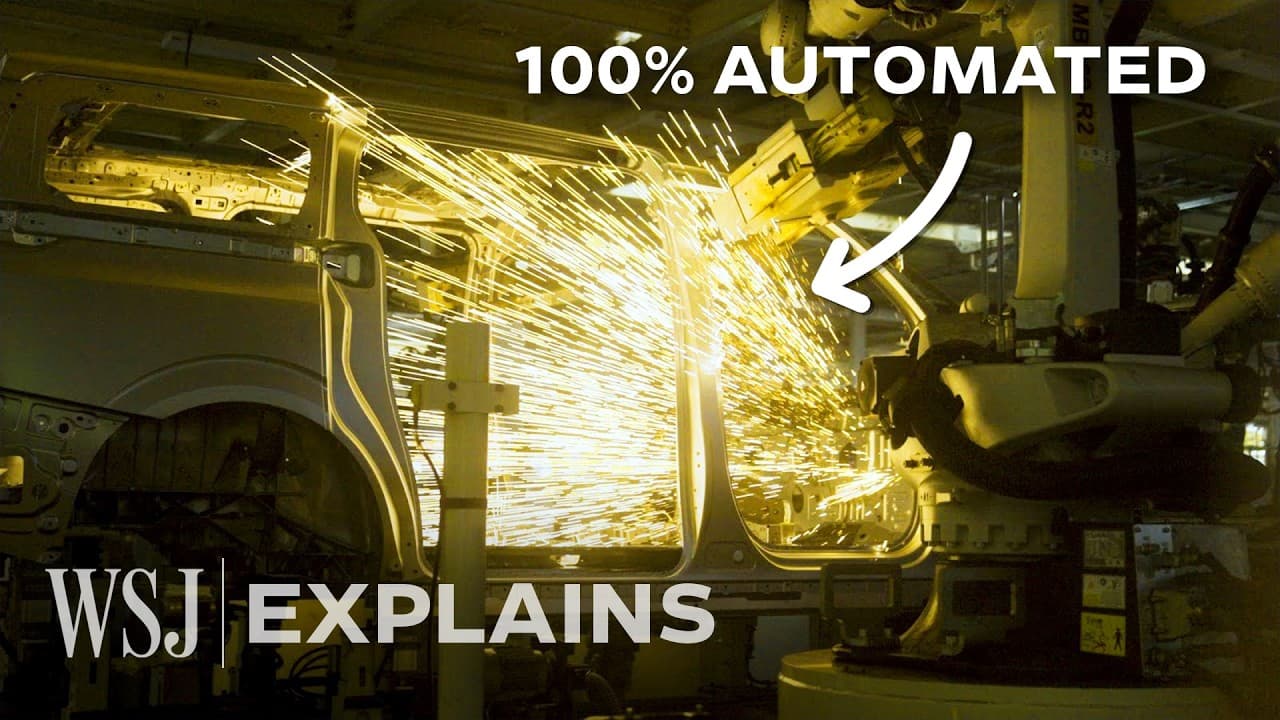
China’s dark factories use extensive robotization to manufacture electric vehicles around the clock with limited human presence, helping producers increase speed and reduce exposure to rising labor costs. This capacity strengthens China’s EV industry, but it also intensifies domestic competition and overcapacity because trade barriers and concerns about local industries restrict access to many foreign markets.
Transcript
- [Reporter] With lights dimmed and no workers in sight, this car factory in China uses hundreds of robots to churn out dozens of electric vehicles an hour 24/7. This is a dark factory, an area of the plant so automated and with so little human presence that in theory the lights could be completely shut off. Factories like this one are part of Chin... Read More
Key Insights
- Dark factories are production areas where automation and limited human presence make constant lighting theoretically unnecessary. Robots can operate continuously, enabling manufacturers to run vehicle production around the clock while people enter mainly for specialized assembly, oversight, and maintenance.
- ZEEKR’s flagship factory can produce up to 300,000 cars annually, equivalent to more than 800 vehicles per day. The luxury EV maker, founded in 2021, reached production levels similar to Tesla’s stated volume in far less time, according to the comparison presented.
- Human workers are still necessary for tasks that robots cannot fully handle. At ZEEKR, people meticulously assemble the cables running throughout each vehicle and maintain robotic equipment, showing that dark factories minimize human presence without eliminating it completely.
- China’s robotization level grew sevenfold after the Made in China 2025 initiative was introduced in 2015. The policy sought to transform China from a low-cost factory base into an innovative manufacturing power with stronger domestic technology and reduced dependence on Western inputs.
- China accounted for every other industrial robot installed worldwide in 2023, according to the International Federation of Robotics. This concentration demonstrates the scale of the country’s automation drive and supports rapid expansion across manufacturing sectors such as electric vehicles.
- Hyper-automation can increase vehicle output and exert downward pressure on global prices. American automakers fear that a flood of lower-priced Chinese EVs could harm Western manufacturers, which also face high battery costs, slow charger deployment, staffing expenses, and labor regulations.
- China’s EV industry already produces more electric vehicles than all other automakers worldwide combined. Faster automation intensifies competition among Chinese brands because expanded manufacturing capacity adds more vehicles to an already crowded domestic market.
- Overcapacity is a major challenge because most Chinese EVs are sold within China. Western restrictions and concerns from countries in Brazil, the Middle East, Africa, and Southeast Asia limit export opportunities, as governments worry that Chinese products could undermine their domestic industries.
Install to Summarize YouTube Videos and Get Transcripts
Explore YouTube Video Summarizer or Get YouTube Transcript Extractor
Questions & Answers
Q: What is a dark factory in electric vehicle manufacturing?
A dark factory is a highly automated production area where robots perform so much of the manufacturing that few workers need to remain on the floor. Because robots do not require normal workplace lighting, the lights could theoretically be switched off. Human workers still enter for specialized activities, including cable assembly and maintenance of robotic equipment.
Q: How does ZEEKR use robots to manufacture electric vehicles?
ZEEKR uses hundreds of robots in its flagship factory in northeastern China to support electric vehicle production around the clock. The plant can produce up to 300,000 cars per year, or more than 800 each day. Robots handle many repetitive production operations, while workers assemble complex cables and maintain the automated machinery.
Q: Why is China automating its factories so rapidly?
China is expanding factory automation partly because labor costs have risen for many years, reducing the advantage previously provided by abundant cheap labor. Robotization helps factory owners limit the impact of those costs. It also supports China’s goal of increasing domestic technological capability, reducing reliance on American and other Western inputs, and producing more goods for export.
Q: What role did Made in China 2025 play in robotization?
Made in China 2025, introduced by President Xi Jinping in 2015, aimed to transform China from the world’s factory floor into an innovative manufacturing powerhouse. Robotics was intended to play a larger role in the economy. Since 2015, China’s level of robotization has grown sevenfold, supporting greater domestic production and technological independence.
Q: Why do Western automakers view China’s EV industry as a threat?
Western automakers fear that China’s automated factories can produce enormous numbers of electric vehicles and potentially flood global markets. Greater supply could pull prices down and hurt competitors trying to match Chinese manufacturers. Ford and GM have also scaled back ambitious EV expansion plans because of high battery costs and slow deployment of charging infrastructure.
Q: Why is factory automation easier to expand in China than in the West?
China faces fewer labor-related impediments to automation than many Western countries, according to the account presented. Chinese manufacturers have less labor regulation and do not deal with labor unions in the same way. Western producers also face higher staffing costs, while their EV plans have been constrained by expensive batteries and slow charger rollouts.
Q: Why does China’s EV production create an overcapacity problem?
Chinese companies already produce more electric vehicles than all other automakers worldwide combined, and rapid robotization enables even greater output. Most of those vehicles are sold inside China because political and trade concerns restrict access to foreign markets. The resulting concentration of supply intensifies competition among domestic producers and makes excess production capacity a major industry problem.
Q: Why are many countries cautious about importing Chinese EVs?
Western concerns about Beijing’s EV expansion have largely kept Chinese brands out of their markets. Countries with friendlier relations with China, including Brazil and countries in the Middle East, Africa, and Southeast Asia, also worry about their domestic industries. They fear that a flood of Chinese products could undercut local manufacturers and weaken national production capacity.
Summary & Key Takeaways
-
Dark factories are highly automated production areas where robots perform enough work that human presence and lighting can be minimized. At ZEEKR’s flagship plant in northeastern China, hundreds of robots support continuous EV manufacturing, although workers remain responsible for cable assembly, maintenance, and other tasks that still require human skill or supervision.
-
China’s push toward robotized manufacturing accelerated after the Made in China 2025 initiative began in 2015. By 2023, every other industrial robot installed worldwide was installed in China, and the country’s robotization level had increased sevenfold as it sought greater technological capability and less reliance on Western inputs.
-
Hyper-automation allows Chinese EV manufacturers to produce vehicles rapidly, potentially lowering prices and pressuring Western competitors. However, Chinese companies already make more EVs than all other automakers combined, while foreign resistance limits exports. Most vehicles are therefore sold domestically, making overcapacity and fierce competition significant challenges for the industry.
Read in Other Languages (beta)
Share This Summary 📚
Summarize YouTube Videos and Get Video Transcripts with 1-Click
Try YouTube Summary with ChatGPT & Claude or YouTube Transcript Generator
Explore More Summaries from The Wall Street Journal 📚





Summarize YouTube Videos and Get Video Transcripts with 1-Click
Try YouTube Summary with ChatGPT & Claude or YouTube Transcript Generator