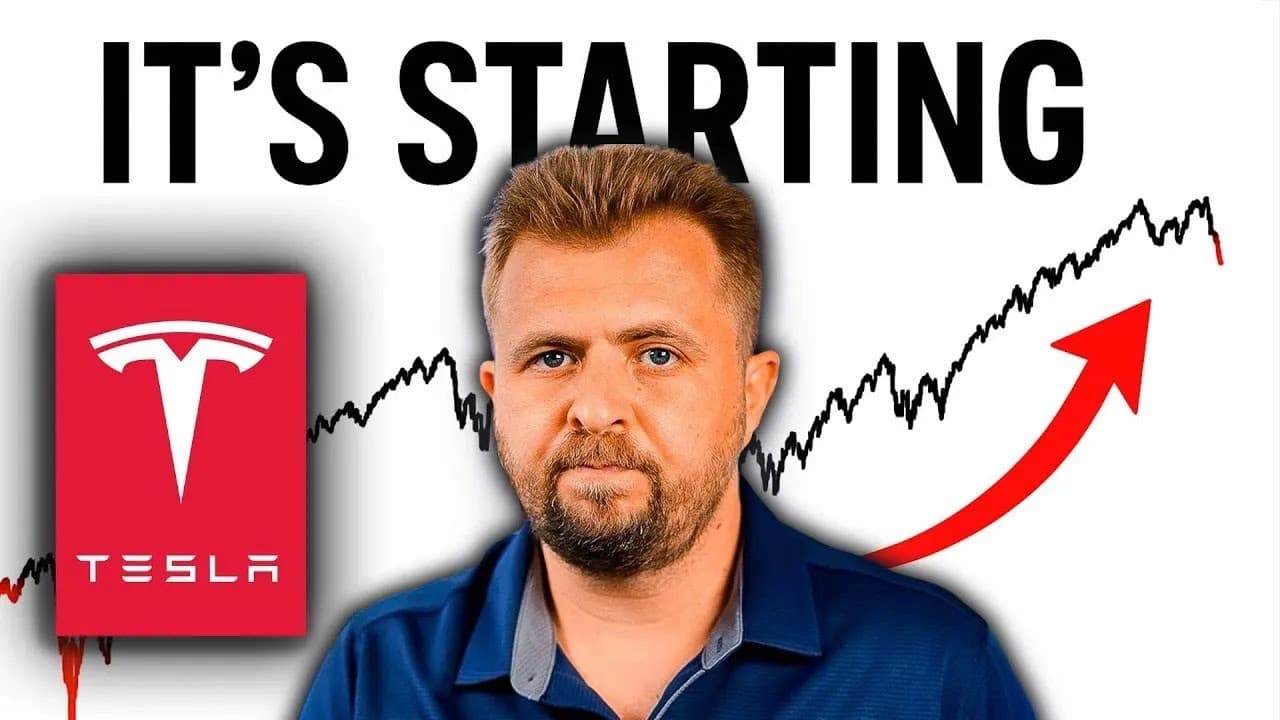
Why Could Tesla Stock Have Asymmetric Upside?
TL;DR
Tesla’s potential upside rests on energy storage, robotaxis, and Full Self-Driving software, according to the bullish argument presented. Energy already contributes revenue at strong stated margins, while successful autonomy could shift Tesla toward recurring, higher-margin services. The thesis remains conditional because Tesla must solve full autonomy, gain regulatory acceptance, achieve broad customer adoption, and potentially secure licensing agreements.
Transcript
Hey, this is Tom and this is going to be the most thorough deep dive of Tesla I have ever made on this channel. Now, over the past 12 months, my portfolio, which has 20% of Tesla in it, has done pretty well. I'm up 582% on Palunteer. I'm up 22% on my S&P 500 allocation. And even Tesla is up 67%. Yes, I know it's hard to believe, but if you zoom out... Read More
Key Insights
- Tesla’s investment case is presented as an asymmetric payoff because several separate businesses could expand revenue and margins, while current market sentiment focuses heavily on political controversy, Elon Musk’s public activity, and recent share-price weakness.
- Tesla Energy is described as a quiet profit engine that currently represents about 10% of revenue, carries a margin of about 30%, and benefits from rapidly expanding battery-storage deployments and additional production capacity in China and Texas.
- Megapack growth is projected to raise Tesla Energy deployments from about 30 gigawatt-hours in 2024 to about 100 gigawatt-hours in 2030, with the latter level potentially producing $25 billion in revenue at the stated selling economics.
- Robotaxis could change Tesla’s business model from one-time, lower-margin vehicle sales to recurring transportation-service revenue with higher margins. The thesis depends on Tesla solving full autonomy and regulators allowing the service to expand over the next 5 years.
- Tesla robotaxis are projected to cost customers about 30 to 50 cents per mile, compared with about $2 per mile for Uber and Lyft. The claimed advantage comes from lower electric-vehicle operating costs, reduced maintenance, no paid human driver, and higher utilization.
- Tesla’s competitive advantage over Waymo is described as lower capital expenditure, vertical integration, and cheaper per-mile operations. The argument claims Waymo’s vehicle cost structure would make large-scale competition difficult, although this conclusion is presented as the creator’s assessment.
- Full Self-Driving is presented as both the foundation for robotaxis and an independent software business. Its potential depends on reaching level four autonomy, achieving broad adoption, expanding Tesla’s installed vehicle base, and securing licensing agreements with other automakers.
- FSD economics are described as software-like because one-time purchases and monthly subscriptions could carry high gross margins. The projection assumes greater customer utility and stronger penetration by 2030, but these outcomes remain dependent on technical, commercial, and regulatory milestones.
Install to Summarize YouTube Videos and Get Transcripts
Explore YouTube Video Summarizer or Get YouTube Transcript Extractor
Questions & Answers
Q: Why is Tesla described as an asymmetric investment opportunity?
Tesla is described as asymmetric because the bullish thesis identifies several separate routes to substantial growth, including energy storage, robotaxis, and Full Self-Driving software. The creator argues that Tesla could significantly expand revenue and profit margins even if only some of these opportunities develop over the next 5 years. However, the expected payoff depends on projections and assumptions rather than guaranteed results.
Q: How could Tesla Energy contribute to the company’s growth?
Tesla Energy is described as an existing business with growing deployments, strong stated margins, and expanding manufacturing capacity. It currently represents about 10% of Tesla’s revenue and is said to have a margin of about 30%. The creator expects battery-storage demand and new capacity in China and Texas to support further growth, particularly through sales of Megapacks.
Q: What revenue opportunity does the creator project for Tesla Megapacks?
The creator says Tesla deployed about 30 gigawatt-hours of energy storage in 2024 and generated about $10 billion of revenue from the energy business. He projects deployments could reach about 100 gigawatt-hours in 2030. Using a stated Megapack selling rate of about $250 per kilowatt-hour, he estimates that deployment level could produce $25 billion in revenue.
Q: How could robotaxis change Tesla’s business model?
Robotaxis could move Tesla beyond one-time sales of relatively low-margin vehicles and toward recurring transportation-service revenue. The creator compares this opportunity to a software-as-a-service model because Tesla could earn revenue repeatedly as autonomous vehicles carry passengers. He argues that removing the human driver, lowering operating costs, and increasing vehicle utilization could support cheaper rides and higher gross margins.
Q: What must happen before Tesla robotaxis can scale?
Tesla must solve Full Self-Driving at a level that enables full autonomy, and regulators must permit the service to operate and expand. The creator views Tesla’s limited launch in Austin, Texas, as evidence that the company is close, but he acknowledges that neither technical completion nor regulatory acceptance is certain. Large-scale deployment therefore remains conditional on both milestones.
Q: Why does the creator think Tesla robotaxis could be cheaper than ride-hailing services?
The creator projects Tesla robotaxi pricing at about 30 to 50 cents per mile, compared with about $2 per mile for Uber and Lyft. He attributes the difference to the lower operating and maintenance costs of electric vehicles, the absence of a paid human driver, and higher vehicle utilization. These economics are projections that depend on successful autonomous operation at scale.
Q: Why is Full Self-Driving considered a separate revenue opportunity?
Full Self-Driving could generate revenue independently through both one-time purchases and monthly subscriptions, even though it also provides the technical foundation for robotaxis. The creator expects software-like margins because delivering the product does not carry the same cost structure as manufacturing a vehicle. Success requires level four autonomy, substantial customer adoption, a larger vehicle base, and possible licensing agreements with automakers.
Q: What are the main risks in the bullish Tesla thesis?
The central risks are that Tesla may not solve full autonomy, regulators may restrict robotaxi deployment, customers may adopt Full Self-Driving less widely than projected, and licensing agreements with other automakers may not materialize. The financial estimates also rely on future vehicle deployment, utilization, pricing, and margin assumptions. The description explicitly frames the analysis as opinion, education, and entertainment rather than investment advice.
Summary & Key Takeaways
-
Tesla is presented as an asymmetric investment opportunity whose operating progress is being obscured by negative sentiment, political controversy, and attention to Elon Musk. The bullish case does not depend solely on vehicle sales. It instead emphasizes several possible growth routes that could materially increase revenue and profit margins if even some succeed.
-
Tesla Energy is described as a quiet but increasingly important profit engine. The argument cites rapidly growing deployments, strong margins, expanding production capacity in China and Texas, and persistent demand for battery storage. Megapack deployments are expected to support substantial revenue growth, although the figures discussed remain projections rather than guaranteed outcomes.
-
Robotaxis and Full Self-Driving form the largest part of the thesis. Successful autonomy could transform Tesla from a seller of lower-margin vehicles into a provider of recurring, high-margin transportation and software services. That outcome requires technical success, favorable regulation, broad adoption, a much larger vehicle base, and possible licensing arrangements with automakers.
Read in Other Languages (beta)
Share This Summary 📚
Summarize YouTube Videos and Get Video Transcripts with 1-Click
Try YouTube Summary with ChatGPT & Claude or YouTube Transcript Generator
Explore More Summaries from Tom Nash 📚
Summarize YouTube Videos and Get Video Transcripts with 1-Click
Try YouTube Summary with ChatGPT & Claude or YouTube Transcript Generator