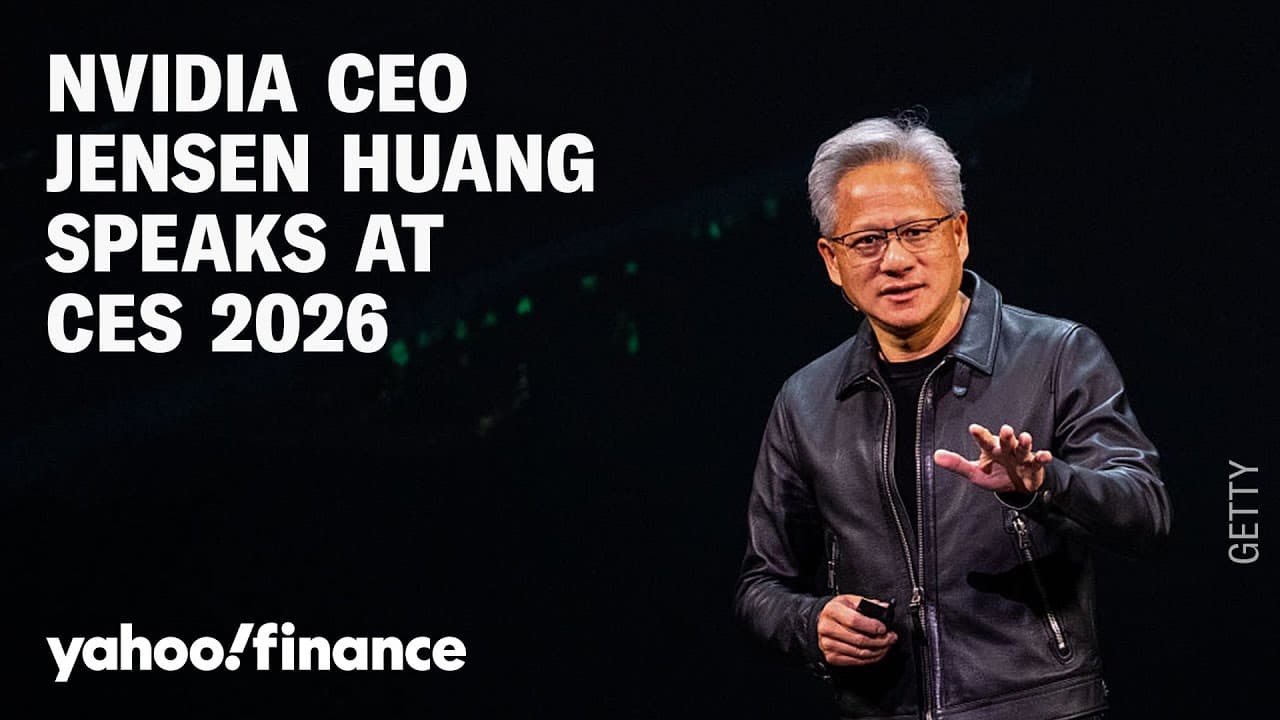
Jensen Huang on AI's Dual Platform Shift at CES 2026
TL;DR
The computer industry resets every 10 to 15 years with a platform shift, but two shifts are happening at once: applications are being built on top of AI, and how software is developed and run has fundamentally changed. You now train software instead of programming it, and run it on GPUs instead of CPUs, modernizing roughly $10 trillion of computing.
Transcript
lay. Please take your seats. Our event is about to begin. [music] >> Hey lays excuse Or would you Go fetus glory glory kicked into the cur. It's better than my name. I got a fire in me. You're going to set burn. [music] my nails. Loose go. Hey, hey, hey. Heat. Heat. Hey. Hey. Hey. Yeah. Yeah. Yeah. Natalie. Hey, hey, hey. Heat. Heat. Ready, Let's g... Read More
Key Insights
- The computer industry resets every 10 to 15 years through platform shifts, moving from mainframe to PC, PC to internet, internet to cloud, and cloud to mobile, with each shift causing applications to target a new computing platform.
- Two simultaneous platform shifts are happening at the same time: applications are now being built on top of AI, and the entire way software is developed and run has fundamentally changed.
- Software development has been reinvented so that you no longer program the software, you train it, and you no longer run it on CPUs, you run it on GPUs, generating every pixel and token from scratch each time.
- The money funding AI comes from modernizing roughly $10 trillion of computing from the last decade, hundreds of billions in annual VC funding, and R&D budgets shifting from classical methods to artificial intelligence.
- Test time scaling, introduced with ChatGPT's first o1 reasoning model, is another way of saying thinking in real time, adding to pre-training and post-training with reinforcement learning as phases requiring enormous compute.
- Physical AI understands the laws of nature and interacts with the physical world, while AI physics is AI that understands the encoded information and laws of physics within the world itself.
- Open models reached the frontier in 2025, staying about six months behind frontier models, with DeepSeek R1 being the first open reasoning model that caught the world by surprise and activated the movement.
- NVIDIA builds its own DGX cloud AI supercomputers, worth billions of dollars, not to enter the cloud business but for its own use developing frontier open models across domains like proteins, weather, and robotics.
Install to Summarize YouTube Videos and Get Transcripts
Explore YouTube Video Summarizer or Get YouTube Transcript Extractor
Questions & Answers
Q: How often does the computer industry reset with a platform shift?
According to Jensen Huang, the computer industry resets every 10 to 15 years when a new platform shift happens. He traces the history from mainframe to PC, PC to internet, internet to cloud, and cloud to mobile. Each time this happens, the world of applications targets a new platform, which is why it is called a platform shift, and developers write new applications for a new computer.
Q: What are the two simultaneous platform shifts happening in AI?
Huang explains that unlike previous single platform shifts, two are now happening at the same time. First, applications are now being built on top of AI, rather than AIs simply being applications. Second, how you run and develop software has fundamentally changed. The entire stack of the computer industry is being reinvented, so both the application layer and the underlying development and execution model are transforming simultaneously.
Q: Why do you train software instead of programming it now?
Huang describes how computing has been fundamentally reshaped by accelerated computing and artificial intelligence. You no longer program the software, you train it. You do not run it on CPUs, you run it on GPUs. Whereas applications were previously pre-recorded, pre-compiled, and run on your device, now applications understand the context and generate every single pixel and every single token completely from scratch every single time.
Q: Where is the money for AI investment coming from?
Huang answers that roughly $10 trillion of computing from the last decade is being modernized to the new way of computing. Hundreds of billions of dollars, about a couple hundred billion, in VC funding goes into this each year. A hundred-trillion-dollar industry is shifting several percent of its R&D budget from classical methods to artificial intelligence methods. This modernization and shifting of R&D budgets is where the money comes from.
Q: What is test time scaling in AI?
Test time scaling was invented with the first o1 reasoning model from ChatGPT, which Huang calls completely revolutionary. He describes it as a common-sensical idea and another way of saying thinking, where the model thinks in real time. It joins pre-training, where a model learns, and post-training with reinforcement learning, where it learns skills. Each of these phases of artificial intelligence requires an enormous amount of compute.
Q: What is the difference between physical AI and AI physics?
Huang distinguishes the two: physical AI is AI that understands the laws of nature and interacts with the physical world. AI physics, by contrast, refers to AI that understands the encoded information and laws of physics within the world itself. In the case of physical AI, you have AI that interacts with the physical world, while AI physics is AI that understands the laws of physics that structure that world.
Q: How advanced are open models compared to frontier models?
Huang states that open models have reached the frontier but remain solidly about six months behind frontier models. However, every six months a new model emerges, and these models keep getting smarter. He cites DeepSeek R1 as the first open reasoning model, which caught the world by surprise and activated the entire movement. Downloads have exploded because startups, large companies, researchers, students, and countries all want to participate.
Q: Why did NVIDIA build its own DGX cloud supercomputers?
Huang says NVIDIA started building and operating its own AI supercomputers, called DGX clouds, several years ago. Despite speculation, the answer to whether NVIDIA is entering the cloud business is no. NVIDIA built these DGX supercomputers, worth billions of dollars in operation, for its own use to develop open models. This work supports frontier AI research across domains like proteins, weather prediction, robotics, and self-driving cars.
Summary & Key Takeaways
-
Every 10 to 15 years the computer industry resets through a platform shift, and this time two shifts occur simultaneously: applications are built on top of AI, and the full stack of software development and execution is being reinvented from programming to training and CPUs to GPUs.
-
The investment funding AI comes from modernizing about $10 trillion of prior computing, a couple hundred billion in yearly VC funding, and R&D budgets across a hundred-trillion-dollar industry shifting from classical to AI methods, explaining the intense activity in the field.
-
NVIDIA operates its own DGX supercomputers to build frontier open models and open-sources both models and training data across domains including proteins, weather prediction, robotics, and self-driving cars, aiming to let every company, industry, and country join the AI revolution.
Read in Other Languages (beta)
Share This Summary 📚
Summarize YouTube Videos and Get Video Transcripts with 1-Click
Try YouTube Summary with ChatGPT & Claude or YouTube Transcript Generator
Explore More Summaries from Yahoo Finance 📚





Summarize YouTube Videos and Get Video Transcripts with 1-Click
Try YouTube Summary with ChatGPT & Claude or YouTube Transcript Generator