Why Did Nvidia Reach a $5 Trillion Valuation?
TL;DR
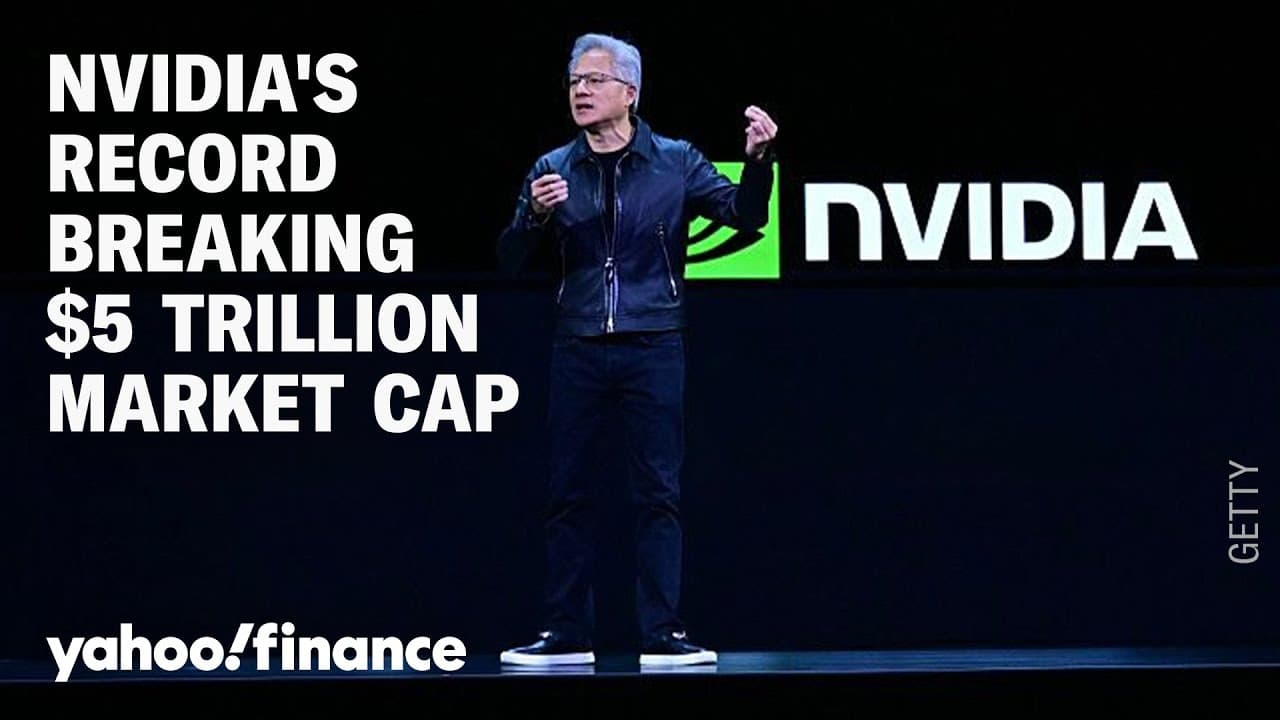
Nvidia reached a $5 trillion market capitalization because investors expect hyperscalers to sustain heavy AI infrastructure spending, while stronger data center forecasts and possible Blackwell sales to China add further upside. The rally also lifted much of the semiconductor sector, but the long-term case depends on whether AI investments and partnerships generate enough incremental cash flow to justify their cost.
Transcript
Here it is above $5 trillion for that market cap for Nvidia. Just yesterday, we were talking about Microsoft and Apple being above 4 trillion. Um, and Nvidia says, "Hold my beer." And here we are at 5 trillion for that stock. Take a look at the price action here today. That was the market cap. Whoops. Here's uh I'll get there. I'll get there eventu... Read More
Key Insights
- Nvidia became the first company to reach a $5 trillion market capitalization, with its shares rising 5.4% during the reported session. The move followed new GTC announcements and expectations that future data center revenue could exceed analysts’ previous forecasts.
- Hyperscaler infrastructure spending is central to Nvidia’s valuation because major technology companies continue building AI capacity. Doug Clinton argued that none of the hyperscalers appeared ready to stop spending, making continued demand for Nvidia’s technology a major part of the market’s expectations.
- Potential Blackwell sales to China represent additional upside, but they were not confirmed. Clinton estimated only a 10–20% chance that the high-end GB200 chip would be fully opened to China, suggesting such access was probably not fully reflected in Nvidia’s share price.
- Wall Street capital expenditure forecasts may underestimate future spending by Google and Amazon. The cited expectations were 12% and 9% growth for the following year, compared with about 40% for Meta, leading Clinton to expect stronger spending commentary from Google and Amazon.
- Nvidia’s rally lifted much of the semiconductor sector, including Broadcom, TSM, AMD, and ASML. Stronger-than-expected results from South Korean memory chipmaker SK Hynix also supported the broader move, although Intel and Texas Instruments were notable companies that did not rise.
- AI partnership announcements can boost share prices without guaranteeing higher profits. Clinton said management teams recognize the market benefits of announcing deals with Nvidia or OpenAI, but emphasized that long-term shareholder returns depend on whether those agreements produce meaningful incremental cash flow.
- AI investments should be judged over three, five, or seven years rather than by immediate returns. Clinton said the spending would not be justified this year or the next, making longer-term cash generation the determining factor for whether partnerships and infrastructure projects succeed.
- An OpenAI public offering could become a watershed moment for the AI investment cycle. Clinton argued that strong demand for OpenAI might encourage lower-quality companies to test the public markets, which would provide a more credible reason to raise concerns about an AI bubble.
Install to Summarize YouTube Videos and Get Transcripts
Explore YouTube Video Summarizer or Get YouTube Transcript Extractor
Questions & Answers
Q: How did Nvidia reach a $5 trillion market capitalization?
Nvidia reached the milestone as its shares rose 5.4% amid several supportive developments. Its Washington, DC GTC event highlighted sovereign AI, data center expansion, government collaboration, and a broad set of partnerships. Investors also responded to indications that data center revenue could surpass analysts’ expectations and to the possibility, still uncertain, of future Blackwell sales to China.
Q: Why is hyperscaler spending important to Nvidia’s growth?
Hyperscalers are building the infrastructure required for the expanding AI market, making their capital expenditure a major source of demand for Nvidia. Doug Clinton said none of these companies appeared ready to stop spending. He expected upcoming earnings commentary to show that infrastructure construction would continue, supporting the belief that Nvidia’s revenue estimates could keep moving higher.
Q: Could Blackwell chip sales to China push Nvidia shares higher?
Blackwell sales to China could provide additional upside because the possibility was probably not fully priced into Nvidia shares. However, access remained uncertain and depended on an agreement involving China and the United States. Clinton placed the probability of fully opening the high-end GB200 chip at only 10–20%, while suggesting approval could send Nvidia shares even higher.
Q: Will AI infrastructure spending accelerate further?
The discussion suggested that spending may remain very strong even if it does not technically accelerate. Clinton argued that Wall Street estimates for Google and Amazon, cited at 12% and 9% for the following year, could be too low compared with about 40% for Meta. He expected Google and Amazon to signal continued spending, forcing forecasts upward.
Q: How did Nvidia’s rally affect other semiconductor stocks?
Nvidia’s advance helped lift much of the semiconductor sector. Broadcom, TSM, AMD, and ASML were among the companies trading higher, while Intel and Texas Instruments were identified as exceptions. Better-than-expected results from South Korean memory chipmaker SK Hynix also contributed to the positive environment, showing that the move extended beyond Nvidia alone.
Q: Do Nvidia partnership announcements guarantee shareholder profits?
Partnership announcements do not guarantee that shareholders will receive higher profits. Clinton observed that companies can enjoy a favorable stock-market reaction after announcing deals with Nvidia or OpenAI. The meaningful test is whether the technology creates incremental cash flow that justifies the spending over three, five, or seven years, rather than whether an announcement creates an immediate share-price gain.
Q: Why is Microsoft considered direct exposure to OpenAI?
Microsoft was described as probably the best direct exposure to OpenAI because it holds a very large stake in the company and has a strengthened partnership following OpenAI’s recapitalization and restructuring. Clinton said the arrangement benefits both sides by preserving Microsoft’s exposure while allowing OpenAI to attract additional capital partners to finance its substantial future needs.
Q: When could concerns about an AI investment bubble become more credible?
Bubble concerns could become more credible when OpenAI goes public and its offering encourages many other companies to enter the public markets. Clinton expected substantial long-term demand for OpenAI shares, but warned that this demand could open the initial public offering window for businesses of lower quality. That broader wave, rather than OpenAI’s offering alone, would be a stronger warning signal.
Summary & Key Takeaways
-
Nvidia became the first company to reach a $5 trillion market capitalization as its shares rose 5.4%. The advance followed announcements at its Washington, DC GTC event, stronger expectations for future data center revenue, expanding sovereign AI initiatives, and optimism about possible Blackwell chip sales to China, although those sales remained uncertain.
-
The investment case rests heavily on continued capital spending by hyperscalers building AI infrastructure. Doug Clinton argued that forecasts for Google and Amazon spending may be too low and could rise. Nvidia’s advance also supported semiconductor companies including Broadcom, TSM, AMD, and ASML, while Intel and Texas Instruments declined.
-
Nvidia’s growing partnership network may expand commercial opportunities, but announcements alone do not establish lasting shareholder value. The decisive test is whether AI technology produces incremental cash flow over three, five, or seven years. Microsoft’s OpenAI exposure and a potential OpenAI public offering also illustrate how interconnected the broader AI investment cycle has become.
Read in Other Languages (beta)
Share This Summary 📚
Summarize YouTube Videos and Get Video Transcripts with 1-Click
Try YouTube Summary with ChatGPT & Claude or YouTube Transcript Generator
Explore More Summaries from Yahoo Finance 📚




Summarize YouTube Videos and Get Video Transcripts with 1-Click
Try YouTube Summary with ChatGPT & Claude or YouTube Transcript Generator