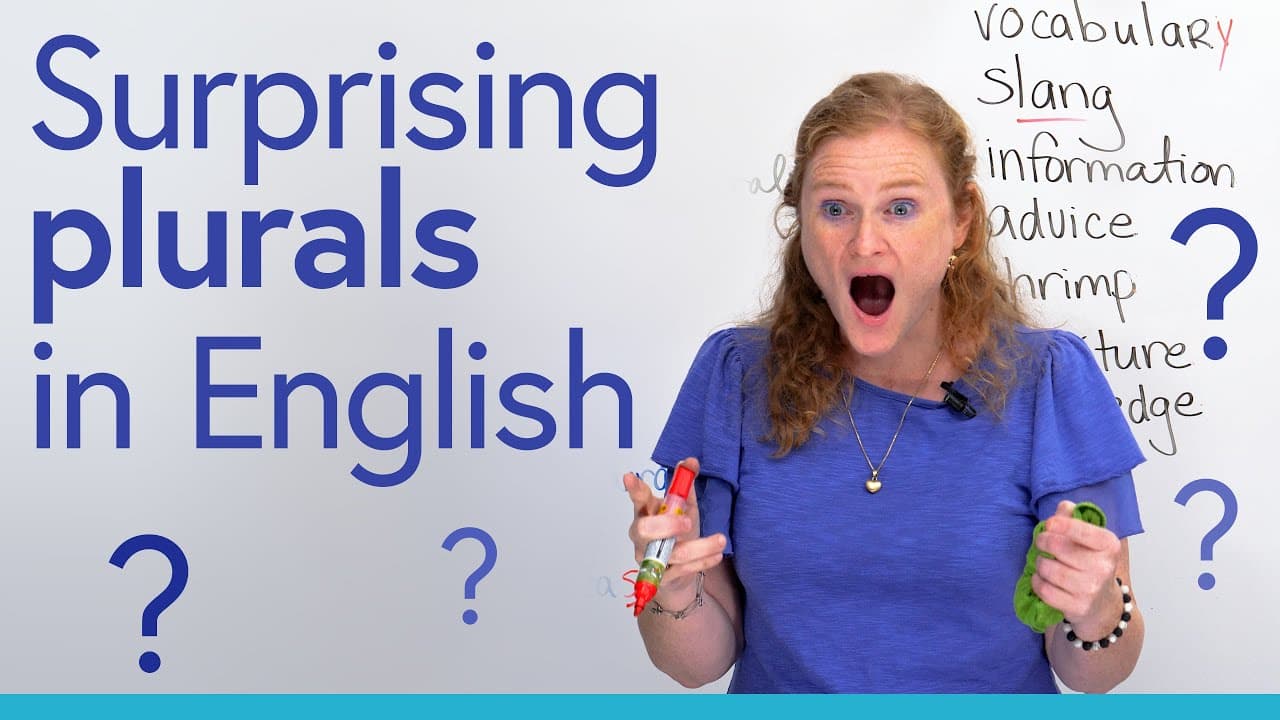
What Are the Most Surprising English Plurals?
TL;DR
English plurals can be confusing; for example, 'people' is always plural, while 'everyone' is singular despite sounding plural. Additionally, uncountable nouns like 'furniture' and 'knowledge' don't have a plural form. Understanding these exceptions can help avoid common mistakes in English grammar.
Transcript
Are you surprised? I'm surprised. Every day, I'm surprised. I wake up and I'm like "Wow, I didn't die. I'm surprised I'm still here." I'm more surprised that you haven't given me a donation. Come on, what's going on? Open your pockets, open your wallet, give me some money. I'm dying here! Today, I'm going to surprise you with some surprising plural... Read More
Key Insights
- ❓ English plurals can be unpredictable and do not always follow a logical pattern.
- 👯 Some words, like "people" and "everyone," are always plural, while others, like "no one" and "nobody," are actually singular.
- 💁 Uncountable nouns, such as "knowledge" and "furniture," do not have plural forms.
Install to Summarize YouTube Videos and Get Transcripts
Explore YouTube Video Summarizer or Get YouTube Transcript Extractor
Questions & Answers
Q: Why are plurals in English so surprising?
Plurals in English often do not follow a logical pattern, making it confusing for non-native speakers.
Q: How should we use verbs with the word "people"?
Since "people" is always plural, we should use the verb in its plural form, such as "people are always buying things they don't need."
Q: Are "everyone" and "nobody" singular or plural?
Although they may seem plural, "everyone" and "nobody" are actually singular and require a verb with an "s," like "everyone likes me."
Q: How do we use "all of the" with plural nouns?
When using "all of the" with a plural noun, such as "all of the dogs," we must ensure that the noun itself is plural, and no "s" is added.
Q: Can we use plurals for uncountable nouns?
No, uncountable nouns, such as "furniture" and "information," do not have plural forms and should be used in their singular form.
Summary & Key Takeaways
-
English plurals can be surprising and do not always follow a logical pattern.
-
Some words, like "people," are always plural and require a verb in the plural form.
-
Other words, like "everyone" and "no one," may seem plural but are actually singular and require a verb with an "s."
Read in Other Languages (beta)
Share This Summary 📚
Summarize YouTube Videos and Get Video Transcripts with 1-Click
Try YouTube Summary with ChatGPT & Claude or YouTube Transcript Generator
Explore More Summaries from English with Ronnie · EnglishLessons4U with engVid 📚





Summarize YouTube Videos and Get Video Transcripts with 1-Click
Try YouTube Summary with ChatGPT & Claude or YouTube Transcript Generator