How to Take Notes for Deeper, Faster Learning
TL;DR
Translate lectures into your own words instead of copying every sentence, then capture the main themes before adding minor details later. Choose a simple format, record questions and personal reactions, ask for clarification immediately, and connect each new idea to knowledge you already have. Active engagement may feel uncomfortable, but it can reduce the amount of studying needed outside class.
Transcript
all right welcome back to class everyone wait could you repeat that repeat what what you just said welcome back to class welcome back to thank you class no problem no problem okay what are you doing what are you doing stop that please please stop I mean I know the feeling I know how it feels to strain your wrist and your neck as you're trying to co... Read More
Key Insights
- Transcription is a passive note-taking habit that can create a false sense of progress. Copying every word keeps the hand active but often excuses the mind from processing the professor’s meaning, especially when lecture slides and recordings can be reviewed later.
- Translation is the process of expressing a professor’s ideas in your own words. Listening for 10–20 seconds before writing helps you digest a chunk of information, identify its main point, and create notes that reflect understanding rather than verbatim recall.
- The structure of knowledge should be established before its minor details. The lecture’s key themes, messages, and purposes provide the overall shape, while facts, dates, diagrams, events, and other specifics can be added later to refine that initial understanding.
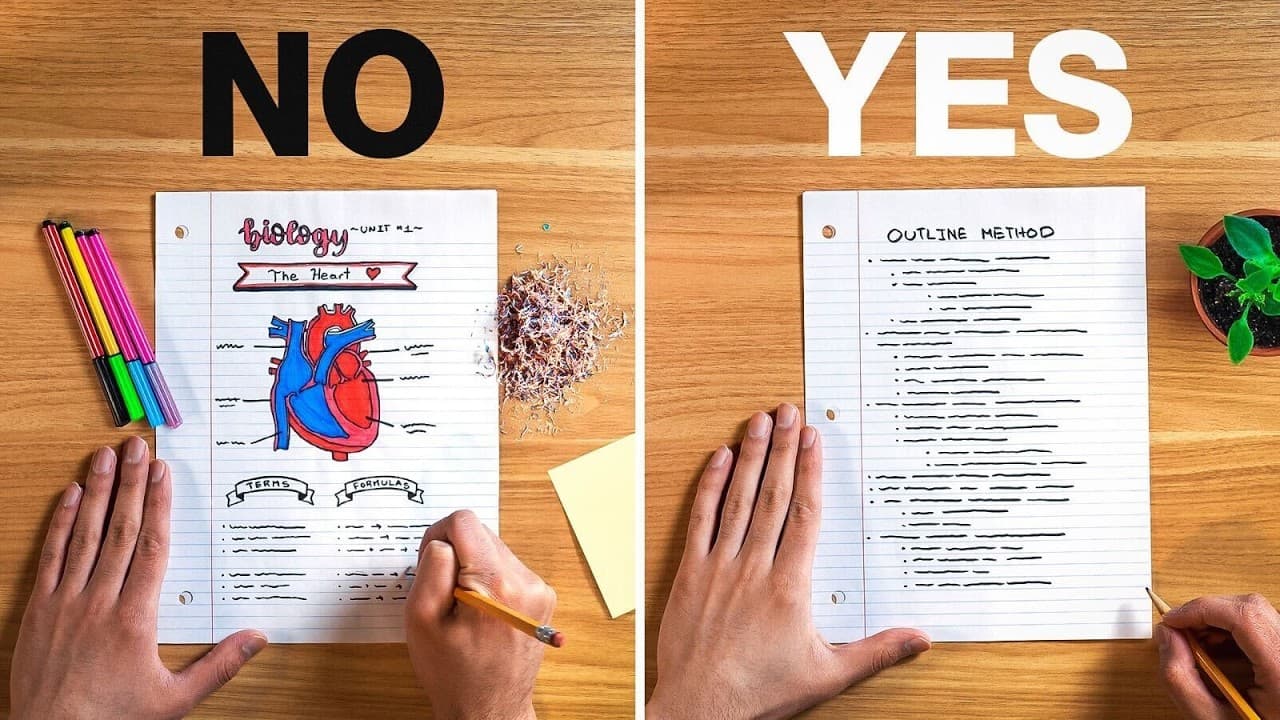
- Aesthetic note-taking can reduce attention to the actual lecture. Decorating notes during class divides attention, creates pressure to keep pace with the professor, and can feel productive without requiring meaningful engagement with the material being presented.
- The best note format is one that supports active processing and feels practical to the student. Outlines, Cornell notes, boxed notes, and mind maps offer different structures, but processing ideas in your own words matters more than following a format prescribed by someone else.
- Mind maps represent knowledge as connected ideas branching from a central concept. They are better suited to studying after gaining familiarity with a topic because building branches and choosing colors during a lecture can become confusing and distract from listening.
- An inner monologue is useful information that belongs in personal notes. Recording confusion, humor, surprise, memories, and connections to lived experience makes the material more personal, while question marks create visible indicators of topics that need clarification or additional study.
- Contextualization connects new information to previously learned or adjacent ideas. Knowledge that remains isolated can fade over time, so each new concept should be embedded within an existing network of understanding, similar to adding a branch to a tree or mind map.
Install to Summarize YouTube Videos and Get Transcripts
Explore YouTube Video Summarizer or Get YouTube Transcript Extractor
Questions & Answers
Q: How should students take notes during a lecture?
Students should listen to the professor for 10–20 seconds, allow the idea to digest, and then write the main point in their own words. They should focus first on overarching themes, messages, and the reason the material matters. Minor facts, dates, diagrams, and events can be revisited later through available slides, recordings, textbooks, or other course resources.
Q: Why is copying every word from a lecture ineffective?
Copying every word can create a false sense of progress because the student’s hand remains active while the mind may not meaningfully process the material. It also shifts attention away from the professor’s central ideas and spontaneous explanations. Since lecture slides and recordings can often be accessed later, verbatim transcription may duplicate information without improving understanding.
Q: What is the difference between transcribing and translating notes?
Transcribing means writing down the professor’s words verbatim, while translating means restating the ideas in your own words. Translation requires the student to listen, digest a chunk of information, identify its meaning, and express the main point. That active process is more demanding, but it creates notes based on understanding rather than simple copying.
Q: Should students make their notes aesthetically pleasing during class?
Students should not prioritize aesthetics while the lecture is happening. Decorating or embellishing notes takes attention away from the professor and can create panic when trying to keep up. Students who enjoy attractive notes can improve their appearance outside class, but lecture time should be used to process ideas, identify key themes, and record meaningful questions or connections.
Q: Which note-taking format should students use?
Students should choose a format that feels practical and supports active engagement. The outline method uses hierarchical bullets, Cornell notes divide the page into cues, detailed notes, and summaries, and the box method visually groups related information. No format compensates for passive thinking, so translating ideas and recognizing key messages remain more important than the page layout.
Q: When should students use mind maps for studying?
Students should generally use mind maps after becoming familiar with a topic and understanding its surrounding landscape. A mind map places a central idea in the middle and branches related concepts outward, helping reveal how knowledge fits together. During a lecture, however, deciding where to split branches or use colors can become messy and distract from the professor.
Q: Why should students record questions and personal reactions in their notes?
Questions and personal reactions make notes more memorable and reveal how the student is processing the material. A student can record confusion, humor, surprise, memories, or connections to personal experiences. Question marks are especially valuable because they identify unclear concepts, encourage immediate clarification, and later direct study time toward difficult material instead of self-explanatory topics.
Q: How can students connect new information to existing knowledge?
Students can contextualize a new concept by identifying how it relates to something previously learned or to an adjacent topic from another class. The goal is to embed the information within an existing knowledge network, much like adding a branch to a tree or mind map. Without these connections, new knowledge remains isolated and may gradually fade over time.
Summary & Key Takeaways
-
Effective note-taking requires active thought rather than rapid transcription. Listen to the professor for 10–20 seconds, digest the material, and record the main point in your own words. Prioritize the professor’s overarching themes and spontaneous explanations, since specific facts, dates, diagrams, slides, and recordings can often be revisited later.
-
Note aesthetics and rigid formatting should not distract from the lecture. The outline method organizes topics hierarchically, Cornell notes separate cues, notes, and summaries, and the box method groups related ideas visually. Mind maps are especially helpful for studying familiar material because they reveal relationships, but they may become messy during lectures.
-
Personal annotations make notes more memorable and useful. Record reactions, connections to lived experiences, and question marks beside confusing material. Ask for clarification during the lecture when possible, then use unresolved questions to guide later study. New ideas should also be connected to previous or adjacent knowledge rather than left isolated.
Read in Other Languages (beta)
Share This Summary 📚
Summarize YouTube Videos and Get Video Transcripts with 1-Click
Try YouTube Summary with ChatGPT & Claude or YouTube Transcript Generator
Explore More Summaries from Gohar Khan 📚




Summarize YouTube Videos and Get Video Transcripts with 1-Click
Try YouTube Summary with ChatGPT & Claude or YouTube Transcript Generator