How Factory Humanoid Robots Are Becoming Practical
TL;DR
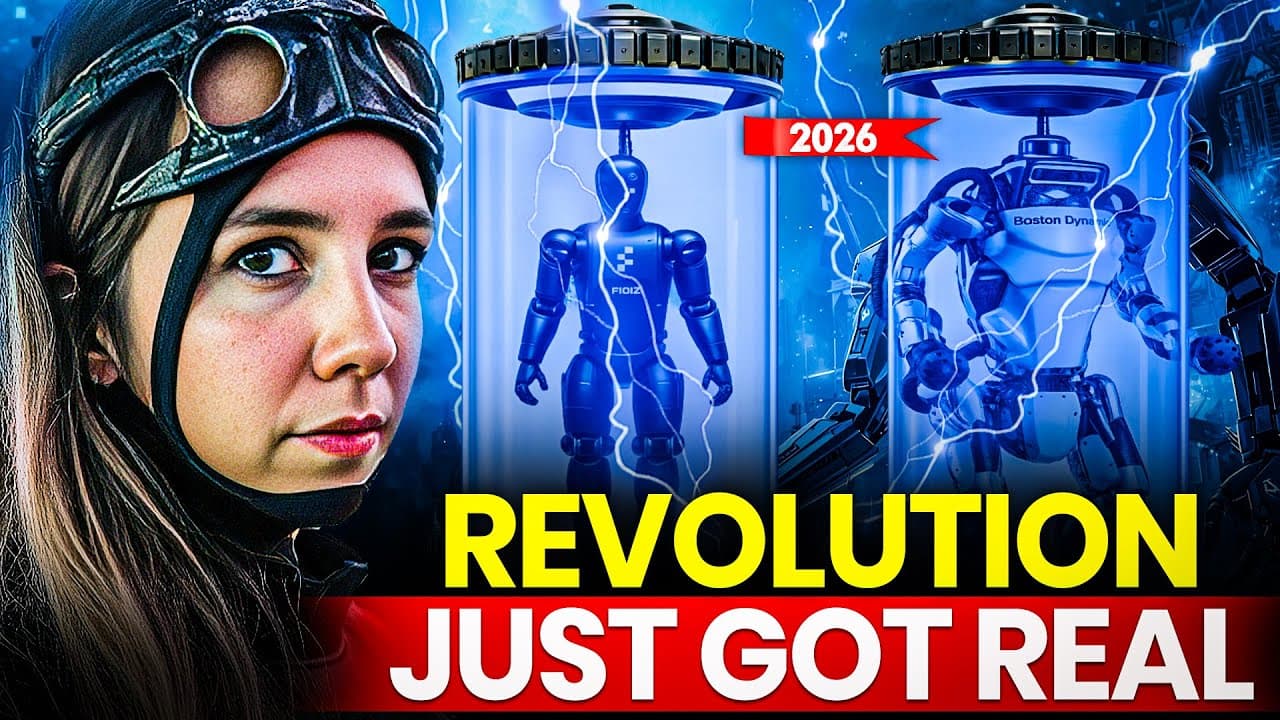
Humanoid robots are moving from demonstrations into sustained factory work, with Atlas presented as production-ready and Figure 02 reporting 1,250-plus runtime hours at BMW. The decisive capabilities are autonomous task execution, reliable object handling, rapid task learning, and repairable hardware. These deployments could reduce downtime and improve manufacturing output, but they also raise serious concerns about replacing more factory jobs than they create.
Transcript
It's 2026 and we're talking about actual robots doing actual work in actual [music] factories starting this year. Ladies and gentlemen, please welcome Atlas to the stage. We're not talking about robot demos anymore. We're not talking about viral videos of humanoids doing back flips [music] or walking down streets. Most people have no idea how fast ... Read More
Key Insights
- Working capability is the meaningful benchmark for humanoid robots because industrial systems must perform useful tasks repeatedly, handle unexpected conditions, and operate without constant human control. Walking, dancing, and backflips can demonstrate mobility, but they do not establish that a machine is reliable enough for factory deployment.
- Atlas is presented as an autonomous factory system that can identify car parts, grasp them, transfer them between containers, and arrange them in the required assembly sequence. It can continue for hours and make decisions when conditions differ from the expected workflow, without remote control.
- Boston Dynamics' advantage is built on more than 30 years of robotics development, according to the transcript. Atlas combines balance in unpredictable environments, navigation across changing factory floors, manipulation of irregular objects, spatial awareness, and decision-making without continuous supervision.
- Large behavior models are described as systems for robot movement and decision-making, developed through Boston Dynamics' partnership with Google DeepMind. Atlas can learn tasks through simulation and real-world practice, then execute them autonomously, with the transcript claiming that a new task can be learned within 48 hours.
- Modularity is a practical industrial advantage because Atlas components can be replaced, upgraded, or repaired on site. A maintenance technician can swap a failed component on the factory floor, avoiding the weeks of downtime that could occur if the entire robot had to return to its manufacturer.
- Figure 02 achieved deployment-level results during an 11-month BMW trial, including more than 90,000 parts loaded, over 1,250 runtime hours, and participation in producing more than 30,000 X3 vehicles. It also completed more than 1.2 million steps across over 200 miles.
- Figure 02 met demanding sheet-metal loading targets, including an 84-second cycle time, 37 seconds for loading, greater than 99% placement accuracy per shift, placement within a 5 mm tolerance in two seconds, and zero human interventions or resets per shift.
- Job displacement is a central consequence of scalable humanoid robotics because one robot can work around the clock with battery swaps and share learned tasks with other units. The transcript argues that replacing 100 factory workers might create only 10 maintenance, programming, or supervision roles, leaving 90 workers needing alternatives.
Install to Summarize YouTube Videos and Get Transcripts
Explore YouTube Video Summarizer or Get YouTube Transcript Extractor
Questions & Answers
Q: What makes a humanoid robot ready for factory work?
A factory-ready humanoid robot must do more than walk or perform a staged demonstration. It must manipulate varied objects, navigate changing workspaces, maintain balance, follow production sequences, and respond when conditions differ from expectations. It must also repeat tasks accurately for long shifts without constant human supervision. The transcript presents autonomy, reliability, precision, serviceability, and sustained runtime as the essential measures of readiness.
Q: How does Atlas perform manufacturing tasks autonomously?
Atlas is described as locating car parts, determining how to grasp them, moving them between containers, and arranging them in the correct sequence for assembly. No remote operator controls each movement. The robot uses spatial awareness, advanced hands, and autonomous decision-making to execute the workflow for hours. If an object slips or circumstances change, it can adjust its grip or behavior in real time.
Q: Why is Boston Dynamics considered ahead in humanoid robotics?
The transcript attributes Boston Dynamics' lead to more than 30 years of robotics work and the integration of mobility, manipulation, and autonomy. Atlas can recover its balance, navigate obstacles and uneven surfaces, rotate its joints through unusual ranges, handle irregular engine parts, and make decisions without continuous oversight. These combined abilities distinguish useful factory performance from robots that mainly demonstrate walking under controlled conditions.
Q: What are large behavior models for robots?
Large behavior models are described as a system for robot movement and decision-making, comparable in broad concept to ChatGPT for physical behavior. Boston Dynamics partnered with Google DeepMind on this approach. Atlas learns new tasks through simulation and real-world practice, then performs them autonomously. The transcript claims Atlas can learn a new task within 48 hours and repeat it thousands of times reliably.
Q: Why does modularity matter for industrial humanoid robots?
Modularity allows maintenance teams to replace, repair, or upgrade individual robot components at the worksite. This matters because machines operating continuously will eventually experience component failures. Instead of discarding a $50,000 robot or shipping it away for weeks, a technician could replace a failed motor on the factory floor. The resulting reduction in downtime can protect productivity in high-volume manufacturing operations.
Q: What did Figure 02 accomplish at BMW's factory?
During an 11-month deployment at BMW's Spartanberg plant, Figure 02 loaded more than 90,000 parts, accumulated over 1,250 runtime hours, and contributed to more than 30,000 X3 vehicles. It took over 1.2 million steps and traveled more than 200 miles. The robot worked 10-hour shifts from Monday through Friday on a sheet-metal pick-and-place task supporting welding operations.
Q: How accurate and reliable was Figure 02 at BMW?
Figure 02 was required to support an 84-second production cycle, complete loading within 37 seconds, and achieve greater than 99% placement accuracy per shift. It placed parts within a 5 mm tolerance in two seconds and completed shifts with zero interventions, meaning no human resets were required. The transcript characterizes these results as deployment-level performance rather than a controlled demonstration.
Q: How could factory humanoid robots affect employment?
The transcript argues that factory humanoids could eliminate many roles because they can work around the clock, resume operation after battery swaps, and share learned tasks across multiple units. New positions may emerge in robot maintenance, programming, and supervision, but the suggested arithmetic remains unfavorable: replacing 100 factory workers might create only 10 new roles, leaving 90 people needing different employment.
Summary & Key Takeaways
-
Boston Dynamics presents Atlas as an industrial worker rather than a demonstration platform. Atlas can autonomously locate, grasp, move, and sequence car parts while responding to changing conditions. Its advantages include advanced mobility, manipulation of irregular objects, spatial awareness, autonomous decision-making, and the ability to learn a new task within 48 hours.
-
Atlas is designed around industrial serviceability. Its modular structure allows maintenance teams to replace or upgrade components on the factory floor instead of returning the entire robot to its manufacturer. This approach can reduce costly downtime and extend operating life, especially when robots perform repetitive work continuously in high-volume manufacturing facilities.
-
Figure demonstrated meaningful progress during an 11-month deployment at BMW's Spartanberg plant. Figure 02 loaded more than 90,000 parts, ran for over 1,250 hours, and contributed to more than 30,000 X3 vehicles. The trial also exposed forearm reliability problems that informed a simpler wrist architecture for Figure 03.
Read in Other Languages (beta)
Share This Summary 📚
Summarize YouTube Videos and Get Video Transcripts with 1-Click
Try YouTube Summary with ChatGPT & Claude or YouTube Transcript Generator
Explore More Summaries from Julia McCoy 📚






Summarize YouTube Videos and Get Video Transcripts with 1-Click
Try YouTube Summary with ChatGPT & Claude or YouTube Transcript Generator